Geen Resultaten Gevonden
De pagina die u zocht kon niet gevonden worden. Probeer uw zoekopdracht te verfijnen of gebruik de bovenstaande navigatie om deze post te vinden.

Text JF. Pierets Photos Rudy Thewis
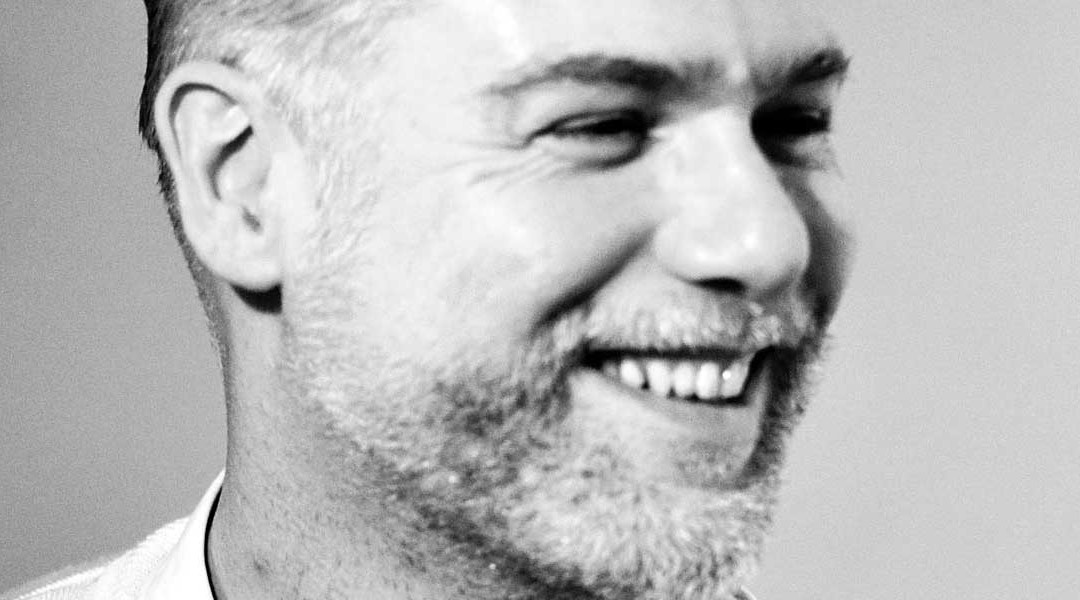
Jonathan Kemp won two awards and was shortlisted twice for his debut London Triptych. Gay bookstore Het Verschil in Antwerp, asked to interview the British author for a live audience due to the Dutch translation of his novel, Olie op doek. A conversation about history, gay writers and a fascination for language and sex.
In London Triptych you tell three stories. There’s the rent boy Jack Rose in the London of the 1890s, of the 1950’s with painter Colin Read and male escort David, living in the London of the 1990s. The three stories explore the subculture and underworld of male prostitution. You seem to know quite a lot about the subject matter?
I did a lot of research in one way or another, and I was very interested in giving a voice to the voiceless. Male prostitution is a minority within the society of prostitution. Most of the historical focus has always been on female prostitution so they’re like a minority within a minority. As a writer you’re always trying to find a perspective that has not been tackled before and this seemed like a really interesting angle.
London Triptych started out as a short story called ‘Pornocracy’, which told the tale of Jack Rose, one of the boys who testified against Oscar Wilde in 1895. Is Jack historically correct?
Jack starts to work as a telegram boy and then he got involved in prostitution through this man called Alfred Taylor. Taylor really existed and supplied boys to Wilde so there are elements of truth from what I had gathered on research. If it weren’t for the fact that Wilde had been arrested and in prison, it would be even harder to find material on the subject matter. Ironically, given the negative outcome for Wilde, that kind of stamped it in the history books in a way that it wouldn’t have been otherwise. The transcripts of the trial have been very useful. Jack himself is an invention. He’s a mixture of a lot of different boys Wilde played with – he called them Panthers. Their danger appealed to him, their lack of gentility. He was a well-educated, upper middle class man so he liked their roughness, this spontaneity that he didn’t find in his immediate circle.
You seem like a big Wilde fan.
I have loved Oscar Wilde ever since I was a teenager. As I got older and came out myself, I got more interested in gay history. Wilde almost became this figurehead. The idea that he established in many ways, the parameters, the identity that was to go on in the 20th century. The concept that he is almost the prototype of the modern homosexual. He gives it a shape, a voice and a way of being. That was always fascinating to me. I often think the work is overshadowed by his life but I find him an incredible wordsmith. The poetry and ideas in his books have always appealed to me.
Your love of Wilde, the fact that London Triptych is populated by rent boys, models, aristocrats, artists and gangsters,… are you a little nostalgic?
I must say that Jack became my favorite character, that was my favorite piece to write, What appealed to Wilde in these boys is what appealed to me when I got under Jack’s skin. There must have been many Jacks in London at that time and the more I read about queer history, the more I became interested in trying to represent that minority voice.
The minority voice stays but times are changing.
Jack could go to prison for what he was doing, but David, the male escort in the 1990s, is free because of the change in the law in 1967. It’s sort of a history of gay liberation and the humanitarian progress during the century.
The book is filled with sex but it remains sexy instead of becoming a dirty story. It’s a thin line between what your write and pornography.
I’m fascinated by the way that language expresses human experience. Pornography is the most straight forward way sex can be represented. It has a very specific aim and that is to turn you on. There’s nothing wrong with that but it felt a bit limiting to me. I’ve always been attracted to writers like Jean Genet, who wrote about sex in a much more poetic way. For me it was essential to the book that sex had to appear but not in a sort of bashful way. The most interesting thing is often ‘what goes where and who does what to whom’, so I wanted to find much more different metaphors and to describe the emotions rather than the mechanics.
When I read the book if felt like all 3 characters were imprisoned. Because of love. Is that so or is it just my imagination?
As much as sex was an important aspect, love was also. When it became clear to me that this was going to be a novel about prostitution, I wanted to write three love stories. Love coming from the least likely places for example. They are very tragic love stories and I wanted to overturn the cliché of the hard-bitten prostitute who is incapable of love. So love and that trajectory of love is very important.
You ran a theatre company in the 90’s. Why did you switch from that to writing novels?
Writing theater plays was actually a diversion from writing prose. I have always written novels. The first one I wrote was when I was about 17. But I didn’t really pursue it very hard. Every writer gets rejected by publishers but when I got the letters I gave up quite quickly, thinking it was no good. At that time I was living with an actor who wanted to do his own plays so I thought ‘how hard can it be?’ We started of with monologues, it was a one-man show, and after a while I added more characters and got more confident with each play we did. When the company disbanded because there wasn’t enough money in theatre – even less than in books – I went back to writing prose. So London Triptych was the first novel I wrote after the excursion into the theatre.
Your second book is called Twentysix. It’s not a novel nor is it a collection of short stories. I wrote down: ‘Poems about sexual encounters between men. One of every letter of the alphabet’. It’s completely different from London Triptych
It is, but I think it picks up on some of the themes of London Triptych. When I was writing about London and its sexuality, I was trying to gain some originality or poetry in the descriptions. I wrote Twentysix almost immediately after the novel was finished. At first I just wrote down these short episodes, these short encounters. I was exploring language and post structuralism, reading Derrida, Bataille, and wanted to experiment. Midway through the book I considered what to do because I could go on writing about these sexual encounters and publish this huge volume, so I had to put a limit to that. 26 seemed like a slim manageable number.
I read on the net that you once said; ‘I think sometimes being gay has led me to broader horizons than it otherwise would be.’
I think straight comes with a script. You are aware of the life trajectory you’re expected to follow. The model you’re expected to conform to. You’re going to get married, have children, a mortgage. I’m not saying that all people do – and I know straight people who forge a different path – but I think that, when you don’t have that script at hand, you create new possibilities. You kind of invent a way of being. And there is a sort of courage that comes from having to live outside that mainstream model. There’s a security in that model that is not available to you.
It’s a different way of being in the world. You have to be more original in the things you are going to be or going to do. Just that slightly greater edge of invention.In London Triptych, David describes playing a game when he was a child, standing on a train track, with all his friends. The game was called ‘chicken’ and was about who could stand there the longest. David always won. This unanticipated courage, that was me. I knew from the beginning that staying where I grew up would kill me. Spiritually.
Being gay is as much about character as having a sexual drive?
Whether moving to London had to do with my sexuality, I don’t know, maybe that was a force of character that made me invent and explore. I do think it had to do with the sexual exploration and with courage, I find it hard to separate the two.
Some gay writers don’t want to be referred to as being ‘a gay writer’. Because they are also a white writer, a male or female writer, an American writer,… Yet you don’t mind being in that category.
I don’t. You can call me a black writer if you want to. I can understand why people are against it but then I think; ‘you are gay and you write, so why not’. I feel that it can work negatively because maybe straight readers wouldn’t go for a gay book. While gay readers will rush to it, but nevertheless will also read lots of straight books. So I understand why that label can feel restricted but I don’t mind. I love to write for gay people. It matters to represent these lives in books. People identify with what they read so why not write for gays. I can imagine that some straight people might find a book like Twentysix quite alien but then again, parts of their lives are alien to me. I’m not trying to write for everyone, I’m trying to write for people who can find something in my work. If a straight reader has an open mind, well go ahead. When I came out, exploring my own sexuality, I discovered there was a whole history of gay men writing. That was great! To know that now, after centuries, you have bookshops filled with gay writers is just fantastic. Its history is very short compared with the history of literature, but to discover people like Genet, Vidal or Capote who were exploring and experimenting was a revelation. By putting a label on it, it allows gay readers to find those books. Because if you are confronted with this huge mountain of literature as a gay man or a gay woman, you are going to want to find the books that speak to you because we are all looking for books that give us alternatives. The alternative to see the world from a different consciousness. So I think if you are looking for gay books and there is a big sign where to look, I don’t mind. I find it very useful. It saves you a lot of time. It’s all about things you want to share.
You are not afraid to exclude readers?
Those kind of closed minds are not the kind of people you want to speak to anyway. I can’t say that I’m never going to read a book by a straight person because they have nothing to say to me. Then you will be missing out so much of the things I’ve read and enjoyed.
You are working on a third book.
Yes, and it’s almost finished. My first two books are very related because I was fascinated about sex and language. My new novel is something completely different. The main character in All There Is + All There Is Not, is a 65 year old woman who lives on a narrowboat in North West London. One day she’s out shopping and she sees the spitting image of her first husband who died 40 years previously. She thinks she’s going mad. She keeps on seeing him and it turns out that he’s not a ghost, not a figment of her imagination but a gay man with a striking resemblance, like people often do. He becomes a portal to her. And like Alice she’s tumbling through a portal to an entirely different life and culture.
Sounds great! Looking forward already.
And last but not least. What’s your most flamboyant future dream?
I would love London Triptych to be made into a TV series. A British 3-part TV drama.
And if you were asked to play one of the characters? Who would you choose?
Oscar, of course.
www.myriadeditions.com/jonathankemp
www.birkbeck.academia.edu/jonathankemp


De pagina die u zocht kon niet gevonden worden. Probeer uw zoekopdracht te verfijnen of gebruik de bovenstaande navigatie om deze post te vinden.
Text Wendy Donckers Photos Courtesy of The Guerrilla Girls
The Guerrilla Girls are a group of anonymous estrogen-bomb dropping, creativily complaining feminists. They fight discrimination and corruption in politics, art, film and pop culture with ‘facts, humor and fake fur’. Behind their scary gorilla masks you can find women of all sorts and kinds with pseudonyms of dead female artists. Let’s take a look at the Guerrilla Girls’ deadly weapons.
Facts.
The Guerrilla Girls started off in 1985, after a protest against an exhibition at the Museum of Modern Art in New York, the most influential museum of modern art in the world. The exhibition included only 17 women out of the 165 displayed artists. A bunch of female artists made posters that stated these facts of discrimination and put them up throughout art neighbourhood SoHo. The Guerrilla Girls were born. The group started making statistics of women artists and artists of color in museums, academies and art galeries. They committed themselves to counting, writing letters, and researching museums and galleries. “There’s a popular misconception that the world of High Art is ahead of mass culture. But everything in our research shows that, instead of being avant garde, it’s derriere.”, the Guerrilla Girls stated in an interview on their website. The GG’s even did a ‘weenie count’ in the Metropolitan Museum of Art in New York. They came to the conclusion that less than 5% of the artists in the Modern Art sections were women, while 85% of the nudes were female. A new Guerrilla poster was made and showed the back of a naked gorilla-headed woman that lies down and seems to say: “Do women have to be naked to get into the Met. Museum?” A quarter of a century later the same updated poster demonstrates figures that have hardly changed: female artists at the Metropolitan Museum dropped down to 4% and the female nudes became 76%.
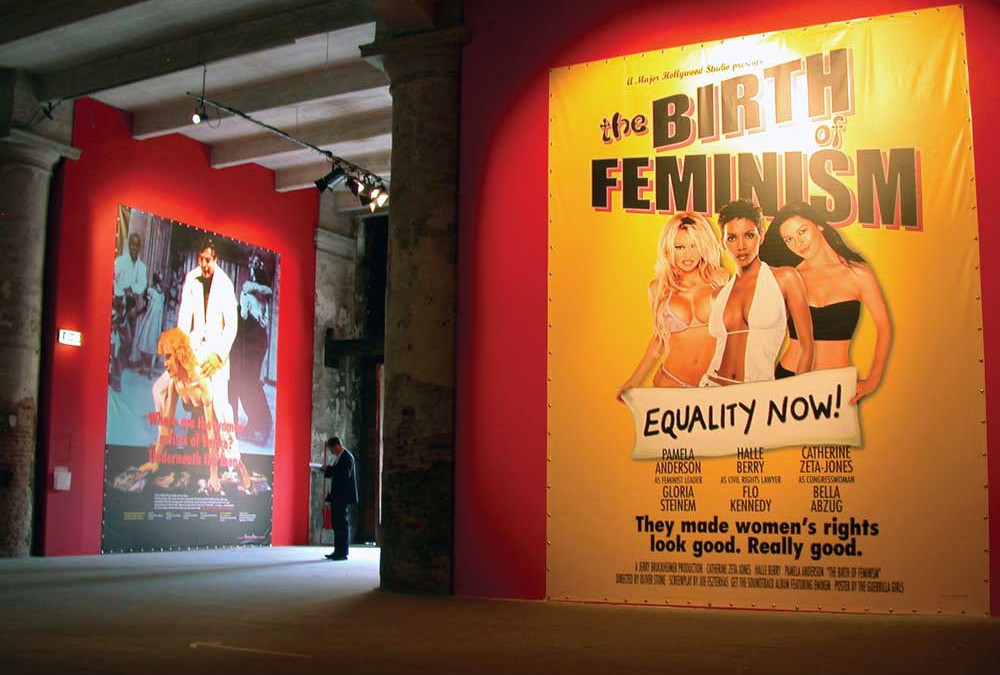
Many other posters came up, as well as stickers, a website and fun fact books. The GG’s hung up female named banners over the generally male artist names on European museum façades, invaded the Venice Biennale with giant banners, launched a anti-film industry billboards in Hollywood right before the Oscar Awards, put up an interactive feminist banner outside the city art gallery at the Art Boom festival at Krakow and many more. With their striking statements and provocative appearances the Guerrilla Girls continuously endeavour to undermine the reigning stereotypes in the art world and other areas. “One poster led to another, and we have done more than hundred examining different aspects of sexism and racism in our culture at large, not just the art world.” In their campaigns the ‘girls’ don’t avoid other sensitive subject that are important to them such as abortion rights, the gulf war, racism, queer issues, homelessness and (sexual) violence. “We are a collaborative group, we don’t work in an orchestrated way. Members bring issues and ideas to the group and we try to shape them into effective posters.” 28 years after the start the Guerrilla Girls have become a habitual -and sometimes notorious- presence in exhibitions, film festivals, newspapers, university aula’s, museum bathrooms and on walls and billboards all over the world. “What started out as a lark has become an ongoing responsibility, a mission. We just can’t abandon our masked duty! It’s been a lot of fun, too!”
Humor.
Another main mission of the Guerrilla Girls is to modernize the word ‘feminism’, their own proclaimed ‘f’ word. Although they call themselves ‘girls’ and sometimes wear short skirts and high heels, the Guerrilla Girls consider themselves pure feminists. “By reclaiming the word ‘girl’, it can’t be used against us. Wearing those clothes with a gorilla mask confounds the stereotype of female sexiness.”, one of the members confirms drily. With their –let’s say- remarkable appearance the GG’s hope to shock and provoke the world. “Our situation as women and artists of color in the art world was so pathetic, all we could do was make fun of it. It felt so good to ridicule and belittle a system that excluded us.”
To the question of how many the Guerrilla Girls are, their answer is that they secretly suspect that all women are born Guerrilla Girls. “It’s just a question of helping them discover it. For sure, thousands; probably, hundreds of thousands; maybe, millions.” Over the years the Guerrilla Girls have become one fluid and crazy but close family off all ages, As they work anonymously they hardly ever accept new members. They rather stimulate their numerous fans all over the world to take them as a roll model and start up their own actions and strategies. And most of all motivate them to complain, complain and complain, but rather in a funny and creative way. To give an idea, they published their Guerrilla Girls’ Art Museum Activity Book, wich is stuffed with funny games, facts and tips like ‘putting up posters and statements in the museum bathrooms’ and ‘dress up and give a do-it-yourself guided tour in your favorite art gallery about the real story behind the displayed art.’ The Guerrilla Girls’ website has several downloadable posters and stickers, like for example the call to drop a new weapon on Washington: the Estrogen Bomb. ‘If dropped on the super-rich trying to take over the country, they would throw down their big guns, hug each other and start to work on human rights.’
Fake fur.
Shortly after their first actions in 1985 and the following press attention, the group members decided to hide their identities when appearing in public. As most of the members are active in the small art world, they prefer to avoid career problems and to bring the focus to the issues, not to the Guerrilla Girls’ personalities. And it seems to help: the mystery surrounding their identities has attracted attention ever since then.The GG’s give themselves names of dead female artists like Frida Kahlo, Eva Hesse, Kathe Kollwitz, Gertrude Stein and Georgia O’Keeffe, in order to reinforce these women’s position in cultural history.The slightly aggressive gorilla masks with sharp teeth were an accidental idea that emerged after a bad speller wrote ‘Gorilla’ instead of ‘Guerrilla.’ The masks immediately became symbol of the Guerrilla Girls’ strength. The good avengers are not afraid to use their loud voice or roll their muscles. But at the end the day, each Guerrilla Girl hangs up her mask and returns anonymously to her daily life. Untill the next mission comes along. And looking at the world today, these kind of missions will still be required for a while. So if you see some Gorilla heads popping up behind the corner of your street, don’t get scared and run away. Just join and play.


De pagina die u zocht kon niet gevonden worden. Probeer uw zoekopdracht te verfijnen of gebruik de bovenstaande navigatie om deze post te vinden.
Text JF. Pierets
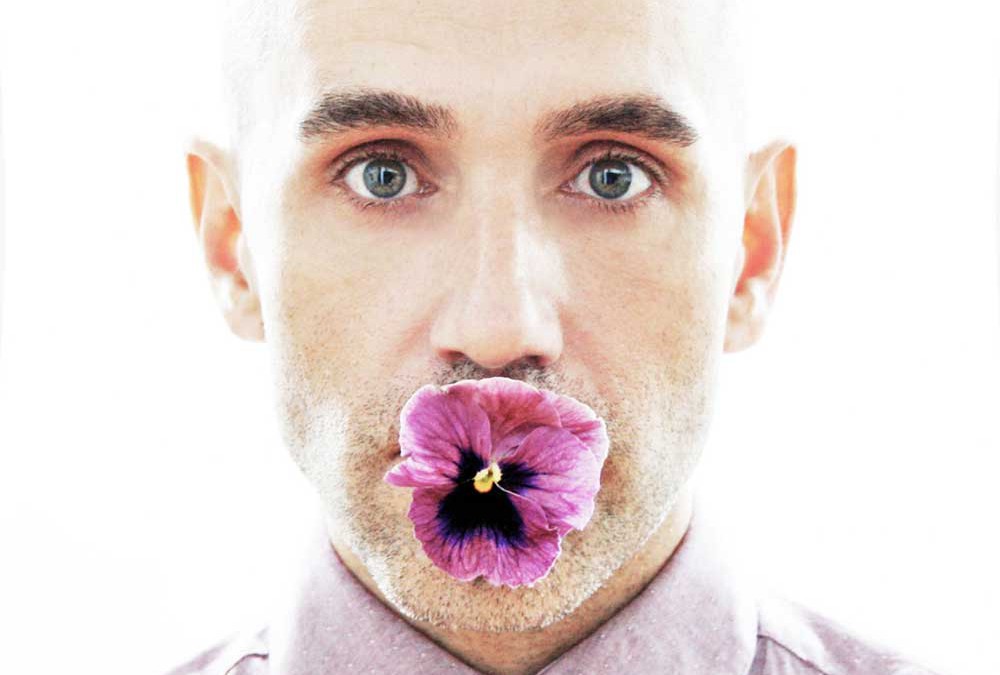
‘The Pansy Project’ is an on-going initiative and artwork devised by Paul Harfleet in 2005. He revisits locations where homophobia was experienced and plants self seeding pansies to mark the spot. They act as a living memorial to the abuse and operate as an antidote to it. After they are individually planted, the pansy’s location is photographed and named after the abuse received.
The Pansy Project has had many incarnations; from small scale unmarked individual plantings to free pansy ‘Hand Outs’ where the artist speaks to passers-by about the project. Additionally, installations of thousands of plants at the site of homophobia and exhibitions of the photographs the artist has made over the last seven years. The Pansy Project has garnered a worldwide following and has featured in various festivals and exhibitions internationally from New York to London.
How it all began.
A string of homophobic abuse on a warm summer’s day was the catalyst for this project. Two builders shouting “It’s about time we went gay bashing again, isn’t it?” is how that day began. It continued with a gang of guys throwing abuse and stones at the artist and his then boyfriend, to end with a bizarre and unsettling confrontation with a man who called them ‘ladies’ under his breath. Over the years Harfleet became accustomed to this kind of behavior, but later realised it was a shocking concept to most of his friends and colleagues. It was in this context that Harfleet began to ponder the nature of these verbal attacks and their influence on his life. Realizing that he felt differently about these experiences depending on his mental state, he decided to explore the way he was made to feel at the location where these incidents occurred. What interested Harfleet was the way that the locations later acted as a prompt for exploration of the memories associated with that place. In order to feel differently about the location and the memories it summoned, the artist wanted to manipulate these associations somehow. Planting unmarked pansies as close as possible to where the verbal homophobic abuse had occurred became his strategy. He would entitle the photograph after the abuse and post an image of the pansy alongside the quoted abuse online.
A positive action versus a negative incident.
Harfleet did not feel it would be appropriate to equate his own personal experience of verbal homophobic abuse with a death or fatal accident; he felt that planting a small unmarked living plant at the site would correspond with the nature of the abuse. A plant continues to grow through experience, as the protagonist does. Sowing a live plant felt like a positive action, it was a comment on the abuse and a potential ‘remedy’. He was interested in the public nature of these incidents and the way one was forced into reacting publicly to a crime that often occurred during the day and in full view of passers-by. He had observed that the tendency to place flowers at the scene of a crime or accident had become an accepted ritual and considered a similar response. Floral tributes subtly augment the reading of a space that encourages a passer-by to ponder past events generally understood as a crime or accident. The artist’s particular intervention could encourage a passer-by to query the reason for his own ritualistic action.
Very quiet yet extremely visible.
Without civic permission to plant one unmarked pansy to mark his own and latterly other’s experiences of homophobia, Harfleet continued as The Pansy Project developed. As growing numbers of pansies were planted with titles such as “Let’s kill the Batty-Man!” and “Fucking Faggot!” a particular view of gay experience which often goes unreported to authorities became apparent. When verbal homophobic abuse is experienced the assailant forces the unwilling participant to assimilate and respond to this public verbal attack; ignore or retaliate? The Pansy Project acts as a formula which prevents the ‘victim’ from internalizing the incident. The strategy becomes a conceptual shield; a behavior that enables the experience to be processed via the public domain, in this case the location where the incident occurred and, latterly, the website which collates and presents the incidents and operates as a virtual location of quiet resistance.
Pansy.
Which plant to use was of course vitally important and the pansy instantly seemed perfect. The name of the flower originates from the French verb Penser (to think), as the bowing head of the flower was seen to visually echo a person in deep thought, hence its Victorian association with effeminate or gay men. The subtle and elegiac quality of the flower was ideal for The Pansy Project’s requirements. The action of planting reinforced these qualities, as kneeling in the street and digging in the often neglected hedgerows felt like a sorrowful act. The bowing heads of the flowers became mournful symbols of indignant acceptance.
How it evolved.
What was originally an autobiographical work has become a project that has been somewhat embraced by the gay community who see the project as a strategy that explores a shared experience. Many statistics reveal that large numbers of the LGBT community have at some time experienced varying levels of homophobic abuse. In association with festivals, Harfleet also regularly hosts events where pansies are often handed out to the general public. At these events the pansies are donated to the public in exchange for hearing about the project. This subtle ‘gift’ presents itself as ‘Free Pansies’ with no catch. However the people receiving the flower take the story of The Pansy Project with them, enabling it to be communicated to a much wider, non-specific, audience.
The various on-line presences of The Pansy Project, such as blog, website, Twitter and Facebook profiles, enable the images of these – mostly ephemeral – acts to be bundled and presented to a wide on-line audience who are then vicariously able to explore and engage with the nature of this artwork and the incidents it documents. The juxtaposition of the images of delicate flowers placed in urban settings with offensive and hurtful abuse creates a complex yet anecdotal anthology of homophobic abuse as experienced by a gay population. The humbly planted pansy becomes a record; a trace of this public occurrence which is deeply personal and concurrently accessible to the public on the street and on-line. After seven years of The Pansy Project Paul Harfleet has planted over ten thousand pansies: Sometimes sowing two thousand at a time as he did for ‘Memorial to the Un-Named’ at the Homotopia Festival in Liverpool, 2008.
Four thousand were planted in the Gold Medal winning ‘Conceptual Garden’ at the RHS Hampton Court Palace Flower Show, 2010, and he continues to seek out locations and plant individual flowers such as the one he recently placed at the British Embassy in Istanbul. Often unsanctioned – though frequently in association with festivals, organizations and even police forces – Harfleet continues to intuit his way through The Pansy Project. In 2011 he collaborated with London based jewelry making company Tatty Devine; together they created a small wooden pin. A hand painted pansy, adorned with “Fucking Faggot”, is a subtle embodiment of The Pansy Project so far.
In September 2012 The Pansy Project featured at the Steirischer Herbst festival in Graz; ‘Truth is Concrete’ was a 24/7 marathon camp attended by over a hundred international artists where Paul planted pansies of historical significance around Graz and spoke about his work alongside Richard Reynolds of ‘On Guerrilla Gardening’; a publication that charts the evolution of guerrilla gardening and features The Pansy Project. The image exclusively included here is taken by Malc Stone and will be the cover image of The Pansy Project publication Paul Harfleet is currently working on. For more information and background visit:


De pagina die u zocht kon niet gevonden worden. Probeer uw zoekopdracht te verfijnen of gebruik de bovenstaande navigatie om deze post te vinden.

Text JF. Pierets Photos Courtesy of Buck Angel
Buck Angel is a female-to-male transsexual and founder of Buck Angel Entertainment. As an adult actor, he was able to create a unique niche, calling himself “The Man With a Pussy”, as he had not had any genital surgery and still possessed a vulva. In 2007 he received the AVN Award as Transsexual Performer of the Year and in April 2008 he was presented with a “Feminist Porn Award” for “Boundary Breaker of the Year”. Today, he travels the world as an inspiring advocate, educator, lecturer and writer. A tête a tête with an inspiring personality.
In an interview I read that you always wanted to be a man. Nowadays, your individual self is your brand. How does it feel to be looked at as something special when for you it was inevitable?
I always felt like a man, so of course I wanted to be looked at as a man. I felt this way my whole life, but so many people did not see me that way when I was younger. As I got older it made me feel horrible about myself. When I was able to change my physical appearance to match how I felt on the inside, it made me the happiest person in the world! I am so happy that now people see me for the man I am and it makes people realize that you can become whoever you want to be. Society should not put limitations on you just because they do not understand. So I like that the world views me as something special; I think this is a good thing.
Transwomen are more visible than transmen. Why do you think that is?
Well I cannot speak for transwomen or transmen, really. I think we are all different in how we want to be visible in the world. Though I do think the visibility of transwomen has been more widespread because they have been around longer as a community. Transmen have just started to become more visible because the community is now becoming larger and more active.
You are – amongst many other things – a pornstar, an educator and a writer. Yet, there’s a very fragile glance in your eyes.
I am indeed all the above, though I’d like to think of myself more as someone who motivates people to think outside the box and to become themselves, like I have. My eyes…well I have lived through some rough times before my change. I was homeless and suicidal, and I was a drug addict. My past was sad in many ways, but I like to think that I have overcome it. Maybe my eyes still show the hurt that was in my soul for so many years? I know that this pain has helped me to have compassion for others. I feel very blessed and grateful for the happy life I have now, and I hope that I have the ability to inspire others to overcome the pain.
You just started a dating site for transmen. “Buck Angel Dating. A safe environment for those seeking out relationships or just fun with transmen and the people who love them”. What if it turns out to be a site for fetishists? Would that bother you?
Interesting question. Why do people think that fetishizing something is bad? I am not saying that this site was intended to do that—I just opened the site for people to have a place to meet because there was clearly a lot of demand. It isn’t just for people looking to have a partner but to also for those who want to meet to have sex without having to explain their transgender status. On my dating site that is not an issue, so you can just get on with having a good time. Some people enjoy being fetishized; I do. So maybe some people will go there with that intention? You know there are some in the trans community who call themselves “activist” and they hate that I am a pornographer. They think it hurts the trans community. I think that is so sad, because my whole life changed for the better when I finally learned to love my body and have sex without feeling guilty. Many trans people feel that someone will never want have sex with them or they don’t feel sexy because their bodies are different than what society tells us is sexy and normal. My work helps to change that and show that if you love yourself (and yes, that includes sex) then others will too!
You are a pioneer and an educator. I think that comes with large responsibilities? When did you decide to talk to people about your experiences?
You are right—it came with a bigger responsibility than I thought. I have learned so much by putting myself out there. I have had some in the trans community tell me that I am a bad person for saying things that I felt were important. But you know I think that by talking about my experiences some people (or maybe many people) can relate to me and feel less alone. I had a tough time in the beginning of my change as I had no community and no one to talk to or identify with. I think by me talking about this I can show how far I have come just because I had determination to be myself.
The other reason I feel passionate to talk and educate is because some people in the trans community say there is only one specific way to be a trans person. This makes me even more passionate and I want to help the people who are individuals and who want become their true selves, and not have to fit how the community wants them to be.
Your website reads that you are “re- defining gender and educating an entire generation on the fluidity of sexuality and identity politics.” I guess that sounds very complicated to someone who’s not into the subject matter. How would you rephrase your message to the mainstream public?
I think you are right about that. Maybe I should rephrase it for the mainstream and say something more like, “Showing you that becoming yourself and loving yourself can make you happier.” This is really the message I want to project. Since I have learned to love myself and create the body that I always wanted to have, I am so happy and comfortable with myself. It can be quite tiresome to always worry what people think of you and it can make life miserable—not just for trans people but anyone. I have all kinds of friends and fans who ask me all the time, “How can I live life like you do, without a care of what other people think?” I would always say that “Just learn to love yourself and become yourself.”
The overriding theme of your work is about self-love and acceptance. Are you a positive & optimistic person?
For sure I am! This is truly one of the keys to being happy. It took me many years to learn this but with determination and the desire not to have hate in my life, I have done it. The odd thing is that I notice the more “popular” I become, the more of a target of hate and envy I become for some in the trans community. Their hateful words kind of shock me sometimes, but I learned to not take these comments personally. I know that these people have not learned to love themselves like I have. They experience these reactions towards a person like myself who is free of that.
“A day in the life of Buck Angel”. What to expect?
Ok, you will be shocked! I think people think I have some crazy lifestyle but really I am pretty mellow. My days are spent at my awesome home in Mexico (if I am not on the road working). I am married and have 7 rescue dogs and spend my time with them. I love to read and also workout everyday. I am also very much into health and fitness. I think this is a very important part of loving yourself.
It was great talking to you. Thank you very much and I wish you lots and lots of success.
Thank you so much for the interview and I hope that my work can help to inspire some of your readers.


De pagina die u zocht kon niet gevonden worden. Probeer uw zoekopdracht te verfijnen of gebruik de bovenstaande navigatie om deze post te vinden.

Text JF. Pierets Photos Renate Breuer
He makes television shows for Dutch channel KRO. One of them is called ‘Uit de kast’ – Out of the Closet – in which he supports youngsters in their coming out. Striking a pose on the cover of a gay magazine is something he does without batting an eye even though he was born and raised as the son of a preacher man in a small village in The Netherlands. He preaches and parties. He’s kind and intelligent but he likes to do things his own way. Yes, there’s a lot to say about Arie Boomsma. A conversation about religion, gay icons and controversy.
When reading the above, one must think you’re quite the schizophrenic type. Yet you sound like you are completely at ease and in balance. How do you combine all these traits in one person?
Let‘s say that I love this kind of tension. I find it very satisfactory to get these contradictions to unite. It gives me the feeling that things are in motion. Maybe it appears to be contradictory but that’s not necessarily so. I sometimes find it difficult to be seen as someone who stands on the barricades while all I want to do is create programs about things that I find important. I feel it is my quest to make youngsters see that they ought to be open and free but I never felt the urge to be a taboo breaker.
You are very religious. Not exactly something you automatically connect with being biased. How come you’re so open minded?
The fundamentals were secured in my upbringing. My parents, who are also very religious, kept the doors to our home open to anyone who needed shelter. People who’d just come out of prison, missionaries from Africa or the occasional vagabond in need of a bath; they were all welcomed with open arms. My parents always said that faith is their basic principle but they also told me to check out their bookshelves and read. They knew that not everybody had the same belief and thought it very important for us to keep an open mind. For us to take a more profound look at the world around us was very important to them.
Is it very narrow minded of me to think that religious people are not tolerant towards any other range of ideas?
It remains a difficult discussion. I know a whole bunch of religious people who really think differently. But those are not the ones you hear the most. Therefore I find it very important to apply myself for a theme such as homosexuality. Because if you take the bible seriously you’ll read that it’s a command to step into the world with love in your hart and not to be judgmental.
I’m often in conflict with people who I think are abusing religion to prohibit people to do or to be something they don’t really are.
And is that the reason why you make television programs like ‘Uit de Kast’?
I want to be inspired by the things around me, by what happens at this moment, contemporary themes. Only, when it comes to sexual orientation, I’m even more motivated because I want to underline that if you acknowledge the existence of God, you know that he would never tell someone what he can or cannot do. God loves everyone and sees no difference between gays, hetero- or transsexuals, lesbians or anyone else. God makes no mistakes; he makes every person the way he or she ought to be. I would never say such a thing during the show, but I like to accentuate this vision during the promotion of it.
Sounds like you get much satisfaction from your work?
I do. Very much. I love to go out, eat, drink and party but in my work I find it very important to make a difference. To be relevant and to make a contribution, to make something right, as you like. Mind you, there’s a shadow side to the whole thing because I can feel pretty guilty when I’m not working. Then again that might be a Calvinistic motivation.
Do you feel successful?
That would be a little too easy. The second season of ‘Uit de Kast’ had about 700.000 viewers. It would be very tempting to sit back, relax and enjoy the success but that’s not my motive. Now, while working on season 3, I want to make it better, I want stories that matter, that inspire even more than the previous series. I don’t want it to end like some kind of trick, a format that works on TV. You have to watch out not to repeat yourself because it’s successful. It has to be repeated to have more impact. I want to keep evolving because even if some people think that homosexuality is widely accepted, it is not. For the biggest part it’s still something many people don’t know about. Something scary.
An idealist.
The core of idealism is that you should always feel that what you do is something good or that it adds something. It’s nice to get confirmation, but it’s not my first aim.
Those kids from ‘Uit de Kast’ really trust you. You can almost hear them say, “Here’s my hart, you can do with it whatever pleases you”.
That’s true. But that’s because we take our time and we talk a lot. We never give those kids the feeling that they are obliged to do anything. They are the ones that decide what will happen. We’re the happy few who can be present at this process. I’m always very proud that they want me there because there’s a lot at stake for those boys and girls. The stories they tell are real and sometimes very raw. That’s why I want a program like this on television. To show all those struggling kids out there that they are not alone. Let’s say I’m not done with trying to bring confidence and a sense of self-worth to those who need it.
It must be hard to get those stories out of your head.
In the previous season there was this boy who told me that he hated himself when he looked in the mirror. He used to call himself a dirty faggot and stated that he would give both his legs to not have to be this way. Can you imagine that? That you are so disgusted of yourself because everyone in your environment always told you that it’s wrong, that it’s not the way you ought to be. So yes, those stories keep wandering through your head while you ponder on how to make this right. Fortunately everything is becoming better. The boy and I stay in touch. He has a boyfriend and slowly he starts to accept who he is. His mother is very interested, his family is strictly orthodox but they had the strength to put love in the first place.
And what about you? Are you very influenced by your surroundings?
I’m aware of my position in society but I try not to be too influenced. Some moments are easier than others and I don’t want to be bound fighting against any form of judgment. Then again I’m aware of my exemplary function. I work with high school kids and some of them look up to me. Personally I can run around, saying I’m a free spirit and it ought to be possible to experiment with whatever you like, but I would never say “go ahead”. Because you never know what goes on in someone else’s mind.
You do so many things, yet they keep calling you a gay icon. Doesn’t that bother you?
In the beginning I was quite bothered by all those questions about being gay or not. I had to keep explaining that it’s not because you are on the cover of a gay magazine or the host of a themed television show, that you are necessarily gay. Nowadays I don’t mind anymore. I keep thinking that as long as hetero men are bothered about being called gay, well, I will keep shaking the tree. It’s very important that men like Obama or John Irving stand up for homosexuality. They should say that gay rights are civil rights, and that everyone should get over it. Those are people with a lot of influence, they could change a lot.
Your quote on Twitter says: ‘Optimism borders on irresponsibility’.
When you are optimistic, you have to be fully so against all odds. You must be prepared to see the beautiful side of things, even if it tends to be a little naïve. Being so hopeful, being so willing for everything to be fine, that it’s almost irresponsible.
Do you have it in your nature?
Yes, but it also became a way of living. People often mistake optimism for weakness but it isn’t. It’s looking at how to get out even when you are down. Like that Baron Von Munchhausen, who grabs himself by the hair and makes decisions to move on, even though it’s hard at times. It’s not in my nature to tend to the negative side of things. I see them and I’m not ignorant about them and sometimes they do kick in, but in the end there’s always something worth fighting for. Don’t get me wrong, it’s not that I’m never sad. I have my downs once in a while and sometimes I need to pull back from the world. I Draw the curtains, watch some movies and read some books to recharge my batteries. During these episodes I sometimes start to feel that the character of it all is temporary. I start to notice that the more you have, the greater your fear is to lose it all. Until now I never had any reason to be afraid. I have a lot of beautiful opportunities. I have a lot of possibilities and room to create, but because of that I also sometimes wonder what I would do if all this wasn’t happening. If I would still have so much satisfaction from what I do if there wouldn’t be any camera’s to register the act.
Would you?
I don’t think so. If you want to make a difference it better be grand and impressive to have the biggest impact possible. Not in the least with an audience. Although a large audience has to be the result, not the goal.
Yet you are working for public television.
I am, but I never have the feeling they keep me on a tight leash. We talk a lot. But indeed, on the other hand I’m dependent on the space they allow me to have. Luckily that’s a lot of space.
Is that why you are writing? Because there’s a chance that it might all end?
Maybe it is. It’s indeed something I could do forever. But the biggest motivation to write is because it’s such a nice antithesis of my public life. Those quiet moments, that kind of loneliness, just letting it all out. It’s a whole different way of expressing myself.
Last question. Almost every article about you is saying how involved, kind, intelligent or good looking you are. What’s the angle?
I don’t know. Even though I am everything that I am, this keeps being a relevant question; who am I, apart from what I do as a public person? A friend of mine once told me that he had the feeling I was living in a world of illusion. People talk different because they know me from television and I’m offered free coffee in a bar. Nevertheless, considering the programs I’m making, I feel like I’m standing right in the middle of it. No illusion at all. It’s what we talked about in the beginning of this conversation; everybody captures another part of your character and it’s not always easy to keep all those facets in one person. In no way do I mean that to be negative because I love being in the spotlights, but on one hand you have to take care that everything keeps on moving fluently and on the other hand you need and anchor. You must not forget what you do and what you do it for. And yes, maybe for some people I’m all paradox, but then again… I love flirting with those boundaries.


De pagina die u zocht kon niet gevonden worden. Probeer uw zoekopdracht te verfijnen of gebruik de bovenstaande navigatie om deze post te vinden.