Geen Resultaten Gevonden
De pagina die u zocht kon niet gevonden worden. Probeer uw zoekopdracht te verfijnen of gebruik de bovenstaande navigatie om deze post te vinden.


Text JF. Pierets Artwork AMVK
Anne-Mie Van Kerckhoven is known for creating a diverse body of work in painting, sculpture and installation that has made her among the most important Belgian artists of her generation. She embraces a complex array of subjects, including alchemy, mythology, artificial intelligence and mystical scriptures from the past, working with the conviction that her work can someday answer the question if we, or if we don’t possess a soul. AMVK uses existing images in a disjunctive and semi-coherent way that only make full sense in the work’s final moment, when all the layers are combined together. Her career remains a subject of fascination and understandably so, because far from the mainstream circuit, she’s busy blazing her own conceptual trail. Her relationship with creativity is raw, almost primitive in its absence of compromise or concession. We meet Anne-Mie in her beautiful atelier in Antwerp, filled with books, work in progress and nude magazines. A conversation about reincarnation, porn and the urge to draw.
Your work contains contemporary issues regarding technology and sexuality while sourcing material from the past. Why this thirst for history?
Let’s start at the beginning. More than 10 years ago I’ve bought a book called ‘La science du bien et du mal’ by Victor Géhant that was written in 1848. In this book he’s searching for the connections between the fact that we are sleeping, the fact that we divide good and evil and the fact that we are convinced of having a soul. Afterwards it seemed that this book was based on the intellectual legacy of Marguerite Porete, a French mystic who died in 1310. We’re talking about the end of the ’90s so I had to search a long time before I could find ‘Le Miroir des Âmes Simples et Anéanties’ – ‘The mirror of the simple souls’. One of the last romans chevalier and one of the first mysterienspiele. The title of Porete’s book refers to the simple soul, which is united with God and has no will, other than God’s own, a spiritual dealing with the workings of Divine Love. She was burnt at the stake for heresy in Paris in 1310 after a lengthy trial, when refusing to remove her book from circulation or recant her views. It was only until 1965, when the original Old French version of ‘Le Miroir des âmes simples’ got published, that Porete’s status became one of the greatest of Medieval Mystics, as one of the most visionary exponents of the Love Mysticism of Beguine spirituality. When I read this book I felt like dropping down, I felt that I was her reincarnation.
How did this epiphany influence your work?
It was only when I finished my Headnurse project (96 women’s bodies combined with 96 terminologies taken from books on artificial intelligence. Ref.) I realized that this mystic, Marguerite Porete, had the same issues, the same pain as I have: the agony of a huge duality between my heart and my head. In 2005 I made a trialogue between Porete, Giordano Bruno, an astronomer, and Marcuse, who wrote ‘Eros et civilisation’, because those three people are also suffering from the same pain. I made drawings inspired by this trialogue and named it ‘I’ll Rob You’. I’ve been working on the subject ever since.
Are you heading towards a point where you can bring it all together?
Yes. It’s quite an ambitious project and sometimes my head can’t stop spinning but lately there are moments in which things start to fall into place.
You once stated that every piece of work you create is a survival mechanism.
Every period in my life is outlined by a series of entities that automatically evolve into a specific theme. By using these themes in my work, I’m able to control them, able to give them a logical position in my life. You can say I translate or canalize my inner process into an exterior three-dimensional structure.
When do you stop reading and start to work?
I do everything at the same time. I have concentration issues so most of the time it turns out that I’m drawing while reading, using the lyrics in my work. I make all different kinds of work at the same time. I need my drawings to place basic things such as anger, and grief.I can’t plant that in my bigger work.
You make all sorts of work. Paintings, sculptures, installations, you name it. You were never interested in sticking to one thing?
Some people used to complain about the fact that I make too much and all too different, but that’s who I am and what I am. Let’s say I have a wild creativity. From morning till night, it never stops. Picasso was also like this and I don’t hear anyone complain about him.
Does the slightly soft porn aspect of your work cause eyebrows to be raised?
You’re referring to the fact that my work is often called obscene. I have this big amount of nude magazines dating to the sexual revolution. In those magazines I find a lot of hidden filters to work with. Starting from those pictures I’m able to explain and deal with contemporary human or social issues. My choice of images is mostly based on false feelings of indignation. They haunt me with their nasty sort of beauty. It happens that they stick to me for 10 years or more before I’m able to really deal with them. In their innocence they touch something very deep and vital. For instance look at this scene (shows a 50’s black and white image of a woman playfully hanging on a rope in an artists’ studio. Ref.), why is she hanging there like this, what was that photographer thinking? To me the whole scene hides an essential urge from both sides of the lens, even with that retouched pubic hair. I find these women and the way they are depicted extremely beautiful too. The big challenge is to combine a tantalising image with peevishness and try to end up with something new that is meaningful and interesting.
Those 50’s images are quite harmless compared to contemporary porn. Are you even more annoyed when you look at this evolution?
I hardly buy those kinds of magazines because they are too simple-minded, too focused on one thing. But new kinds of sources do inspire me. For instance a year ago I found a magazine printed in 2000 with a lot of white and red rubber and women in funny scenes, with furry donkey ears. Very inspiring, I love it. I have also this thing with plastic, from when I was a kid. Lately I worked a lot with Sleek magazine with its homoerotic- and sado-masochistic images, flirting again with nazi-imagery, dark heavy leather, and bearded sexy men with an Arabic touch, in skirts. And again, quasi-silly. I find this all interesting and double because these magazines pretend merely to exist to sell clothes.
It sounds like you have the fierce need to push the limits of your inspiration?
Connecting sex and technology has always been my main activity as an artist . I am intrigued why naked women are portrayed, but on the other hand I’m also truly inspired by all things regarding the synthetic; thermodynamical laws and outer space issues. I had that since I was a child. I work with computers since 1977. I’m a pioneer when it comes to that. When I studied at the art academy we had a lot of contact with students who were both aspirant scientists as well as musicians. Performers. By that time I got very well acquainted with Luc Steels, who later started the laboratory of artificial intelligence (AI) at the VUB in Brussels, and it is thanks to him that I could start working with computers so early. I made my first movie on a very rigid piece of machinery that could only go black and white and was hugely pixelated.
What interested me from the start is that you can keep on working in different layers, which you can manipulate apart from each other, without focusing on a final result. And of course I loved drawing my naked women on these highly sophisticated machines. Something quite unusual to be done in the sterility of an AI-lab. The symbolic gesture of it was a statement and of big importance to me at the time.
What’s so interesting about artificial intelligence?
I always had this hunger for consuming science, as an outsider. I had a subscription on ‘The New Scientist’ as a student. In the beginning of the 80’s AI kept on searching for the essence of what defines human beings. Things like: what is intelligence, what is creativity, and how they related to each other. The books on knowledge representation reflected a modern kind of theology to me. AI used psychology and philosophy research and terminology, in order to develop new insights and to compact the abstract. At a certain moment the trail somewhat fell apart on the idea that language was the thing that made us more intelligent than other species. Later they decided that it is the complexity of human social structures that made us develop technologies as we do. As an artist I quickly knew I was more mesmerized by all things evolutionary, new ideas and new perceptions instead of art itself. Include my distrust towards the art world, because there were so few female examples, hardly any women to be found in art history books, and I soon felt much more liberated being creative in an atmosphere of science, logic and future.
How long did it take to find your path?
Not very long. As soon as I left the academy I started reading De Sade and Wittgenstein. This, combined with The New Scientist magazine, really influenced my choices.
Is there something you are looking for?
I’m not necessarily looking for something but I’m trying to make connections. I’m very conscious about all those different significance layers in reality and I like creating things that places everything back in perspective. That doesn’t exist in real life but it does in my work. Maybe it’s because I read a lot of fairy tales when I was young.
You talked earlier about the lack of women in the art world. Do you feel in place?
I consider myself a stand-alone. The past 10 years I thought a lot about it, but recently I decided to stop doing that. It starts to get too upsetting. The art world is mostly ruled by men. You have to have that certain mentality that when you find something that works, you stick to it. You are constantly supposed to stimulate the surroundings by shouting: look at me, look at my work, I’m the only thing that matters. You have to have an obese ego and I loathe it. I don’t know how this works with the younger generation of female artists. Maybe it has to do with the way I am brought up as a woman, that I keep other people as much in account as I do myself. For me the way I do it though is the only way I want it.
Do you find it important what people think about your work?
I’m very much interested in what people think about my work but I don’t take their judgments into account. When you work on something in your studio, you have a very intimate contact with your creation. You are in fact your work. From the moment you share it with another person you start looking through his or her eyes and your work has already changed by then. So it’s very important with whom I’m watching. After a while you let go, but in the beginning it’s essential.
And the final question; do you like living in Antwerp?
I do, I have a wonderful atelier here and Antwerp has a good vibe. I guess that’s why there are so many great artists living here. The only thing that bothers me is the lack of good spots to party, to dance. Since I’m also a DJ, maybe I’ll have to start one myself. Anyone interested?


De pagina die u zocht kon niet gevonden worden. Probeer uw zoekopdracht te verfijnen of gebruik de bovenstaande navigatie om deze post te vinden.
Text JF. Pierets Photos Charlotte Lybeer
From 2003 until 2008, Charlotte Lybeer photographed gated communities and actual “theme parks” in the US, South Africa, Europe, China and the Arab Emirates. ‘The success of these ‘enclaves’ proves that in a society without boundaries, we still desire controllability. It seems that happiness is only possible in an artificial reality where everything is under control of its makers. An architectural décor is being built; a scene in which the inhabitants step away from everyday reality.’
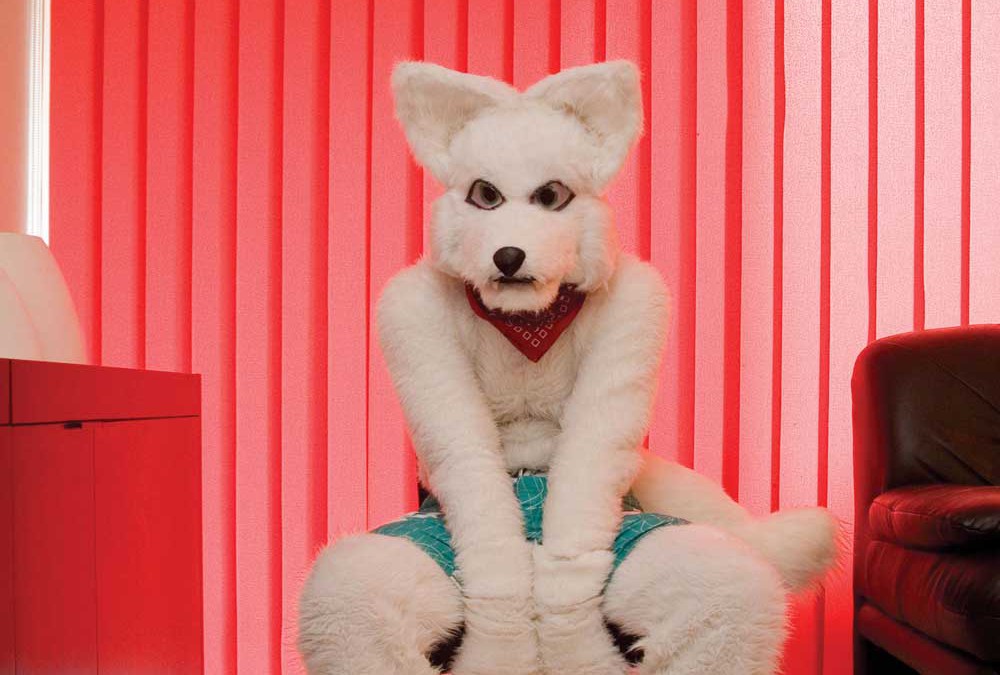
Charlotte Lybeer studied photography at the Academy of Fine Arts Ghent and the HISK in Antwerp. For the series ‘The furtastic adventures of the cabbit and the folf’ she submerged in the world of furries. ‘Each of my series is a logical continuation of the previous one. In this case it was a continuation of ‘Larp, taking a holiday from everydayness’ from 2009. A series of portraits from LARP (Life Action Role Playing) players.
Charlotte uses photography to research the capsular aspects of our society. In her projects Lybeer takes an aesthetic, as well as a social look at people who form groups and/or separate themselves from others. In this case; Furries. The furry fandom is a subculture interested in fictional anthropomorphic animal characters with human personalities and characteristics like intelligence, facial expressions, the ability to speak, to walk on two legs and wear clothes. During the 1980s, furry fans began to publish fanzines, developing a diverse social group that eventually began to schedule social gatherings. By 1987, there was sufficient interest to stage the first furry convention and throughout the next decade, the Internet became accessible to the general population.
To create ‘The furtastic adventures of the cabbit and the folf’, Charlotte had to infiltrate into its fandom. ‘I became a member of different forums and online communities related on the subject matter and went to conventions in England and Germany. They’re gathering yearly in large hotels which they rent for private use.’ For this series the individuals were taken out of their safe groups and placed into their personal and intimate habitats. The contrast between the costume, which the person uses to tell us something about his or hers virtual identity, and the homey interior is an approach rarely to be seen. The setting reveals the personal identity and daily reality of the player, yet he is still in character.
Gaining those people their trust is a tour de force since they are often described as freaks in mainstream media. ‘The hardest part of this project was gaining that trust. If it would have been easy, there would be much more series like this. The first step was to become a member of the group and talk openly and clear about my work and what I wanted to achieve. The second part was to prove that I was serious on the subject matter. That can be achieved by being humorous without being flippant. The hardest part was to get personal so they would trust me enough to let me into their houses.’
‘The furtastic adventures of the cabbit and the folf’ is part of Charlottes project to get her doctors degree. It’s called ‘Lifestyle Supermarket’. She’s photographing different fandoms that are related to virtual, three-dimensional worlds such as Second Life, in which players can create a second identity. ‘It’s a very intriguing given. People can transform themselves into a superhero, a monster or and animal with human characteristics such as furries. The unique feature of these fandoms is, that these trans human identities are nowadays also assumed outside the virtual world. For me, those are examples of how contemporary men tries to fit in the image imposed by mass media such as movies and games. All my projects are inspired by how people react in a world that is changing. Not only geographical, but also on an imaginary level.’


De pagina die u zocht kon niet gevonden worden. Probeer uw zoekopdracht te verfijnen of gebruik de bovenstaande navigatie om deze post te vinden.

Text JF. Pierets Photos Jill Peters
Northern Albanian women, faced with a culture that subjugates females, live and dress as men in order to provide for their families. These sworn virgins took a vow of chastity, wear male clothing and live as men in the patriarchal northern Albanian society. In an ongoing series, photographer Jill Peters has captured the fascination of a tradition dating back hundreds of years.
When and where did you come up with the idea of making this series?
In late 2008 I was reading a book written by Serena Nanda about gender diversity around the world, and came across a chapter about the Sworn Virgins of Albania. I was intrigued by the idea of such a tradition. I knew nothing about them, nor had I ever heard of their existence. The general consensus that they would soon be dying out made me act quickly. I had to meet one and I was determined to photograph at least one. This idea soon expanded to making a documentary film and I put a crew together. We all traveled to Albania in July 2009 and some of these portraits were taken then. I returned again in late 2011 to continue the project.
Was it easy to find these women?
It was not easy to find them. The Sworn Virgins are very proud but extremely private people. The majority live in very small secluded villages not often seen by outsiders. They remain suspicious of foreigners and their trust must be earned over time. Once they accept you however, they are talkative, warm and hospitable, often offering coffee, tea or cigarettes to their guests.
They live as men yet I guess everybody in the village knows they are women – otherwise you would not have found them. Or am I wrong?
The most remarkable aspect of this tradition is that everyone knows they are women. In this culture however, the way one dresses dictates how they are perceived. A woman who cuts her hair short, wears men’s clothes and adopts masculine traits is accepted as a man. Because this practice has a long history and is associated with family honor, inherited wealth and clan survival, the burneshas are well respected and regarded as a benefit to the family. For the most part, villagers in these areas are so accustomed to knowing a Sworn Virgin, or “burnesha”, first hand that they often wonder what all the interest on our part is about.
What do they think of this paradox?
I was drawn to this project because of the paradox of a strident patriarchal society accepting a woman who switches her gender by choice. I want to make it clear if it isn’t already, that this has nothing to do with sexual identity. As westerners we tend to jump at the chance to label someone gay or straight because those seem like the only two options in our culture. The remarkable thing about these women is that they are beyond labels.
I read that this decision is more related to gender roles than to sexuality. Nevertheless they have to remain virgins. Why is that?
I believe swearing to remain a virgin for life and thus avoiding any kind of romantic relationship altogether was their only way of circumventing such labels. Regardless of any orientation, they could not be with a man and still be considered a man. Nor could they be with a woman, as that would technically be a homosexual relationship since they were known to be biologically female. Also, the Kanun, which is the tribal code still influencing many in the rural north, states that a woman is only worth half as many bags of grain as a man, but a virgin is equal to the value of a man. I find it sad in the broader scope, as a woman, that this extreme sacrifice was necessary in order for a woman to exercise her free will. Because a woman wears a pair of pants she is “suddenly” deemed capable of inheriting property, driving a car or running a business. It simply amazes me. I think the injustice in that is evident to everyone today.
Some women became burneshas when they did not want to marry the man their family had chosen for them. Again this is a sad reflection on what it meant to be a woman in those times. Once the vow is taken though, it is forever. To go back on a vow would be to disgrace the family and could result in a deadly feud between the two families that could perpetuate generations of honor killings. I was relieved to discover that for the most part, the burneshas did not regret their decision and insist they have led happy lives. Most would make the same choice given the same circumstances. They are pleased with the progress women have made in the past 50 years and understand why it is a custom that is dying out.
You said in an interview that this is an ongoing project. What are your plans?
My future plans for the project include finishing my documentary film. I’m proud to say I have a good relationship with my subjects and have developed a level of trust over the years.


De pagina die u zocht kon niet gevonden worden. Probeer uw zoekopdracht te verfijnen of gebruik de bovenstaande navigatie om deze post te vinden.
Text Wendy Donckers Photos Courtesy of The Guerrilla Girls
The Guerrilla Girls are a group of anonymous estrogen-bomb dropping, creativily complaining feminists. They fight discrimination and corruption in politics, art, film and pop culture with ‘facts, humor and fake fur’. Behind their scary gorilla masks you can find women of all sorts and kinds with pseudonyms of dead female artists. Let’s take a look at the Guerrilla Girls’ deadly weapons.
Facts.
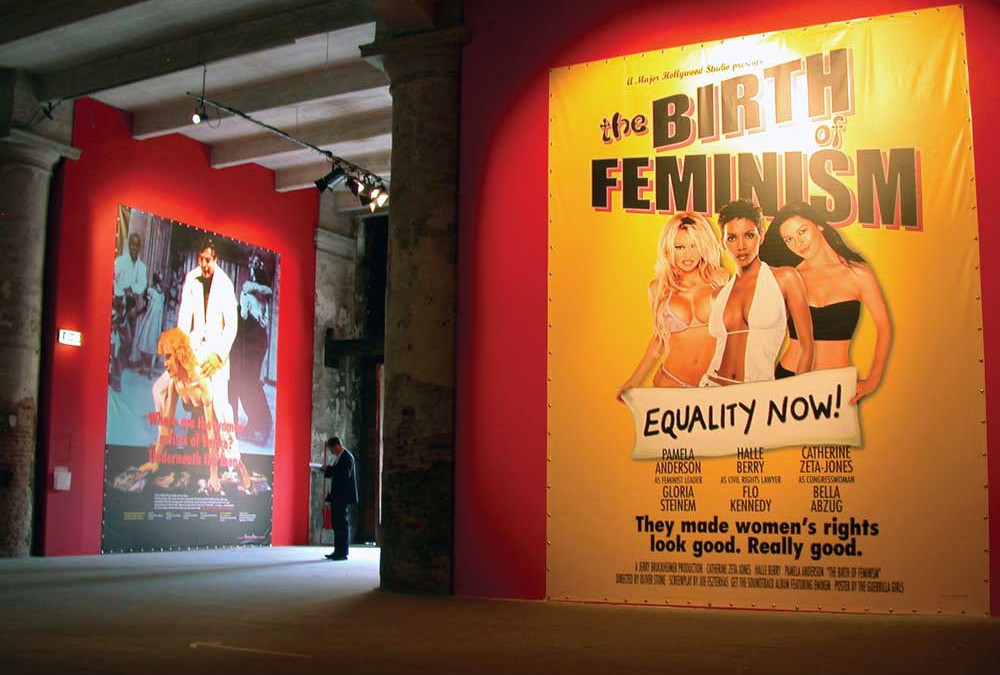
The Guerrilla Girls started off in 1985, after a protest against an exhibition at the Museum of Modern Art in New York, the most influential museum of modern art in the world. The exhibition included only 17 women out of the 165 displayed artists. A bunch of female artists made posters that stated these facts of discrimination and put them up throughout art neighbourhood SoHo. The Guerrilla Girls were born. The group started making statistics of women artists and artists of color in museums, academies and art galeries. They committed themselves to counting, writing letters, and researching museums and galleries. “There’s a popular misconception that the world of High Art is ahead of mass culture. But everything in our research shows that, instead of being avant garde, it’s derriere.”, the Guerrilla Girls stated in an interview on their website. The GG’s even did a ‘weenie count’ in the Metropolitan Museum of Art in New York. They came to the conclusion that less than 5% of the artists in the Modern Art sections were women, while 85% of the nudes were female. A new Guerrilla poster was made and showed the back of a naked gorilla-headed woman that lies down and seems to say: “Do women have to be naked to get into the Met. Museum?” A quarter of a century later the same updated poster demonstrates figures that have hardly changed: female artists at the Metropolitan Museum dropped down to 4% and the female nudes became 76%.
Many other posters came up, as well as stickers, a website and fun fact books. The GG’s hung up female named banners over the generally male artist names on European museum façades, invaded the Venice Biennale with giant banners, launched a anti-film industry billboards in Hollywood right before the Oscar Awards, put up an interactive feminist banner outside the city art gallery at the Art Boom festival at Krakow and many more. With their striking statements and provocative appearances the Guerrilla Girls continuously endeavour to undermine the reigning stereotypes in the art world and other areas. “One poster led to another, and we have done more than hundred examining different aspects of sexism and racism in our culture at large, not just the art world.” In their campaigns the ‘girls’ don’t avoid other sensitive subject that are important to them such as abortion rights, the gulf war, racism, queer issues, homelessness and (sexual) violence. “We are a collaborative group, we don’t work in an orchestrated way. Members bring issues and ideas to the group and we try to shape them into effective posters.” 28 years after the start the Guerrilla Girls have become a habitual -and sometimes notorious- presence in exhibitions, film festivals, newspapers, university aula’s, museum bathrooms and on walls and billboards all over the world. “What started out as a lark has become an ongoing responsibility, a mission. We just can’t abandon our masked duty! It’s been a lot of fun, too!”
Humor.
Another main mission of the Guerrilla Girls is to modernize the word ‘feminism’, their own proclaimed ‘f’ word. Although they call themselves ‘girls’ and sometimes wear short skirts and high heels, the Guerrilla Girls consider themselves pure feminists. “By reclaiming the word ‘girl’, it can’t be used against us. Wearing those clothes with a gorilla mask confounds the stereotype of female sexiness.”, one of the members confirms drily. With their –let’s say- remarkable appearance the GG’s hope to shock and provoke the world. “Our situation as women and artists of color in the art world was so pathetic, all we could do was make fun of it. It felt so good to ridicule and belittle a system that excluded us.”
To the question of how many the Guerrilla Girls are, their answer is that they secretly suspect that all women are born Guerrilla Girls. “It’s just a question of helping them discover it. For sure, thousands; probably, hundreds of thousands; maybe, millions.” Over the years the Guerrilla Girls have become one fluid and crazy but close family off all ages, As they work anonymously they hardly ever accept new members. They rather stimulate their numerous fans all over the world to take them as a roll model and start up their own actions and strategies. And most of all motivate them to complain, complain and complain, but rather in a funny and creative way. To give an idea, they published their Guerrilla Girls’ Art Museum Activity Book, wich is stuffed with funny games, facts and tips like ‘putting up posters and statements in the museum bathrooms’ and ‘dress up and give a do-it-yourself guided tour in your favorite art gallery about the real story behind the displayed art.’ The Guerrilla Girls’ website has several downloadable posters and stickers, like for example the call to drop a new weapon on Washington: the Estrogen Bomb. ‘If dropped on the super-rich trying to take over the country, they would throw down their big guns, hug each other and start to work on human rights.’
Fake fur.
Shortly after their first actions in 1985 and the following press attention, the group members decided to hide their identities when appearing in public. As most of the members are active in the small art world, they prefer to avoid career problems and to bring the focus to the issues, not to the Guerrilla Girls’ personalities. And it seems to help: the mystery surrounding their identities has attracted attention ever since then.The GG’s give themselves names of dead female artists like Frida Kahlo, Eva Hesse, Kathe Kollwitz, Gertrude Stein and Georgia O’Keeffe, in order to reinforce these women’s position in cultural history.The slightly aggressive gorilla masks with sharp teeth were an accidental idea that emerged after a bad speller wrote ‘Gorilla’ instead of ‘Guerrilla.’ The masks immediately became symbol of the Guerrilla Girls’ strength. The good avengers are not afraid to use their loud voice or roll their muscles. But at the end the day, each Guerrilla Girl hangs up her mask and returns anonymously to her daily life. Untill the next mission comes along. And looking at the world today, these kind of missions will still be required for a while. So if you see some Gorilla heads popping up behind the corner of your street, don’t get scared and run away. Just join and play.


De pagina die u zocht kon niet gevonden worden. Probeer uw zoekopdracht te verfijnen of gebruik de bovenstaande navigatie om deze post te vinden.

Text JF. Pierets Photos Paul Buijs
Young, reckless and fresh from the Arnhem art academy. In order to find a suitable subject for his graduation project, Paul Buijs went where no other student would follow; the shady underworld of gay darkrooms and sex parties. Hovering unsettlingly between fiction and reality, documentary style and art photography, Buijs’ work is of an unedited realism. What normally stays in the shades is now brightly lit up in an uncomfortable, confronting way. It reveals a curious and previously unexamined aspect of the gay scene, and provides a window into the collision of the club life, kinky sex and dark cellars that color the streets of Amsterdam.
Paul just returned from his exhibition and lecture at the Berlin Porn Film Festival when we meet. He’s once again flabbergasted by the way people react when confronted with his pictures. “It’s weird to experience that people are still to be shocked since it was never my intention to provoke. When searching for ideas that would suit my graduation project, I was a frequent visitor of the Warmoesstraat and the Regulierdwarsstraat in Amsterdam. The gay areas, so to speak. I started to take pictures and soon my teachers pointed out that I was on to something.”
During that time, Paul got very much intrigued by an article called ‘Life When The party is over’. Written by a psychologist who had made a study on gay men in their mid 30’s – 40’s and published in Wink magazine. He stated that a lot of gay men weren’t able to enjoy their teenage years because of their family for whom they only came out of the closet when they were already in their 20’s. Due to the social impact of such oppression, they started their outgoing life when most straight people in society started to settle.
A phenomenon that in a lot a cases leads to heavy party life and the drug use that often goes along with it. Not to speak of a low career expectation. “This article explained what I questioned: what lies behind the surface of that fashionable, sexual and glamourous appearance. What was behind the mask of the people involved in this scene?”
Still in the stream of perfectioning his art school assignment, his teachers advised him to focus on his signature. Being a huge fan of the Disney and populair culture he swiftly found a symbiosis between the personages that populate his work and the alienation of mainstream entertainment. “All Disney characters are drawn in a certain, monotonic way. They all have the same glance, facial expression and are very similar in style. It stroke me that a lot of my fellow party people wore the same Fred Perry shirt, the same Bikkemberg shoes and had the same hair-do. By asking to wear a mask I wanted to underline the oneness of a certain scene, by making it half a mask, I made a pairing between the monotony of the public statement and their own private personality. “
With the best will in the world you can’t say that Buijs’ work is approachable or reassuring, hence the numerous galleries who rejected his work for being too shocking and the multiple reactions of viewers who found his images to confronting, to surreal, to raw and to bright. “I had no idea my work would have such an impact. I have the upmost respect for my models and I always show them their picture before I make it public because they still can be recognized despite of the mask and I shoot them while we both experience an autobiographical moment of obsession and dependency. The images are viewed like a private journal made public and it works out to be a little too much to handle for a lot of spectators. For example I got fired as a teacher because they thought my work to be too dangerous for the children and their parents. I don’t quite get it, but let me tell you that I’m too passionate and too engaged to just give up. I invariably believe that somewhere, sometime my work will be acknowledged so I keep on going”.


De pagina die u zocht kon niet gevonden worden. Probeer uw zoekopdracht te verfijnen of gebruik de bovenstaande navigatie om deze post te vinden.