Geen Resultaten Gevonden
De pagina die u zocht kon niet gevonden worden. Probeer uw zoekopdracht te verfijnen of gebruik de bovenstaande navigatie om deze post te vinden.


Text JF. Pierets Photos Courtesy of Buck Angel
Buck Angel is a female-to-male transsexual and founder of Buck Angel Entertainment. As an adult actor, he was able to create a unique niche, calling himself “The Man With a Pussy”, as he had not had any genital surgery and still possessed a vulva. In 2007 he received the AVN Award as Transsexual Performer of the Year and in April 2008 he was presented with a “Feminist Porn Award” for “Boundary Breaker of the Year”. Today, he travels the world as an inspiring advocate, educator, lecturer and writer. A tête a tête with an inspiring personality.
In an interview I read that you always wanted to be a man. Nowadays, your individual self is your brand. How does it feel to be looked at as something special when for you it was inevitable?
I always felt like a man, so of course I wanted to be looked at as a man. I felt this way my whole life, but so many people did not see me that way when I was younger. As I got older it made me feel horrible about myself. When I was able to change my physical appearance to match how I felt on the inside, it made me the happiest person in the world! I am so happy that now people see me for the man I am and it makes people realize that you can become whoever you want to be. Society should not put limitations on you just because they do not understand. So I like that the world views me as something special; I think this is a good thing.
Transwomen are more visible than transmen. Why do you think that is?
Well I cannot speak for transwomen or transmen, really. I think we are all different in how we want to be visible in the world. Though I do think the visibility of transwomen has been more widespread because they have been around longer as a community. Transmen have just started to become more visible because the community is now becoming larger and more active.
You are – amongst many other things – a pornstar, an educator and a writer. Yet, there’s a very fragile glance in your eyes.
I am indeed all the above, though I’d like to think of myself more as someone who motivates people to think outside the box and to become themselves, like I have. My eyes…well I have lived through some rough times before my change. I was homeless and suicidal, and I was a drug addict. My past was sad in many ways, but I like to think that I have overcome it. Maybe my eyes still show the hurt that was in my soul for so many years? I know that this pain has helped me to have compassion for others. I feel very blessed and grateful for the happy life I have now, and I hope that I have the ability to inspire others to overcome the pain.
You just started a dating site for transmen. “Buck Angel Dating. A safe environment for those seeking out relationships or just fun with transmen and the people who love them”. What if it turns out to be a site for fetishists? Would that bother you?
Interesting question. Why do people think that fetishizing something is bad? I am not saying that this site was intended to do that—I just opened the site for people to have a place to meet because there was clearly a lot of demand. It isn’t just for people looking to have a partner but to also for those who want to meet to have sex without having to explain their transgender status. On my dating site that is not an issue, so you can just get on with having a good time. Some people enjoy being fetishized; I do. So maybe some people will go there with that intention? You know there are some in the trans community who call themselves “activist” and they hate that I am a pornographer. They think it hurts the trans community. I think that is so sad, because my whole life changed for the better when I finally learned to love my body and have sex without feeling guilty. Many trans people feel that someone will never want have sex with them or they don’t feel sexy because their bodies are different than what society tells us is sexy and normal. My work helps to change that and show that if you love yourself (and yes, that includes sex) then others will too!
You are a pioneer and an educator. I think that comes with large responsibilities? When did you decide to talk to people about your experiences?
You are right—it came with a bigger responsibility than I thought. I have learned so much by putting myself out there. I have had some in the trans community tell me that I am a bad person for saying things that I felt were important. But you know I think that by talking about my experiences some people (or maybe many people) can relate to me and feel less alone. I had a tough time in the beginning of my change as I had no community and no one to talk to or identify with. I think by me talking about this I can show how far I have come just because I had determination to be myself.
The other reason I feel passionate to talk and educate is because some people in the trans community say there is only one specific way to be a trans person. This makes me even more passionate and I want to help the people who are individuals and who want become their true selves, and not have to fit how the community wants them to be.
Your website reads that you are “re- defining gender and educating an entire generation on the fluidity of sexuality and identity politics.” I guess that sounds very complicated to someone who’s not into the subject matter. How would you rephrase your message to the mainstream public?
I think you are right about that. Maybe I should rephrase it for the mainstream and say something more like, “Showing you that becoming yourself and loving yourself can make you happier.” This is really the message I want to project. Since I have learned to love myself and create the body that I always wanted to have, I am so happy and comfortable with myself. It can be quite tiresome to always worry what people think of you and it can make life miserable—not just for trans people but anyone. I have all kinds of friends and fans who ask me all the time, “How can I live life like you do, without a care of what other people think?” I would always say that “Just learn to love yourself and become yourself.”
The overriding theme of your work is about self-love and acceptance. Are you a positive & optimistic person?
For sure I am! This is truly one of the keys to being happy. It took me many years to learn this but with determination and the desire not to have hate in my life, I have done it. The odd thing is that I notice the more “popular” I become, the more of a target of hate and envy I become for some in the trans community. Their hateful words kind of shock me sometimes, but I learned to not take these comments personally. I know that these people have not learned to love themselves like I have. They experience these reactions towards a person like myself who is free of that.
“A day in the life of Buck Angel”. What to expect?
Ok, you will be shocked! I think people think I have some crazy lifestyle but really I am pretty mellow. My days are spent at my awesome home in Mexico (if I am not on the road working). I am married and have 7 rescue dogs and spend my time with them. I love to read and also workout everyday. I am also very much into health and fitness. I think this is a very important part of loving yourself.
It was great talking to you. Thank you very much and I wish you lots and lots of success.
Thank you so much for the interview and I hope that my work can help to inspire some of your readers.


De pagina die u zocht kon niet gevonden worden. Probeer uw zoekopdracht te verfijnen of gebruik de bovenstaande navigatie om deze post te vinden.

Text JF. Pierets Photos Renate Breuer
He makes television shows for Dutch channel KRO. One of them is called ‘Uit de kast’ – Out of the Closet – in which he supports youngsters in their coming out. Striking a pose on the cover of a gay magazine is something he does without batting an eye even though he was born and raised as the son of a preacher man in a small village in The Netherlands. He preaches and parties. He’s kind and intelligent but he likes to do things his own way. Yes, there’s a lot to say about Arie Boomsma. A conversation about religion, gay icons and controversy.
When reading the above, one must think you’re quite the schizophrenic type. Yet you sound like you are completely at ease and in balance. How do you combine all these traits in one person?
Let‘s say that I love this kind of tension. I find it very satisfactory to get these contradictions to unite. It gives me the feeling that things are in motion. Maybe it appears to be contradictory but that’s not necessarily so. I sometimes find it difficult to be seen as someone who stands on the barricades while all I want to do is create programs about things that I find important. I feel it is my quest to make youngsters see that they ought to be open and free but I never felt the urge to be a taboo breaker.
You are very religious. Not exactly something you automatically connect with being biased. How come you’re so open minded?
The fundamentals were secured in my upbringing. My parents, who are also very religious, kept the doors to our home open to anyone who needed shelter. People who’d just come out of prison, missionaries from Africa or the occasional vagabond in need of a bath; they were all welcomed with open arms. My parents always said that faith is their basic principle but they also told me to check out their bookshelves and read. They knew that not everybody had the same belief and thought it very important for us to keep an open mind. For us to take a more profound look at the world around us was very important to them.
Is it very narrow minded of me to think that religious people are not tolerant towards any other range of ideas?
It remains a difficult discussion. I know a whole bunch of religious people who really think differently. But those are not the ones you hear the most. Therefore I find it very important to apply myself for a theme such as homosexuality. Because if you take the bible seriously you’ll read that it’s a command to step into the world with love in your hart and not to be judgmental.
I’m often in conflict with people who I think are abusing religion to prohibit people to do or to be something they don’t really are.
And is that the reason why you make television programs like ‘Uit de Kast’?
I want to be inspired by the things around me, by what happens at this moment, contemporary themes. Only, when it comes to sexual orientation, I’m even more motivated because I want to underline that if you acknowledge the existence of God, you know that he would never tell someone what he can or cannot do. God loves everyone and sees no difference between gays, hetero- or transsexuals, lesbians or anyone else. God makes no mistakes; he makes every person the way he or she ought to be. I would never say such a thing during the show, but I like to accentuate this vision during the promotion of it.
Sounds like you get much satisfaction from your work?
I do. Very much. I love to go out, eat, drink and party but in my work I find it very important to make a difference. To be relevant and to make a contribution, to make something right, as you like. Mind you, there’s a shadow side to the whole thing because I can feel pretty guilty when I’m not working. Then again that might be a Calvinistic motivation.
Do you feel successful?
That would be a little too easy. The second season of ‘Uit de Kast’ had about 700.000 viewers. It would be very tempting to sit back, relax and enjoy the success but that’s not my motive. Now, while working on season 3, I want to make it better, I want stories that matter, that inspire even more than the previous series. I don’t want it to end like some kind of trick, a format that works on TV. You have to watch out not to repeat yourself because it’s successful. It has to be repeated to have more impact. I want to keep evolving because even if some people think that homosexuality is widely accepted, it is not. For the biggest part it’s still something many people don’t know about. Something scary.
An idealist.
The core of idealism is that you should always feel that what you do is something good or that it adds something. It’s nice to get confirmation, but it’s not my first aim.
Those kids from ‘Uit de Kast’ really trust you. You can almost hear them say, “Here’s my hart, you can do with it whatever pleases you”.
That’s true. But that’s because we take our time and we talk a lot. We never give those kids the feeling that they are obliged to do anything. They are the ones that decide what will happen. We’re the happy few who can be present at this process. I’m always very proud that they want me there because there’s a lot at stake for those boys and girls. The stories they tell are real and sometimes very raw. That’s why I want a program like this on television. To show all those struggling kids out there that they are not alone. Let’s say I’m not done with trying to bring confidence and a sense of self-worth to those who need it.
It must be hard to get those stories out of your head.
In the previous season there was this boy who told me that he hated himself when he looked in the mirror. He used to call himself a dirty faggot and stated that he would give both his legs to not have to be this way. Can you imagine that? That you are so disgusted of yourself because everyone in your environment always told you that it’s wrong, that it’s not the way you ought to be. So yes, those stories keep wandering through your head while you ponder on how to make this right. Fortunately everything is becoming better. The boy and I stay in touch. He has a boyfriend and slowly he starts to accept who he is. His mother is very interested, his family is strictly orthodox but they had the strength to put love in the first place.
And what about you? Are you very influenced by your surroundings?
I’m aware of my position in society but I try not to be too influenced. Some moments are easier than others and I don’t want to be bound fighting against any form of judgment. Then again I’m aware of my exemplary function. I work with high school kids and some of them look up to me. Personally I can run around, saying I’m a free spirit and it ought to be possible to experiment with whatever you like, but I would never say “go ahead”. Because you never know what goes on in someone else’s mind.
You do so many things, yet they keep calling you a gay icon. Doesn’t that bother you?
In the beginning I was quite bothered by all those questions about being gay or not. I had to keep explaining that it’s not because you are on the cover of a gay magazine or the host of a themed television show, that you are necessarily gay. Nowadays I don’t mind anymore. I keep thinking that as long as hetero men are bothered about being called gay, well, I will keep shaking the tree. It’s very important that men like Obama or John Irving stand up for homosexuality. They should say that gay rights are civil rights, and that everyone should get over it. Those are people with a lot of influence, they could change a lot.
Your quote on Twitter says: ‘Optimism borders on irresponsibility’.
When you are optimistic, you have to be fully so against all odds. You must be prepared to see the beautiful side of things, even if it tends to be a little naïve. Being so hopeful, being so willing for everything to be fine, that it’s almost irresponsible.
Do you have it in your nature?
Yes, but it also became a way of living. People often mistake optimism for weakness but it isn’t. It’s looking at how to get out even when you are down. Like that Baron Von Munchhausen, who grabs himself by the hair and makes decisions to move on, even though it’s hard at times. It’s not in my nature to tend to the negative side of things. I see them and I’m not ignorant about them and sometimes they do kick in, but in the end there’s always something worth fighting for. Don’t get me wrong, it’s not that I’m never sad. I have my downs once in a while and sometimes I need to pull back from the world. I Draw the curtains, watch some movies and read some books to recharge my batteries. During these episodes I sometimes start to feel that the character of it all is temporary. I start to notice that the more you have, the greater your fear is to lose it all. Until now I never had any reason to be afraid. I have a lot of beautiful opportunities. I have a lot of possibilities and room to create, but because of that I also sometimes wonder what I would do if all this wasn’t happening. If I would still have so much satisfaction from what I do if there wouldn’t be any camera’s to register the act.
Would you?
I don’t think so. If you want to make a difference it better be grand and impressive to have the biggest impact possible. Not in the least with an audience. Although a large audience has to be the result, not the goal.
Yet you are working for public television.
I am, but I never have the feeling they keep me on a tight leash. We talk a lot. But indeed, on the other hand I’m dependent on the space they allow me to have. Luckily that’s a lot of space.
Is that why you are writing? Because there’s a chance that it might all end?
Maybe it is. It’s indeed something I could do forever. But the biggest motivation to write is because it’s such a nice antithesis of my public life. Those quiet moments, that kind of loneliness, just letting it all out. It’s a whole different way of expressing myself.
Last question. Almost every article about you is saying how involved, kind, intelligent or good looking you are. What’s the angle?
I don’t know. Even though I am everything that I am, this keeps being a relevant question; who am I, apart from what I do as a public person? A friend of mine once told me that he had the feeling I was living in a world of illusion. People talk different because they know me from television and I’m offered free coffee in a bar. Nevertheless, considering the programs I’m making, I feel like I’m standing right in the middle of it. No illusion at all. It’s what we talked about in the beginning of this conversation; everybody captures another part of your character and it’s not always easy to keep all those facets in one person. In no way do I mean that to be negative because I love being in the spotlights, but on one hand you have to take care that everything keeps on moving fluently and on the other hand you need and anchor. You must not forget what you do and what you do it for. And yes, maybe for some people I’m all paradox, but then again… I love flirting with those boundaries.


De pagina die u zocht kon niet gevonden worden. Probeer uw zoekopdracht te verfijnen of gebruik de bovenstaande navigatie om deze post te vinden.
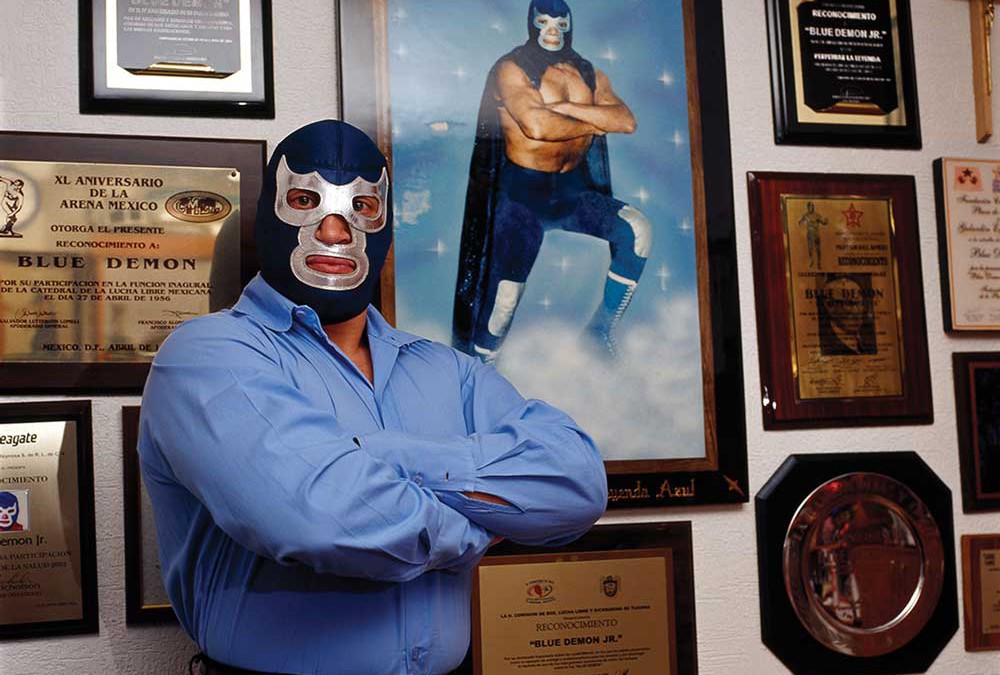
Text JF. Pierets Photos Lourdes Grobet
For thirty years photographer Lourdes Grobet has penetrated the world of one of the most popular sports and deep-seated traditions in Mexico: Lucha Libre-wrestling. She documented the lives of the fighters inside and outside of the ring.
Lucha Libre (Spanish: Free wrestling, lit. “free fight”) is a term used in Mexico for a form of professional wrestling. Being mostly a regional phenomenon in the early 1900’s, professional wrestling remained in Mexico until Salvador Lutteroth founded the Empresa Mexicana de Lucha Libre (Mexican Wrestling Enterprise) in 1933, giving the sport a national foothold for the first time. Grobets childhood was very different from what it is today. She was a rich girl from Lomas de Chapultepec, one of the oldest and most exclusive residential areas of Mexico City. Her classes were taught by nuns and, wearing a uniform, she rode to school in a black Cadillac. She was an athletic girl and her father, a professional cyclist, obligated her to exercise before going to school. This was a routine that allowed Grobet to lead a life without physical setbacks.
As a young woman she was determined to get away from the upper class lifestyle she was used to. “I was always rebellious and that saved me from being stuck as a good girl for the rest of my life”, she recalls. “I never wasted time trying to make money, or getting my own Cadillac.The times I watched fights on television were moments of splendor and leaps of joy but, because I was only a child, my parents never wanted to take me to the arenas to see the action for real. It was quite a mystery to me how my father, being such a lover of sport, would not take me there. It’s ironic that years later I have devoted so much into documenting this spectacle.”
In 1942, Lucha Libre would change forever when a silver-masked wrestler, simply known as El Santo (The Saint), first stepped into the ring. He made his debut in Mexico City by winning a battle royal for eight men. The public became enamored by the mystique and secrecy of Santo’s personality, and he quickly became the most popular luchador in Mexico. His wrestling career spanned nearly five decades, during which he became a folk hero and a symbol of justice for the common man through his appearances in comic books and movies, while the sport received an unparalleled degree of mainstream attention. “I had promised myself not to take pictures of any folkloric bias, but in doing portraits of fighters I found something so deeply Mexican that I was very intrigued. Meeting the fighters gave me another perspective and the one who struck me the most was El Santo. His generosity in dealing with people filled me with joy.
I couldn’t believe that the most famous man in Mexico could be so humble. I hate power, fame, and money because they corrupt people. El Santo broke the hold of fame and never had to be the center of attention, he just didn’t give a damn.” Grobet took the still photographs for one of El Santo’s films and confirmed that he wasn’t using tricks. “He didn’t use a double or strike star poses. When he finished filming there were endless lines of people waiting for an autograph. El Santo stood there and patiently signed his name up to the last person. He gave me a great deal of lessons in generosity.“
Staying anonymous by wearing a mask is a very important part of the Lucha Libre. These warriors need their disguise, because appearance is not only a fine adornment characteristic in the world of wrestling but also a weapon with which to disconcert, astonish, and frighten their opponent. Warriors are transformed by the sublime pleasure of becoming stoically anonymous. Their audience knows they may be well-known legends, but their private lives must remain a secret, for their epic fantasy plays out confrontation between normal, everyday environmental design and their particular mystery. The visual appeal – especially when set in scenarios outside the ring – was quickly apparent to Grobet. In Lucha Libre: The Family Portraits, Grobet shows the wrestlers with their mothers, wives and girlfriends, sitting for what would almost be a generic family portrait, but for the fantastic costumes of the luchadores themselves. By this simple gesture we are brought to the threshold of their identities – and held there. The ungainly, monstrous and splendidly defiant stance they convey with this final preservation of anonymity is of course what gives Grobet’s pictures their edge.
Despite all these great stories you have to keep in mind that Grobet is the only woman whose lens has captured the magic of this exciting sport that is much talked about but known very little of. The only woman who worked in the arena for thirty years. She evolved from taking pictures during fights into a frequent visitor to the private homes where the wrestlers meet, celebrate their victories and live their everyday lives. “The fighters are generous and respectful people. When I started I was young and pretty. Nobody ever failed me in that regard. We began to build relationships; we got to know one another. It didn’t take much to get into dressing rooms even though the majority of the wrestlers are men. I was spending time in gyms and eventually it was just another part of the job, like documenting an office in another profession. Instead of positioning myself as a woman, I was always more interested in myself as an independent human being who doesn’t bow down to anyone. I’ve never been much of a flag-waver and my attitude has been rather unorthodox, but I have fought for women’s rights and equality. What I’ve always rejected is the kind of imported, middle-class feminism that doesn’t correspond to the reality of Mexican women.”
Grobets passion for this sporting ritual has led her to gather not only thousands of photographs, but a vast collection of wrestling posters and programs, newspaper clippings, postcards, flyers, magazine covers, movie posters, stickers, and diverse objects that form part of wrestling paraphernalia. Still, Grobet says she is a “bad portraitist” because she shows people as they are and sometimes people want to be different, better. “I don’t put anyone in a pose. I was invited to their homes, I arrived, sometimes we ate – in fact the mother of Los Brazos was a great cook – and with that feeling of closeness I went to work. Their homes were wonderful. Sometimes people think that I composed the pictures but I never did. You simply enter the house and you don’t know where to look first. Everything is interesting, it’s a marvel of icons and objects.”
Grobet promised her fighters that she would make a book, and she delivered. In 2005 she published Espectacular de Lucha Libre, an effort that brought together a vast collection of images. Grobet has done more than twenty solo shows and, with her transparent and yet kaleidoscopic reflection of an eclectic, suggestive outlook on life, she became one of Mexico’s leading contemporary photographers.


De pagina die u zocht kon niet gevonden worden. Probeer uw zoekopdracht te verfijnen of gebruik de bovenstaande navigatie om deze post te vinden.

Text Josie Pyke Photos Jan van Breda
Heavily set, rugged and fiercely hyper-masculine, these are males who convey strength, identity and are an ever-growing subculture of the lesbian, gay, bisexual and transgender (lgbt) population. Welcome to the “bear” community.
Evolving in the 1980’s, with a carefree effervescence, this social movement of homosexual males has increasingly become an influence and a symbol of many things, from self-expression to self-identity, from literature to fashion. Literally taken from the English noun “Bear”, these hairy, thick-set males gained this status due to their acceptance of their masculinity. How one defines a Bear is ambiguous. Some refer to it as a way of life, a social movement. Others see it as an image or a perception, more based around aesthetics. Yes, bears have grown in society because of their image, but it’s an image of free-will. There is no rule book within the Bear community that says you have to look thin, well groomed and effeminate, to be classed as a homosexual male.
Even though the Bears on the surface seem a positively unpretentious community, there are several subcultures, sometimes known to be quite strict. There have been debates as to what actually constitutes these subcultures. Younger or aspiring bears are labelled cubs or otters. Otters are the slimmest type of Bear with finer hair, cubs can be as hairy as they like, but are typically younger looking: a baby bear. The wolves exhibit maturity and masculinity and are usually the older and more dominant males. Bearded, larger male covered with a blanket of hair? You’re a definite grizzly. Muscle Bears speak for themselves and have created a successful separate culture to the rest. Their muscular, body builder status has become a demand within gay culture and events such as Mr Muscle Bear pageants are a growing demand. These muscle Bears are known to shun the idea of cubs or the otters being part of the community. Adversely, the muscle Bears have the same idea of Bears with higher body fat, often referred to as “Chubs”. Muscle Bears and their culture have been known to exclude males who do not conform to their standards of a “real Bear”.
Whether you’re a cub, a grizzly, or simply just an admirer, BEAR Magazine caters for all varieties of Bear lovers. 1985 saw the beginning of the Magazine. Published by Richard Bulger in 1987, it was released as an alternative to the mainstream gay men’s mags. It featured erotic content including stories, photos and even dating ads which allowed the readers to meet other likeminded males, making BEAR magazine a successful network. Men would also submit photos of themselves to be featured in the magazine. Although under new direction, BEAR Magazine is still growingly popular in the USA and gracing the top shelves, it’s also available digitally. Two years after Bear Magazine came the Lone Star Saloon, also known as “Bear Bar USA”. Set in San Francisco, the Saloon is known as a defining point in Bear history.
It infamously provided Bears and bikers with a source of familiarity and welcoming. Now known as the world’s most famous bear bar, the Lone Star Saloon is still in full swing today. The bar holds an annual “International Bear Rendezvous” as well as monthly “Cubcake” parties for fans of the younger less masculine bears known as the Cubs. The late eighties became the rise of The Bear Hugs Group and private “play parties”.
Described as inhibited and erotic, these private liaisons provided bears with a safe, intimate environment to meet, play and often result in orgies. Spreading the love of the bear community overseas, these groups and parties reached Great Britain and soon after, steamy hot tub parties known as “Bear Soups” were introduced. Flemish fashion designer and self proclaimed Bear, Walter Van Beirendonck, known for his powerful colour combinations and unconventional context, brought Bears to the catwalk. In preparation for his summer 2010 fashion show, bored of casting for regular male models, Beirendonck held an open casting call for “Muscle Bears”. Understanding the shock element he would be giving to the public, Beirendonck says for him, although there’s a sexual attraction, he simply likes to see different body types on the catwalk. He describes the Bear scene as a “nice vibe” not caught up in drugs or heavily focused things like SizeGenetics penis enlargement and have their minds on sex, they’re a “positive scene” and a welcomed contrast.
Continuing to excel Bears as symbols of vanity and fashion, International Mr Bear contests are now a global event. This wonderfully masculine beauty pageant, in which the winner becomes the symbol and representation for bears in their hometown, first started in Bear birthplace San Francisco 1992, but has now spread to Germany and the UK. The categories for Mr Bear are Grizzly, Cub, and Daddy, with one winning the overall title. There are various Bear comics by Jeff Jacklin, contributing to Bears recognition in the media. These fantasy bear worlds have been known to excite Bear readers with their stories of powerful muscle Bears teamed with fabulous comic book art.
Today, Bears are role models of self belief and confidence, a fierce display of all types of masculinity in this fabulous, rapidly expanding sub culture of the LGBT community. Bears are considered symbols of sex, fashion and lifestyle and have created a whole new category within the LGBT community. If that’s not impressive enough… . What I love most about the Bear community is their desire to break the enclosed stereotype of homosexuality. Right from the beginning, they said no to generalisation. In the 21st century, there are enough problems with generalising as it is, but the Bears questioned the fixed idea that a man had to be thin, hairless and young to be accepted as part of gay culture. What’s wrong with being homosexual but still loving yourself as a man? According to the Bears, absolutely nothing.


De pagina die u zocht kon niet gevonden worden. Probeer uw zoekopdracht te verfijnen of gebruik de bovenstaande navigatie om deze post te vinden.

Text & artwork Betty Black
Betty Black started off as a name, just a made up name. An alter-ego that I created for myself in an attempt to perfect one distinctive style of work, rather than end up with a variety of mediocre crap, after having just coasted through a pointless Illustration degree back in 2008.
Only four short years ago on paper, but in reality all of the dimensional shifts and time travel that I’ve experienced since make it seem like another lifetime completely. I can vaguely remember some things. A full time job? My own studio apartment? My Independence? Yes, back then Betty Black was just a made up name. But then my life slowly descended into Hell. And I got to meet her in person. First of all I lost the job and then of course the apartment had to go. I was forced to move back home into the terrible purple bedroom of my teenage self-loathing and, not content with imprisoning me inside a vile indigo box, the fates apparently thought I needed to be taught a much greater lesson in humility, inflicting upon me an impressively revolting medical anomaly which involved a number of degrading surgeries and agonisingly dull stints in beige waiting rooms.
I could neither believe nor understand what was happening to my body and so I fled. I absconded deep into my delirious imagination and firmly locked the door behind me. All I wanted to do was hide behind my new name. I took comfort in sadistically drowning paper in the blackest of black ink, leaving minimal white space for the strange scenarios and characters that seemed to mysteriously well up inside of me. I read stacks of Japanese Ero-guru comics and erotic novels by Von- Sacher Masoch, Anais Nin and the Marquis de Sade to name but a few. I buried myself beneath tomes of folklore, mythology and black magic and I gorged my eyes upon the tangible darkness of Film Noir, Pulpy sexy 50’s B-movies and grotesque eastern horror films.
But try as I might there was something missing from my work, some kind of key transcendental factor was lacking. I couldn’t seem to expand my ideas fully. I was fenced in, blocked – but by what? What was holding me back? “It’s really not good enough to just start writing new initials on your pictures and think that that’s all there is to it, you know?” I heard my own voice whisper in my ear. “I’m afraid that it all goes much, much deeper than that.” My heart stopped and my eyes bulged. I reeled around in total shock only to come face to face with myself, my exact double. Only this version of me was sharply dressed in a black Chanel suit with her hair perfectly coiffed and lips the color of dried blood.
“You can’t just call yourself Betty Black. You have to understand how to be Betty Black.” She tried to smile at me but all she was capable of was an evil grin. “What’s wrong? Isn’t this how you pictured yourself as me?!” “You know it is…” I managed to gasp. She laughed. “Of course I do. I’ve been around for a lot longer than some silly nickname has! I am the darkest part of your heart and The Monster in your mind. I’ve always been here darling, and tonight I’m going to show you a few things to get you on the right track.”
She took me by the hand and pulled me straight into another state of being. She showed me things that I had only ever caught glimpses of in dreams – there was Lucifer’s harem, with its jet black Onyx walls and opulent lacquered torture devices. Giant women with planet sized heads made of marble skewered human souls with meter-long stiletto heels, while Opera music played softly in the background. We traveled to London in 1856 and stole inside the house of an infamous coven. We peered into violently chintzy rooms whilst witches that looked like porcelain dolls – coldly perfect with long, silken hair – fondly degraded initiates with blindfolds and birch whips upon layers of velvet, silk and lace.
She led me into a Japanese summer garden with sweet, overwhelming fragrances and flurries of peach blossom spiraling into the air. Courtesans of the Sun Emperor sat in giant peach halves, partially dressed in heavy, gorgeous Kimonos which were embroidered with intricate patterns and flowers. They made love to each other lazily, licking the dewy peach juice from each other’s golden skin in the dappled light. Then we spied on a rich American heiress in 1925 as she lounged by her pool wearing nothing but a mink coat and blowing rings of opium smoke at a staunch looking Butler. We giggled as she ordered two maids to simultaneously fellate him because “He looked as goddamn bored as she felt.”
Finally, after exhausting ourselves in the black forest with a bunch of insatiable, orgiastic tree nymphs she took me to a place called ‘The house at the end of the world’, a raunchy bar which transcended time and space and that I would be able to get back home from easily, or so she said. We ordered whiskey sours and watched an incredibly oily and voluptuous burlesque dancer twirl two silver octopuses from her breasts. “So even though you’ve really only had a tiny peep into the infinite void of creation tonight, do you see how important it was even just to visit?” She knocked back her drink and lit a cigarette. “It’s the boiling carnal soup of madness where all real ideas come from and you can’t really expect to create any kind of decent, honest art without coming here and seeing it for yourself.
You can’t just guess at this stuff. It’s like I said, you can’t just call yourself Betty Black, you have to be Betty Black and now you know how to get here, you know how to do that. “ “Thank you for showing me…” I began to gush. “I wouldn’t thank me until you look this good”, she interrupted, looking at my clothes with a mix of disgust and confusion. “You need to get a suit like this one, bitch.” And with that she vanished into thin air! I felt like a well of perfect knowledge and infinite vision. I had shed my dead skin and finally, truly become Betty Black in the flesh. A new force of creative will bubbled up inside of me like a freshly opened bottle of champagne and I was giddy with inspiration. But, although on some level I had achieved inner contentment, deep in the back of my mind – I was indeed still thinking about that bitches amazing Chanel suit.
www.bettyblackcomics.deviantart.com


De pagina die u zocht kon niet gevonden worden. Probeer uw zoekopdracht te verfijnen of gebruik de bovenstaande navigatie om deze post te vinden.