Geen Resultaten Gevonden
De pagina die u zocht kon niet gevonden worden. Probeer uw zoekopdracht te verfijnen of gebruik de bovenstaande navigatie om deze post te vinden.

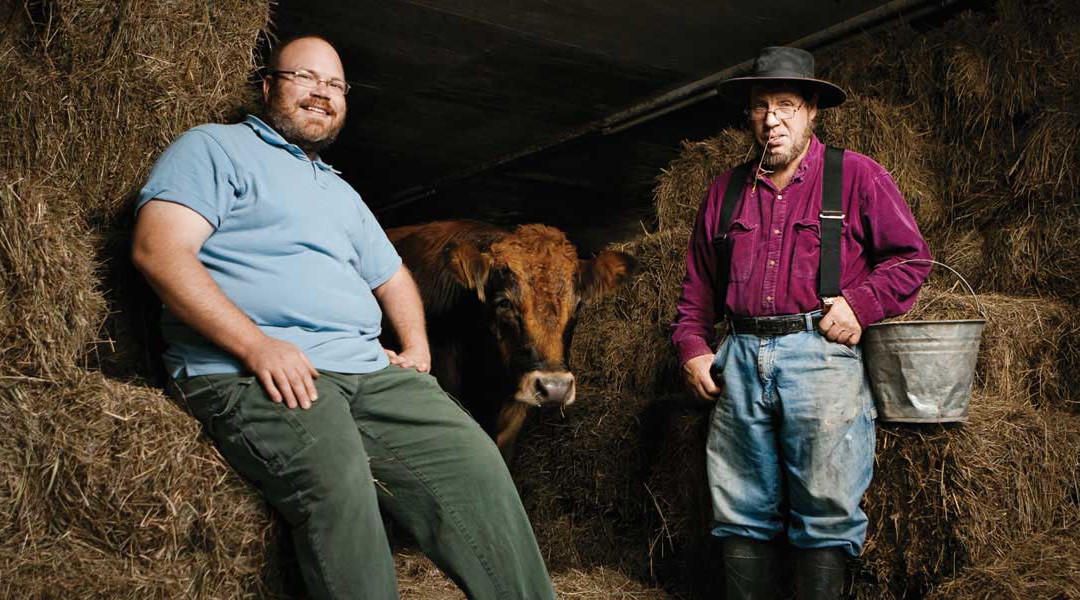
Text JF. Pierets Photos Scott Pasfield
Scott Pasfield celebrates diversity in this first-ever photographic survey of gay men in America. Stereotypes are laid to rest and an intimate, honest picture of contemporary gay life is revealed through stunning personal portraits and narratives of 140 gay men in all 50 states. Joyful and somber, reflective and celebratory. A rare and honest book.
Name Michael & Allen
Location Delta Junction, Alaska
My partner and I have been in Alaska for ten years. We own an eighty-acre ex-dairy farm that we are trying to resurrect. Since 2006, we’ve been building a large (some would say huge) two-story house right in the middle of it. We’re finally getting siding on this month! We’ve begun collecting milk cows; two are currently being milked, and two heifers were born this year. We’re also raising hogs and one of our sows had her second litter two weeks ago. The goats kept eating my garden, so I insisted they had to go. The farm looks out on the glorious Alaska Range, as well as the White Mountains and the Granites. Living here brings us closer to our dream of self-sufficiency. I work as an environmental specialist for the Army. I am also chief of the Delta Junction Rescue Squad, an unpaid volunteer position that takes up many hours. Allen works for the state during the summer as a park ranger and is the true farmer between the two of us. We’re two Southerners who moved here for my job. We were curious how such a small town would greet us, and discovered that everyone knew pretty much everything before we even got here. Small towns have no secrets – even if you want to keep them, which we did not. There was a week of polite but curious gossip and questions, and then nothing. Our lives as gay men here have been completely uneventful. In fact, it’s more like the movie Big Eden, where good-hearted, loving people have pushed us to share our lives with them in a way that completely surprised and overwhelmed me. For this reason alone, we are home.
Name Jakoury
Location Chester, Virginia
I live in what I would call a “retirement” town. There are lots of elderly people, everyone here is pretty conservative, and there are very few activities for people to do. When I entered high school I had just moved here from Atlanta, and it was an extreme change of pace for me. Everyone was quiet and tightly compacted into the stereotype of what was acceptable. I always knew I was gay, and in Atlanta I was slowly beginning to show it. I told my mother before we moved away and she was fine with it, but I was afraid to tell my father. He was a military man straight out of the country; I doubt he had ever come into contact with a sexual minority, let alone spend time with one. When we moved, we left my mother behind. They weren’t quite divorced and they weren’t quite together. I guess they assumed that moving away from each other would help them realize what they really wanted. When we got to Virginia I was excited about the fresh start; I could just come into school gay, no need for a back-story, no need to make friends, I could just be myself. I quickly found that being out of the closet wasn’t going to go over easy. Everyone in town was a carbon copy of each other. All the kids wore the same clothes and looked exactly the same. I forced myself to fit in, even carrying on relationships with girls from time to time. I was upset I had to act this way, to put up a front. During a visit to my mother, I told her how unhappy I was. She explained to me that if the people at my school couldn’t accept me as gay then they really weren’t my friends at all, and that I wouldn’t know those people ten years from now. She said I shouldn’t be something I’m not just to impress people. On the way back to Virginia I decided I would be an out gay male, probably the first my town had ever seen. It was a long ride back, and I told my father everything. At first he was uneasy, but he told me he was going to love me regardless. When I returned I cut my hair into a mohawk, got rid of all my masculine, loose-fitting clothes, and became more fashion-forward. I was on a high; I loved being myself. Unfortunately, other people didn’t. I was ridiculed, mocked, bullied, and harassed. People called me a faggot, wrote “fudgepacker” on my locker, and even threw things at me. Every night I would cry. I was so miserable. I got into fights and was beat up a few times. Someone vandalized my house, writing “faggot” across my front door. My father had enough. He put me in boxing classes and told me to stop being so passive. I spent the whole summer learning to defend myself. On the first day of tenth grade I got in a fight and made an example of the kid. If anyone insulted me I would curse them out so bad that they’d never want to utter another word to me. I became a bit of a bad-ass, but I was happy because people stopped bullying me and started looking up to me. More and more, boys started coming out of the closet, and became examples of how happy gay teens could be. I started a small gay student association at my school and became actively involved in a youth group for teenagers in the city. I’m not worried about fitting in anymore.
Name Jacques & Abi
Location Sacramento, California
I live in Sacramento with Abi, my partner of more than thirty years. We recently married in front of twenty of our closest friends. Abi is very fond of telling me how he first observed me, long before we actually met, paddling my kayak upstream on the American River, which flows through the community where we currently reside. We have lived together since we met on the disco dance floor in 1976, where we were both inventing our own moves and steps. Abi moved to Sacramento from Detroit in 1973, and enjoys a semi-retirement as an antiques dealer. He collects antique miniatures and dollhouses and has an intense passion for finding and arranging furnishings for our home, which is dramatically filled with our shared interests. My hobby is riding and restoring antique bicycles. Using a bicycle built in 1886, I have set a two-hundred-mile distance and time record in Europe, and a one-hundred-mile distance and time record in Australia. When I can pull him away, Abi and I enjoy traveling together to warm, exotic places.
I’m a bit of a maverick, a roamer, and a wanderer. The most stable time in my life was my childhood. Growing up in the Sierra Nevada Mountains in the small California town of Twain Harte, I spent all my time playing in the forest. We had miles and miles of woodland around us. As an adolescent I resented where I lived—it was too remote, too far from my friends. Now, as an adult, I envy those who are able to live and thrive there. I left home at eighteen and spent a few months in southern Oregon before returning to California to attend college, where I came out. After I graduated, I moved to San Diego, and learned all about computers and corporate life. I was young and eager to conquer the world, but after five years of living the gay lifestyle I longed to be back in the country. I found that just because I was gay didn’t mean that I had to conform to the city culture of gay life. San Diego had become too big for me and was not fulfilling on a spiritual level. I met a couple while on vacation who were moving to Austin and they suggested I take a look as a possible place to live. Texas was hot, but there were rolling hills and the people were friendly. I was living on four acres outside of Austin with a couple of friends, enjoying both the country and the many comforts that come with city life. Ultimately we lost the ranch to foreclosure, but I was able to turn what some saw as a tragedy into a dream come true. A few weeks before losing the house I bought a fifth wheel RV. I moved myself, my three dogs, and my cat into my escape pod. It has been two years since I made that move, and I have never been happier. I am now free to roam the country, taking my family and my home with me where ever I go. Native Americans had the right idea keeping their lives so mobile. There is nothing more liberating than coming home one day, hitching up the house, and moving on to another town miles away. The scene outside my windows changes regularly and I love the mobility. There truly is a different way of life for each of us, and I have found mine.
Name Trace
Location Orlando, Florida
I’m from the Deep South. I always knew I was gay. It was never a big issue for me. It didn’t affect the way I thought about myself or make me feel like any less of a man than the other guys at my school or the friends I grew up with. It never occurred to me that I had some need or desire to come out. Over time my family and friends realized I was gay, but there was no need to talk about that, any more than who my brother was dating, or the private lives of other family members. If someone feels the need to ask me directly about my sexual preference, I have a few responses. If you’re an important person in my life, I’ll say yes of course I’m gay. If I’m asked in connection to a civil rights issue, I’m happy to stand up and be counted as gay and fight for our rights, as I do for all civil liberties. If you’re a relative stranger and are prying, I take the Southerner’s approach by politely saying that it’s my personal business and has nothing to do with you.
Scott, what triggered you to make this book?
I wanted to make a book that I wished existed when I was a kid. To show that as a gay man, you can go anywhere and do anything.
When I think about being gay in America, I think of only a few progressive countries. What did you experience?
I think the gay world in America is certainly as diverse and varied as the straight world is. Slowly we are assimilating into mainstream culture and healing from all the discrimination that has been thrown our way. How that compares to the rest of the world, including other progressive countries, is still something I would like to investigate.
You chose to put all stereotypes aside. Why did you make that choice?
I tried to vary the men and stories as much as possible when selecting who to include. I felt it was important to do so, to be true to all types of gay men. Often only the a-listers get all the attention.
Why only men?
I chose to do this for many reasons, including healing from my own past. I saw it as a way to learn from other men who had gone through similar things. They opened up to me and felt comfortable doing so because I was one of them.
You travelled 54,000 miles across fifty states over a three-year span. You listened to stories and documented the lives of 140 gay men. What’s the most beautiful story you heard?
That is a tough one. Many of these men had such wonderful stories. I love Stephens’ in Miami who talks about coming out to his parents at a young age. They dragged him off to a psychiatrist who ended up telling the parents that they were the ones who needed therapy. Such a simple and wonderful tale, if only all of our parents were told so.
Can you tell me your own story? Coming out?
I write a little about my coming out in the book’s introduction. My father was a born again and on his third marriage when I told him. His belief was that I was doomed to go to hell and I should pray to change. Religion is the root of so much hatred and making this book certainly allowed me to see that I was not alone.
Where did you find your models and how did you contact them?
I put ads out on social media and dating sites, looking for guys who might be interested. It was very easy to sort out those men that truly wanted to take part in this. They had to believe in me and my mission and had to send me their ‘story’ before I would commit to photographing them.
What would you like to achieve with these pictures? What do you want the spectator to see?
I want to help educate those that struggle with their own sexuality and perhaps those that struggle with accepting gay men, perhaps even their own family members. We are all God’s children, all created equally. We all face the same issues.
The pictures are accompanied by essays. Do you find it important for people to know the story behind the models?
Absolutely. To hear their own words adds incredible depth to the portraits. The stories are as important as the photos.
You featured 50 states. Was it important to cover the entire country?
It was a goal I set for myself from the beginning and one of the parameters of the project. To look at the life of gay men in every state. I felt it was socially important to view the country as a whole.
As an artist, are you most narrator or photographer?
I have always been more of a photographer than a narrator, but that is changing in time. This project has made me realize how important storytelling is to my job as a photographer.
Why is such a project important for you personally?
To make a difference is something we all aspire to do. I saw this project as a chance to do just that.
Future plans?
My partner and I renovated and opened an Inn and restaurant in Vermont last year and have been having fun getting it up and running. Getting out of the city and challenging ourselves with something new has been a wonderful change of pace. Yet my heart still longs for more photo projects like Gay in America. I’m heading to Los Angeles soon for more work and am looking forward to what that will bring. It’s all about balance.


De pagina die u zocht kon niet gevonden worden. Probeer uw zoekopdracht te verfijnen of gebruik de bovenstaande navigatie om deze post te vinden.
>

Text JF. Pierets Photos Steve Rosenfield
The ‘What I Be’ project by photographer Steve Rosenfield almost sounds like the Et Alors? Magazine mission statement. It’s a global movement about honesty and empowerment. People pose with text written all over their face and arms. Starting with ‘I am not my…’ they courageously reveal their deepest non-‘standard’ state of mind, uncertainties and fears. Rosenfield started this project in the hope to open up the lines of communication. To help everyone accept diversity with an open mind and heart. Needless to say we like every image of it.
The What I Be – project rose out of personal experience, or can we call it necessity?
About 12 years ago, I was working as a network administrator at a big computer company in Boston, MA. I was a very opinionated and materialistic person with a huge ego and I thought being successful meant having a 9 to 5 and making a ton of money. I never shared my feelings or insecurities because I was scared of how I would look to others. I never opened up and that created a lack in my relationships where people were scared to open up to me because they saw me as ‘blunt’. I eventually started to realize how unhappy I truly was. I started reading and journaling and further understanding that, in order to be happy, I needed to be more open and honest with people. I needed to be more compassionate which, in turn, made people feel safe around me. I quit my 9 to 5 in 2002 and started traveling and rock climbing until eventually planting my feet in California in February 2006.
You make it sound very easy. Wasn’t it weird to go from a 9 to 5 to a state of absolute freedom?
Oh of course, but it was a breath of fresh air. I mean, I was scared to just drop everything but I’m a firm believer that everything will work itself out the way it needs to.
How did you start photographing?
I got into photography through my dear friend Boz, whom I met while rock climbing in France. He was photographing the crew and I was immediately inspired by everything he was capturing. I bought my first camera in 2006 and started taking photos of everything. Shortly after, I saw Michael Franti and Spearhead live in concert in Canada. I loved the vibe and quickly became friends with the entire band. I asked if I could take photos at some of their shows and so began my photography work around concerts of various bands. Thanks to the opportunity Michael gave me, I have shot countless other bands since.
When did you set up the What I Be – project?
The project physically started in 2010 when I was talking with a friend about an idea on sharing people’s insecurities without literally showing them, on how I could possibly turn it into an empowering photography project. I decided that night that I wanted to photograph my friend with her insecurity written somewhere on her face or hands. As a way to boldly displaying her greatest insecurity on her skin, combined with a fearless stare into the lens. I wrote ‘thunder thighs’ on Amanda’s hand. Alongside the photograph she came up with the statement, ‘I am not my body image’. The What I Be – project was born.
What where the main reasons to fancy such a project?
Being able to photograph people and make a living off it was so amazing that I wanted to do something that had more meaning. Something that would touch peoples souls.
I guess you can’t have any judgment when you start a project like this.
I tried to have no judgments towards the people I was meeting. Tried to see no ‘flaws’ because I had made myself aware of the fact that we all struggle, we all have our insecurities.
You called it a social experiment. Can you elaborate?
The What I Be – project is a social experiment turned into, what is now, a global movement about honesty and empowerment. In today’s society, we are often told to look or act a certain way. If we differ from these ‘standards’, we are often judged, ridiculed, bullied and sometimes even killed over them. I started this project in the hope to open up the lines of communication. To help everyone accept diversity with an open mind and heart.
Do you have the feeling there are still many taboos?
There will always be things to find out. There are so many things I don’t even know exist. I learn a lot through the project as well. People teach me so much.
Where does the name ‘What I Be’ came from?
The project was pulled from non other than my friend Michael Franti. I was always inspired by the lyrics of Franti. His depth and meaning behind each song. He is the epitome of a powerful musician, activist and poet. Michael’s song, ‘What I Be’ is basically all about being who you are and being the best you that you can be. I loved the song and decided that the meaning behind it completely fitted the project.
Who is collaborating on such a project?
Participants range from high school students and Ivy League masses to some well-known names in the entertainment industry. Subjects are putting their insecurities out in the open, exposing a side of themselves that nobody has seen before. By stating, ‘I am not my_____,’ they are claiming that they do in fact struggle with these issues, but it does not define who they are as a person. It is used to spread awareness on what people go through due to society’s paved roads. These are serious issues that some of us can live with, but most battle on a day-to-day basis. Each person that takes part in the What I Be – Project is extremely courageous. The What I Be experience is cathartic and universally empowering. Each portrait is immortalized for the entire world to see.
What’s the most intriguing story you have heard during this project?
They’re all intriguing. They all have the same importance to me. I have sat down with each and every person and they trust me with their story. That’s the most intriguing part.
What do you expect your viewers to feel, to see?
I encourage every viewer to look at each image and put themselves in the individual’s shoes. By allowing yourself to feel what they feel, you might realize something you’ve never noticed before. If you don’t understand someone’s message, stay tuned. To eliminate any confusion, each participant will be writing a 500 words or less statement explaining how their insecurity has affected their life. Some of the faces you may recognize, some you may not. Take the time to connect with each one. You may see yourself within one of the photos.
What would you write on your self-portrait?
You’ll have to wait until the book to see that!


De pagina die u zocht kon niet gevonden worden. Probeer uw zoekopdracht te verfijnen of gebruik de bovenstaande navigatie om deze post te vinden.

Text JF. Pierets
Despite being a biological woman, she dresses as a super, fabulous, over the top version of a girl. So yes, she’s a drag artist. Yet not a queen or a faux queen; ‘there’s nothing fake about me!’ She prefers to be called a Tranny with a Fanny or Drag Goddess and her aesthetic is 80’s big hair, clashing colors, animal print, Divine and Jackie Beat. ‘I’m too freaky to be mainstream’. A conversation about expression, freedom, fun and a very long time spent in-front of a mirror.
I guess everyone starts with this question but nevertheless: the tranny with the fanny?
I was Holestar, the artist at first. Being the Tranny with a Fanny was a gender bending idea born out of frustration with drag queens being misogynist and vile about women. Feminism gave women many fabulous freedoms but it killed off a lot of glamour. My aim was to reclaim over the top fabulousness and exaggerated femininity to the female body. I was initially called the ‘cock-in-a-frock-without-a-cock’ for a while but it’s a bit of a mouthful.
When did you realize you wanted to be a dragqueen? By the way, I’ve read it’s called Faux Queen?
My American sisters call themselves Faux Queens but I’m not fake anything honey. I like the term Drag Goddess. A goddess is higher than a queen isn’t it? Being a drag starlet was supposed to be a one off art piece, but I met a DJ who wanted me to MC with him. He thought it was a good idea to workshop the idea in front of an audience and it took off. Eleven years later, I’m still spending hours in front of a mirror for art and the entertainment of others.
You ever considered surgery?
Hell no. I don’t buy into the so-called western ideal of what someone is supposed to look like to be considered attractive. I like my transformations to be temporary. I’m full of imperfections but love who I am, lumps, bumps and all. Never say never though. There could come a time when I go for the full Wildenstein.
How do the male to female queens react on your appearance?
Most of them are fine and ok with it as I tend to play and perform on the alternative scene where black and white gender expression is less of an issue. However there are a few girls who have been bitchy or aggressive, as if I’m stepping on their toes. They’re frequently the ones with no talent and or anything interesting to say. Que Sera Sera.
I’ve seen your make-up tutorial for Beige and I wondered; who’s the girl behind the make-up.
I grew up all over England and left school with no qualifications as I’d discovered sex, drugs and dance music. I spent two years in the British army, worked as a professional dominatrix for ten years, discovered art, moved to Vienna, became the Tranny with a Fanny, moved to London and got a Fine Art Masters at Central St Martins. I’m now a DJ, writer, artist, singer, Mistress of Ceremonies, club promoter. Lover not a fighter.
What do you do next to performing and making music? Do you have any hobbies or is everything Holestar related?
Drag and creativity consumes so much of my time. Pretty much everything I’m interested in (art, film, LGBTQ issues, music, performance) is part of what I do as a performer so there’s not much left outside if it. I’m quite quiet in everyday life, an introverted extrovert. I love my dog, travel, watching trash TV, cake.
You’re one of the people behind Hot Laser. Can you tell me about the movie?
I founded the documentary ‘Hot Mess/Dress As A Girl’, around six years ago. The East London alternative scene performs every year at the NYC Downlow at Glastonbury Festival and one year I thought; someone should be filming this. I approached my friend Colin Rothbart to direct a British version of Paris is Burning and we now have five years’ worth of footage that is currently being edited. We need a lot more funding to complete it though. It’s an honest film about how fabulous dressing up and performing can be, but also how human we are underneath it all. My aim is for at least one queer person to view the film, see that they’re not the only one who is different from heteronormative or mainstream gay society and that’s perfectly ok. They can be whoever they want to be, come through all manners of adversity to accept and be comfortable with whom they are.
Do you want to get a message out there?
Love yourself. Be the best you can be. Don’t be shady, be a lady. The biggest love affair you should ever have is with yourself. Queer people have come a long way in the west but there is still work to do. We need to stop bitching among ourselves and help, love and encourage each other more.
Lots of love…for everybody!


De pagina die u zocht kon niet gevonden worden. Probeer uw zoekopdracht te verfijnen of gebruik de bovenstaande navigatie om deze post te vinden.

Text & photos JF. Pierets
Wham!, Boom! and Pow! Pop art is alive and happening and living in Rotterdam. Living amongst posters of Divine, plastic flowers and with a soft spot for John Waters. We talk to painter Peter Popart Radder in his gorgeous house filled with glamour and glitter artifacts. We like!
Off you go.
I started off as a visual merchandiser and window display creator. After 20 years I decided to fulltime spend my days on painting. I used to make decorations and I always wanted to paint, so here we are.
Out of the closet.
I had my coming out at about 16 and I was lucky enough to fall upon the movie ‘Outrageous’. A movie from ’77 about a frustrated hairdresser. He does hair and makeup for the local drag shows but longs to get up on stage himself. I absolutely loved all those movie characters and longed to meet that kind of scene. When you’re only 16, you need something that triggers you to believe in the future. For me it was that movie. Funny to think that my life evolved in a way that I‘m actually around people who are that weird. Hurray!
Back in the days.
I seems like everything was a bit crazier back then. Take for example Studio 54 or club RoXY or IT in Amsterdam. The atmosphere breathes way more freedom than there is nowadays. I’ve been, and still go to quite some parties, experiencing some very cool stuff. But somethings it feels like you’re undergoing a copy from a copy from yet another copy. We’re living in a very tame era. When I enter a gay bar I see people staring at their mobile phones. That’s not what you call; having a wild time. Everything is quite mediocre. But then again, everything has its own particular wave motion.
Bang!
I’ve always been attracted to pop art. I love Warhol, Haring and Lichtenstein and I wanted to make something that I would like to hang on my own walls. You could say that I’m born in the wrong era but I like the fact that some of my work’s spectators, think they are made in the ‘70’s. I like that. Making new things with a retro touch.
Hello Dolly.
My inspiration mostly comes from pop culture, but also from old Hollywood movies, fashion disasters, record covers and disco video clips, you name it. Since I was a child I always wanted to see things that were of the ordinary. Not many weird things happened around me in the early ‘70’s yet I could always find my taste in tv music shows which, in those days, broadcasted clips from The Sweet, David Bowie and Amanda Lear. My preference inclined glamrock videos and the clothes they wore in them. It was pretty amazing to me as a kid.
Lights on.
I had and have quite some exhibitions. One of my favorites was ‘The Non Issue’ in Amsterdam, together with artist Martin C. De Waal. A combination between an expo and a fashion show. I don’t know if I’m aiming for some specific ambition. I love to paint and it’s great if people like my paintings. And of course it would be wonderful to get featured in MoMa, but who wouldn’t like that.
Big Lesbian.
Next to being a painter I also work as a dj. Our formation is called Thunderpussy and DD King. Needless to say people always expect to see a huge lesbian. We Dj at all kind of different gay parties like Flique and Dee Dee’s Dollhouse. This summer we will perform during Gay Pride on the SIN boat at the Amsterdam Canal Parade.
What’s in a name?
I don’t particularly feel like a gay painter. Do you think my paintings look gay? Ok, the work is very flamboyant and in your face. Some spectators think they are all transvestites instead of women. But that’s alright by me. As long as they are having fun. And yes, maybe it’s a little gay. But let’s say I never thought about it. I’m an artiste darling!
Role models.
My latest series of drawings is based on the fact that there is pretty much fuzz regarding gay rights nowadays. And I’m referring to Russia. After watching the two part BBC documentary ‘Stephen Fry Out There’, I was stunned and shocked by all the vicious homophobia on our little planet! I decided to prove all the haters wrong and celebrate those wacky weird wild and wonderful LGBT people who make and made this world so much more exciting and interesting. There have been so many gay icons in the course of history from which some people don’t even now they were gay.
Fast Forward.
I live one day at the time. Having fun, paint and we’ll see about the rest. There are so many nasty things happening that I want to try to make everyday a party. Seize the day!


De pagina die u zocht kon niet gevonden worden. Probeer uw zoekopdracht te verfijnen of gebruik de bovenstaande navigatie om deze post te vinden.

Text JF. Pierets Artwork Lynn Bianchi
Lynn Bianchi is a New York City-based fine art photographer and multi-media artist who has shown work in over thirty solo exhibitions and in museums worldwide. Her photographic art has been featured in over forty publications. Bianchi’s Heavy in White series was inspired by body-consciousness, and the desire to create a fantasy world where women could break free of self-criticism. Small and heavy women celebrate nude while eating and dressing, existing in the moment, challenging societal ideals on weight, beauty and sexuality. The Heavy in White women are not trying to impress or perform. They play dress-up and eat with relish, celebrating their sexuality without trying to be something other than what they are.
Your series ‘Heavy in White’ is right up our alley regarding diversity and a different view on beauty. How did you come up with the idea?
One time, I went to a Whitney biennial exhibition and I saw lots of tables covered with what looked like garbage. They said it was art. Then I went to MoMA. I saw the Impressionist paintings: Monet, Cézanne,… Coincidentally, tables were involved again: beautiful still-life paintings, gorgeous table settings in the impressionist paintings. I went from garbage to beautiful fruits and flowers. After the Whitney exhibits I was very much impressed by the clash of opposites. I thought to myself: I can do that. But what is it that I Iike? I like white. I also could use tables. So tables led to food, food led to body image. Then I wanted a heavy model. And that’s how it started.
Why did you choose to put them in a neoclassic setting?
I guess I’m a neoclassicist inside. One isn’t always in charge of what comes out of ones mind.
Which artist inspires you?
No artist in particular. I’m inspired by my own life experience and by life itself.
How about the models? Were they as positively body-conscious as you wished them to be?
Not necessarily. Being a woman myself, I know that most of us are not satisfied with our bodies, no matter how close to – according to today’s standards – perfection we are. In any case, the photo sessions took away a great deal of the self-consciousness that my models were feeling towards their bodies. For example; I photographed one woman who was bulimic. After our photo sessions, she was able to overcome her bulimia. The sessions were like facing one’s worst fears. Nobody felt self-conscious because the idea of any specific individual or identity was of so little importance compared to the task at hand. The models did not actually lose their identity, however, but rather their sense of ‘self’ was allowed to submerge into the collective. Each model became an important part of the bigger pictures. The photographs weren’t about one individual but spoke of something deep inside each one of them.
How important is diversity in your work?
I love diversity. It’s never boring. It’s life.
It looks like all those women have a lot of fun. Was it a pleasure to shoot them?
Absolutely! The models weren’t self-conscious. Quite the opposite. They were given one task; to eat. And while doing that, they forgot to be in control. They became a monumental sculpture. An exchange of beauty occurred. It was a harmony of shapes and forms. Then came the acceptance of the differences between all of us. It was the best fun.
Why did you want them to eat?
Because that’s what we do every day; we eat and we suffer, we don’t eat and we suffer. You want to eat but you don’t want it to show. But at the core, it is a pleasure to eat. It is a very social thing, too. People get together to eat and have a good time.
Your pictures are very physical. How do you accomplish that feeling?
I just show what’s in front of me. And again; life is very physical.
What do you want your spectators to see?
I want people to see the joy of living, in and of itself. I’m showing them one of their fears, for example the fear of being too fat. But there is a sense of commonality in the nudity and once the differences are exposed, they are more beautiful than scary.
Are you, yourself, free from self-criticism?
I have to say with laughter: no! Absolutely not!
How do you define beauty?
From inside out. Beauty is something that shines through. Physical beauty is pretty to look at, but it disappears quickly if there is nothing much to support it. Beauty is the joy of living.


De pagina die u zocht kon niet gevonden worden. Probeer uw zoekopdracht te verfijnen of gebruik de bovenstaande navigatie om deze post te vinden.