Geen Resultaten Gevonden
De pagina die u zocht kon niet gevonden worden. Probeer uw zoekopdracht te verfijnen of gebruik de bovenstaande navigatie om deze post te vinden.


Text JF. Pierets Artwork AMVK
Anne-Mie Van Kerckhoven is known for creating a diverse body of work in painting, sculpture and installation that has made her among the most important Belgian artists of her generation. She embraces a complex array of subjects, including alchemy, mythology, artificial intelligence and mystical scriptures from the past, working with the conviction that her work can someday answer the question if we, or if we don’t possess a soul. AMVK uses existing images in a disjunctive and semi-coherent way that only make full sense in the work’s final moment, when all the layers are combined together. Her career remains a subject of fascination and understandably so, because far from the mainstream circuit, she’s busy blazing her own conceptual trail. Her relationship with creativity is raw, almost primitive in its absence of compromise or concession. We meet Anne-Mie in her beautiful atelier in Antwerp, filled with books, work in progress and nude magazines. A conversation about reincarnation, porn and the urge to draw.
Your work contains contemporary issues regarding technology and sexuality while sourcing material from the past. Why this thirst for history?
Let’s start at the beginning. More than 10 years ago I’ve bought a book called ‘La science du bien et du mal’ by Victor Géhant that was written in 1848. In this book he’s searching for the connections between the fact that we are sleeping, the fact that we divide good and evil and the fact that we are convinced of having a soul. Afterwards it seemed that this book was based on the intellectual legacy of Marguerite Porete, a French mystic who died in 1310. We’re talking about the end of the ’90s so I had to search a long time before I could find ‘Le Miroir des Âmes Simples et Anéanties’ – ‘The mirror of the simple souls’. One of the last romans chevalier and one of the first mysterienspiele. The title of Porete’s book refers to the simple soul, which is united with God and has no will, other than God’s own, a spiritual dealing with the workings of Divine Love. She was burnt at the stake for heresy in Paris in 1310 after a lengthy trial, when refusing to remove her book from circulation or recant her views. It was only until 1965, when the original Old French version of ‘Le Miroir des âmes simples’ got published, that Porete’s status became one of the greatest of Medieval Mystics, as one of the most visionary exponents of the Love Mysticism of Beguine spirituality. When I read this book I felt like dropping down, I felt that I was her reincarnation.
How did this epiphany influence your work?
It was only when I finished my Headnurse project (96 women’s bodies combined with 96 terminologies taken from books on artificial intelligence. Ref.) I realized that this mystic, Marguerite Porete, had the same issues, the same pain as I have: the agony of a huge duality between my heart and my head. In 2005 I made a trialogue between Porete, Giordano Bruno, an astronomer, and Marcuse, who wrote ‘Eros et civilisation’, because those three people are also suffering from the same pain. I made drawings inspired by this trialogue and named it ‘I’ll Rob You’. I’ve been working on the subject ever since.
Are you heading towards a point where you can bring it all together?
Yes. It’s quite an ambitious project and sometimes my head can’t stop spinning but lately there are moments in which things start to fall into place.
You once stated that every piece of work you create is a survival mechanism.
Every period in my life is outlined by a series of entities that automatically evolve into a specific theme. By using these themes in my work, I’m able to control them, able to give them a logical position in my life. You can say I translate or canalize my inner process into an exterior three-dimensional structure.
When do you stop reading and start to work?
I do everything at the same time. I have concentration issues so most of the time it turns out that I’m drawing while reading, using the lyrics in my work. I make all different kinds of work at the same time. I need my drawings to place basic things such as anger, and grief.I can’t plant that in my bigger work.
You make all sorts of work. Paintings, sculptures, installations, you name it. You were never interested in sticking to one thing?
Some people used to complain about the fact that I make too much and all too different, but that’s who I am and what I am. Let’s say I have a wild creativity. From morning till night, it never stops. Picasso was also like this and I don’t hear anyone complain about him.
Does the slightly soft porn aspect of your work cause eyebrows to be raised?
You’re referring to the fact that my work is often called obscene. I have this big amount of nude magazines dating to the sexual revolution. In those magazines I find a lot of hidden filters to work with. Starting from those pictures I’m able to explain and deal with contemporary human or social issues. My choice of images is mostly based on false feelings of indignation. They haunt me with their nasty sort of beauty. It happens that they stick to me for 10 years or more before I’m able to really deal with them. In their innocence they touch something very deep and vital. For instance look at this scene (shows a 50’s black and white image of a woman playfully hanging on a rope in an artists’ studio. Ref.), why is she hanging there like this, what was that photographer thinking? To me the whole scene hides an essential urge from both sides of the lens, even with that retouched pubic hair. I find these women and the way they are depicted extremely beautiful too. The big challenge is to combine a tantalising image with peevishness and try to end up with something new that is meaningful and interesting.
Those 50’s images are quite harmless compared to contemporary porn. Are you even more annoyed when you look at this evolution?
I hardly buy those kinds of magazines because they are too simple-minded, too focused on one thing. But new kinds of sources do inspire me. For instance a year ago I found a magazine printed in 2000 with a lot of white and red rubber and women in funny scenes, with furry donkey ears. Very inspiring, I love it. I have also this thing with plastic, from when I was a kid. Lately I worked a lot with Sleek magazine with its homoerotic- and sado-masochistic images, flirting again with nazi-imagery, dark heavy leather, and bearded sexy men with an Arabic touch, in skirts. And again, quasi-silly. I find this all interesting and double because these magazines pretend merely to exist to sell clothes.
It sounds like you have the fierce need to push the limits of your inspiration?
Connecting sex and technology has always been my main activity as an artist . I am intrigued why naked women are portrayed, but on the other hand I’m also truly inspired by all things regarding the synthetic; thermodynamical laws and outer space issues. I had that since I was a child. I work with computers since 1977. I’m a pioneer when it comes to that. When I studied at the art academy we had a lot of contact with students who were both aspirant scientists as well as musicians. Performers. By that time I got very well acquainted with Luc Steels, who later started the laboratory of artificial intelligence (AI) at the VUB in Brussels, and it is thanks to him that I could start working with computers so early. I made my first movie on a very rigid piece of machinery that could only go black and white and was hugely pixelated.
What interested me from the start is that you can keep on working in different layers, which you can manipulate apart from each other, without focusing on a final result. And of course I loved drawing my naked women on these highly sophisticated machines. Something quite unusual to be done in the sterility of an AI-lab. The symbolic gesture of it was a statement and of big importance to me at the time.
What’s so interesting about artificial intelligence?
I always had this hunger for consuming science, as an outsider. I had a subscription on ‘The New Scientist’ as a student. In the beginning of the 80’s AI kept on searching for the essence of what defines human beings. Things like: what is intelligence, what is creativity, and how they related to each other. The books on knowledge representation reflected a modern kind of theology to me. AI used psychology and philosophy research and terminology, in order to develop new insights and to compact the abstract. At a certain moment the trail somewhat fell apart on the idea that language was the thing that made us more intelligent than other species. Later they decided that it is the complexity of human social structures that made us develop technologies as we do. As an artist I quickly knew I was more mesmerized by all things evolutionary, new ideas and new perceptions instead of art itself. Include my distrust towards the art world, because there were so few female examples, hardly any women to be found in art history books, and I soon felt much more liberated being creative in an atmosphere of science, logic and future.
How long did it take to find your path?
Not very long. As soon as I left the academy I started reading De Sade and Wittgenstein. This, combined with The New Scientist magazine, really influenced my choices.
Is there something you are looking for?
I’m not necessarily looking for something but I’m trying to make connections. I’m very conscious about all those different significance layers in reality and I like creating things that places everything back in perspective. That doesn’t exist in real life but it does in my work. Maybe it’s because I read a lot of fairy tales when I was young.
You talked earlier about the lack of women in the art world. Do you feel in place?
I consider myself a stand-alone. The past 10 years I thought a lot about it, but recently I decided to stop doing that. It starts to get too upsetting. The art world is mostly ruled by men. You have to have that certain mentality that when you find something that works, you stick to it. You are constantly supposed to stimulate the surroundings by shouting: look at me, look at my work, I’m the only thing that matters. You have to have an obese ego and I loathe it. I don’t know how this works with the younger generation of female artists. Maybe it has to do with the way I am brought up as a woman, that I keep other people as much in account as I do myself. For me the way I do it though is the only way I want it.
Do you find it important what people think about your work?
I’m very much interested in what people think about my work but I don’t take their judgments into account. When you work on something in your studio, you have a very intimate contact with your creation. You are in fact your work. From the moment you share it with another person you start looking through his or her eyes and your work has already changed by then. So it’s very important with whom I’m watching. After a while you let go, but in the beginning it’s essential.
And the final question; do you like living in Antwerp?
I do, I have a wonderful atelier here and Antwerp has a good vibe. I guess that’s why there are so many great artists living here. The only thing that bothers me is the lack of good spots to party, to dance. Since I’m also a DJ, maybe I’ll have to start one myself. Anyone interested?


De pagina die u zocht kon niet gevonden worden. Probeer uw zoekopdracht te verfijnen of gebruik de bovenstaande navigatie om deze post te vinden.
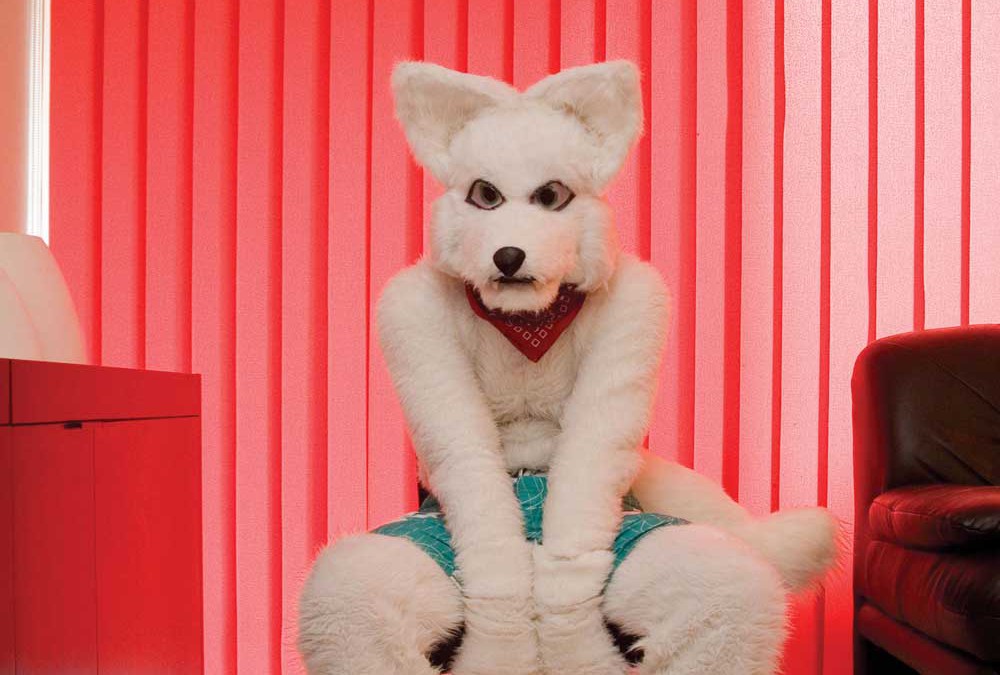
Text JF. Pierets Photos Charlotte Lybeer
From 2003 until 2008, Charlotte Lybeer photographed gated communities and actual “theme parks” in the US, South Africa, Europe, China and the Arab Emirates. ‘The success of these ‘enclaves’ proves that in a society without boundaries, we still desire controllability. It seems that happiness is only possible in an artificial reality where everything is under control of its makers. An architectural décor is being built; a scene in which the inhabitants step away from everyday reality.’
Charlotte Lybeer studied photography at the Academy of Fine Arts Ghent and the HISK in Antwerp. For the series ‘The furtastic adventures of the cabbit and the folf’ she submerged in the world of furries. ‘Each of my series is a logical continuation of the previous one. In this case it was a continuation of ‘Larp, taking a holiday from everydayness’ from 2009. A series of portraits from LARP (Life Action Role Playing) players.
Charlotte uses photography to research the capsular aspects of our society. In her projects Lybeer takes an aesthetic, as well as a social look at people who form groups and/or separate themselves from others. In this case; Furries. The furry fandom is a subculture interested in fictional anthropomorphic animal characters with human personalities and characteristics like intelligence, facial expressions, the ability to speak, to walk on two legs and wear clothes. During the 1980s, furry fans began to publish fanzines, developing a diverse social group that eventually began to schedule social gatherings. By 1987, there was sufficient interest to stage the first furry convention and throughout the next decade, the Internet became accessible to the general population.
To create ‘The furtastic adventures of the cabbit and the folf’, Charlotte had to infiltrate into its fandom. ‘I became a member of different forums and online communities related on the subject matter and went to conventions in England and Germany. They’re gathering yearly in large hotels which they rent for private use.’ For this series the individuals were taken out of their safe groups and placed into their personal and intimate habitats. The contrast between the costume, which the person uses to tell us something about his or hers virtual identity, and the homey interior is an approach rarely to be seen. The setting reveals the personal identity and daily reality of the player, yet he is still in character.
Gaining those people their trust is a tour de force since they are often described as freaks in mainstream media. ‘The hardest part of this project was gaining that trust. If it would have been easy, there would be much more series like this. The first step was to become a member of the group and talk openly and clear about my work and what I wanted to achieve. The second part was to prove that I was serious on the subject matter. That can be achieved by being humorous without being flippant. The hardest part was to get personal so they would trust me enough to let me into their houses.’
‘The furtastic adventures of the cabbit and the folf’ is part of Charlottes project to get her doctors degree. It’s called ‘Lifestyle Supermarket’. She’s photographing different fandoms that are related to virtual, three-dimensional worlds such as Second Life, in which players can create a second identity. ‘It’s a very intriguing given. People can transform themselves into a superhero, a monster or and animal with human characteristics such as furries. The unique feature of these fandoms is, that these trans human identities are nowadays also assumed outside the virtual world. For me, those are examples of how contemporary men tries to fit in the image imposed by mass media such as movies and games. All my projects are inspired by how people react in a world that is changing. Not only geographical, but also on an imaginary level.’


De pagina die u zocht kon niet gevonden worden. Probeer uw zoekopdracht te verfijnen of gebruik de bovenstaande navigatie om deze post te vinden.

Text JF. Pierets Artwork Paul Boudens
Originally, Paul Boudens wanted to become a fashion designer when he first set foot in Antwerp. Yet fate decided differently (he flunked his entrance exam) and nowadays he’s one of the most wanted graphic designers working together with the Antwerp Fashion Museum and icons like Walter Van Beirendonck and Haider Ackermann. We catch up with him just as he returns from the Otis College of Art and Design in LA.
I read you were in LA for a “provocative discussion about the creation, reinterpretation, and presentation of fashion”. Did you also have some fun?
Yes, we had a LOT of fun! Last year, Otis asked me to run some workshops with the students, but after sending some e-mails back and forth, I wondered if it wouldn’t be cool to take designer Walter Van Beirendonck, photographer Ronald Stoops and make-up artist Inge Grognard along with me. That way we had the four-leaf clover of Antwerp fashion: a fashion designer, a photographer, a make-up artist, and a graphic designer. Otis instantly loved the idea, and even involved the School of the Art Institute of Chicago (SAIC) so it turned out to be quite a tour.
Antwerp was put on the fashion map in 1988. How did that happen?
Well, if I remember correctly: six graduates of the Fashion Department of the Antwerp Royal Academy staged a group fashion show at London Fashion Week. The British press called them the “Antwerp Six” and turned Flemish fashion into a (inter)national phenomenon.
And fashion has become the fourth largest industry in Antwerp since then.
It’s amazing how much talent we have over here.
You work with Walter Van Beirendonck for over three decades now. Was it a well-considered decision?
Not at all. I rolled in by accident. He asked me to create prints for his T-shirts in 1989. I was in my third year of Graphic Design and Illustration. We’ve been working together ever since. His work explores challenging social issues and ignores conventional trends. It’s great working with this kind of explosive energy.
And quickly your fluorescent colors and exciting invitations attracted the attention of other designers. Isn’t it difficult to work for and with so many different creative people?
In the beginning we had a blast kicking all things sacred and bourgeois. Something that came both out of rebellion as out of inability, I must say: the folly of youth! Or the ignorance and arrogance, of course. (laughs) As time goes by you develop a kind of empathic skill and I discovered that I’m good in translating what a designer wants or likes to see, without losing my own persona.
Nevertheless you describe your work as ‘classic with a schizophrenic twist’.
You have to: that’s how you become when working with so many different people. (laughs)
The punk twist has become partly one of your signatures and your work communicates a strong vision. Is it possible to hold onto your outspoken style in an industry saturated by hype?
I never was a punk, you know. But, most designers create an aesthetic through a certain photographic vocabulary that is already very strong. There’s no reason for me to re-invent that. The image has to stay close to what they are standing for. But they trust me enough to play around with their ‘vocabulary’.
Don’t you ever feel frustrated not having more to do with the principle image?
No. I love working in the shadow of a fashion designer, helping to expand their vision. Once in a while, I venture out into the limelight, but it quickly bores me. I’m perfectly happy where I am and with what I do.
In the meantime, you can add Dries Van Noten, Olivier Theyskens, Comme des Garçons, Yohji Yamamoto, Wim Neels, Jurgi Persoons, A.F. Vandevorst, Haider Ackermann, The Antwerp Fashion Academy, Het Zuidelijk Toneel and MoMu, the Fashion Museum of the Province of Antwerp, and many others to your palmarès. What are the things you are most proud of?
I consider every thing I design as a sort of ‘baby’, you know. But, two things are very dear to me. First, there’s my monograph Paul Boudens Works Volume I, which was published in 2003, and second there’s my solo exhibition at The Wapping Project in London in 2010 called ‘Trust Me (I Know What I’m Doing)’. How’s that for an ego boost! (laughs)
In 2001, you were responsible for the art direction of ‘Fashion 2001 Landed’, the ambitious fashion city project in Antwerp with Walter Van Beirendonck and Gerdi Esch. Didn’t you become art director and graphic designer of A Magazine during this project?
You are totally right, my dear. (laughs) We wanted A Magazine to be a fashion magazine that explores the universe of a chosen fashion designer in each issue. We invited a guest curator – an international fashion designer, group or house – to develop innovative, personalized content to express their aesthetic and cultural values. Each issue celebrated the designer’s ethos: their friends, their passion, their stories, emotions, fascinations, spontaneity and authenticity. Back then, we made issues with, among others, Bernhard Willhelm, Hussein Chalayan and Olivier Theyskens, and more recently Maison Martin Margiela, Yohji Yamamoto, Haider Ackermann and Riccardo Tisci from Givenchy. The magazine was always a wonderful race against time. I got the material a little ahead of time, so I could do some preliminary lay-outs for when the designer came to Antwerp, we could work like crazy to do the whole magazine in three or four days. Sadly, I had to say goodbye to the magazine: let’s cite musical differences. (laughs)
Does fashion still make you happy?
You know, fashion itself doesn’t interest me. (laughs) But it’s a fun sector to work in. However, society has changed tremendously in the last ten years and fashion became a really serious business. Everything has to be profitable so things are less intuitive, spontaneous and dangerous. Nevertheless, that’s the way it is and I like the fast pace of fashion. I can’t remember what a holiday feels like because I’m always at work and the fashion show invitations are always lurking around the corner.
Next to fashion show invitations you’re also designing books, catalogs, posters. You obviously love your work.
I just love to create stuff. Maybe it’s because I’m easily bored. I always say: ‘the nicest job is always the next one’.
Do you have other ambitions?
Not really, like I said before: I am where I should be, doing what I should do. I once said that finding the right typeface is like falling in love — I guess that illustrates how I feel about my work.
Were you the class swat or the rebel?
As a teenager I was a total wuss: if I would meet myself now I would kick myself and shout ‘MAN UP!’. However, studying graphic design, I had a lot of fun. Mind you, I flunked my entrance exam to the Antwerp Fashion Academy in the mid-80’s and on a comfortable budget from my parents; I tried some other things like Press and Communication and Translation. Nevertheless, the moment I really had to make an effort and discovered Graphic Design, I knew where my heart was and it went rather smoothly.
You started off in the ‘80’s so I guess the tools to work with were quite different from now?
I started off making cassette covers and cards for friends with Mecanorma letters in a time when colour photocopies were still a novelty. Yes, I’m a dinosaur now. (laughs) I guess you can say the possibilities were different, yet not per definition worse; on the contrary: there was a lot more freedom!
Your work shows taped edges and paint splatters on wallpaper or cotton amongst other materials. The result is both rough and sharp, somewhat twisted and leaving a strange impression. Is that where your handywork comes in?
You know, I started analog then went digital — there was no other choice. But I like that combination: design or art is simply not done just on a computer. When you work with tape, paper and scissors, your mind works differently than when behind a screen. Anyway, I always want to give my work a human touch.
What’s your main philosophy when it comes to your work?
I don’t like designs with a shelf life of one day only. How ironic this might seem while working mainly in fashion, I want my work to be timeless, which is actually impossible. However, my work ages quite well, I think — there’s some good genes in it. (laughs)
And does it always work?
Not always, of course. Most of the time the right image pops up in my head and I try to recreate that. If nothing appears, I’m in trouble, but it happens rarely… (laughs) If it takes a little longer, there’s always my gut feeling, which makes me avoid hypes and go for the long run.
Tell me your future dream.
Yuk, what a difficult question! Let’s say ‘publishing the second volume of my monograph’, maybe? It’s Bald Ambition I guess: look at my head! (laughs)


De pagina die u zocht kon niet gevonden worden. Probeer uw zoekopdracht te verfijnen of gebruik de bovenstaande navigatie om deze post te vinden.

Text Nora van Craen
Bart Moeyaert is internationally famous for his work as a poet, a writer, a translator, a lecturer and a screen writer. He once mentioned on television (on ‘Reyers Late’) that society is often overwhelming, that one is alone with one’s thoughts about that, and that it is not always useful to keep on smiling all the time, pretending one is invincibly strong. I could not agree more. Hearing just one of Bart’s quotes was enough to make me realize that he has ‘a certain something’; something that makes him read between the lines of a story. That is why I was not satisfied with simply looking at his Wikipedia page to find out who he is and what he does. I wanted to experience the essence of his inner reality, a reality located in between the lines of Antwerp’s dazzling energy. So, on a sunny, yet rainy Tuesday in sunny, yet rainy May, I managed to meet him in person at the Grand Café in Antwerp. The result of that meeting was an A to Z about Bart Moeyaert, in which I will share with you some of the finest moments of our meeting, some of his unforgettable quotes and some important facts about his life.
A
Astrid Lindgren, a Swedish author best known for Pippi Longstocking, is one of the significant writers that influenced Bart. He even calls Lindgren one of his grandmothers. He cherishes Aidan Chambers’ ‘Dance on my Grave’; a comforting novel about two boys experiencing deep friendship which blossomed into love. This book inspired him to scrutinize his personality and his story telling methods. Bart lives in Antwerp. He was the official poet of this vivid city in 2006 and 2007. ‘Africa Behind the Fence’ (1995) was his first picture book for children. The illustrations were created by Anna Höglund.
B
He was born in Bruges, Belgium, on the 9th of June, 1964. As the 7th son in the family, King Baudouin by tradition became his godfather. In our conversation I mentioned the fact that the number ‘7’ regularly appears in his stories. Interestingly, this fact was new to him. “Blood, sweat and tears are fantastic, so are ugliness and shortcomings,” Bart says when it comes to the difficulties of writing. “Unfortunately, most of us are raised to think that blood, sweat and tears are to be avoided because they are unpleasant.”
C
Bart is i.a. known for his children’s books. The fact that people expect that children always get a message or a lesson from a story makes him nervous. “That is not the way one ought to deal with children. They are not adults yet, there is still plenty for them to learn, but in the meantime adults should not think about them as if they were ignorant or naïve. They can deal with a lot more than adults tend to think. Think deeply about how you were yourself when you were eight, and you will realize how you dealt with adult matters.”
D
With ‘Duet with False Notes’ Bart made his début. He was just 19 years old when he wrote this autobiographical novel. This book emerged from the diary he kept when he was 14 and 15 years old. While reading Bart’s stories, I noticed some sort of distance to the facts, of what has taken place in between two pages. Bart says he would not call this distance. Instead, he believes reality is not primarily constituted by the objective facts of the environment, but by impressions and by one’s thoughts between the lines. He escorts the reader around the covert mind of the main character of the story.
E
Together with illustrator Wolf Erlbruch and the Dutch Blazers Ensemble Bart is writing a trilogy: ‘The Creation’, ‘The Paradise’ and ‘The Heaven’. ‘The Heaven’ is to be published in 2014. In this trilogy a story meets music in a most harmonious way. Not only did he read the Bible to do a background study for ‘The Paradise’, he also made use of gardening manuals to understand why, for example, a tree loses its leaves. The story is very sensual: Eve does not resemble the biblical Eve, she has more of a ‘Lillith’ appearance.
F
Bart wants to be free: he does not want to label people or things, nor does he want his own work to be labeled. When he wrote his début, he never intended for it to be read by young people in particular. He never even thought he was going to become a children’s book author! It was his first publisher who told him an author’s image is important, his being the image of a children’s writer. It took a while before he realized he himself had to determine his writing style and path. “When I am writing a book, I might think the story will probably be read by, say, 7-year-olds, but that’s it. I only know the story I am going to tell and I have some thoughts about the shape or format.”
G
Graz (2009) is a story about Herman Eichler, a pharmacist living in Graz, Austria. One day, a young woman has an accident in front of Herman’s pharmacy. This crucial moment in Herman’s life started off a deep thought process about the man he really is. Is he a homosexual, for example? Bart wrote the largest part of this story while staying at Graz to give lectures. ‘Graz’ was written for the Antwerp theatre group ‘STAN’. Bart was nominated for Gaypersonality of 2011.
H
In 2011 Bart was nominated for the Hans Christian Andersen Award for the 4th time.
I
‘Iemands lief’ (‘Someone’s Lover’) is Bart’s version of ‘l’Histoire du Soldat’ (Stravinsky, Ramuz), written for a narrative performance with top violinist Janine Jansen. It portrays how a soldier cannot resume his normal life because the war has changed him too much. In a similar manner, Bart was so harshly transformed by being a city’s official poet that he could never return to 2005 (see M). “Feeling this sledge hammer blow made this book so much more important to me.”
J
During his stay in Japan, one of the countries where he has been giving lectures, Bart experienced an astonishing moment in a huge store: “In the middle of the computers department I felt euphoric: Japanese was written all over the place and I could not read anything of it and nobody knew my language. In my bag I carried a book which I was able to read, but the funny thing was that it was a Dutch translation of one of Coetzee’s books. This interwovenness of languages and the realization that I am constituted by languages, which I do not mind at all, made me euphorically happy.”
K
The Boekenleeuw 2013 award goes to Bart’s ‘Knock Knock, Who’s There?’ (‘Wie klopt daar?’). This is his 6th Boekenleeuw; he also won one for ‘Kiss Me’, ’Bare Hands’, ‘Its Love We Don’t Understand’, ‘The Creation’ and ‘The Milky Way’.
L
Bart is a lecturer in Creative Writing at the Royal Conservatory of Antwerp. The title of one of Bart’s books is ‘It’s Love We Don’t Understand.’ What he does understand of love is that we are raised to think that the concept of ‘man-woman-child’ and ‘house-garden-dog’ is our target, while the reality is totally different. More interesting than what he himself understands of love is the question why we decide to be with someone after that one spark, he says. Why do we make this choice so quickly, while there might be many other people in the world whom we may be compatible with? When Bart met his boyfriend, he made it clear that there are multiple loves in his life: his love for him and his love for writing. The one cannot live without the other.
M
Bart married Robin Steins in 2006. During Bart’s career as the official poet of Antwerp, it was not easy for him to see eye to eye with the world and its constantly reproducing misery. He wrote a poem, ‘Woman and Child’, about the tragic racist murders by Hans Van Themsche in 2006 and read it out loud at Luna’s funeral, the murdered child. I ask him if he thinks that such a ‘blackened heart’ (‘zwartgeblakerd hart’, used in his poem ‘Lighthouse’) is useful to an artist. To Bart, an artist lives multiple lives: he sees many more things from many more perspectives and tries to describe everything to himself in order to digest it. He sees things he cannot cope with and it gets under his skin, forming that blackened heart. Through writing, a poet can digest his misery.
N
“Now is the moment in which we live. You can only finish the writings you are writing now,” Bart says to me. We were talking about how important ‘trying to be as good as possible’ was to the family he was raised in. I wanted to know how it felt to him, now that he has achieved the status of a successful writer. According to him, ‘At which mountain top would I like to arrive?’ is the most harmful, paralyzing thought to every newbie in writing. Bart did not commence his writing career thinking ‘How am I going to carve this out?’ or ‘How am I going to do this perfectly?’.New York is where he would like to be now if I were able to teleport people. Last year, he stayed there at a writer’s residence to work on his new book.
O
In 2006 he narrated the story of Olek in the musical theatre production ‘Olek Shot a Bear’ with the ‘Flemish Radio Orchestra’.
P
Together with Elisabeth Broekaert, he published ‘Let’s Stick Together’, a photo book with eight of his poems about love. In 2001 the poem ‘Small’ appeared on the side wall of the theatre house HETPALEIS (Meistraat, Antwerp). Broekaert witnessed some weddings with her camera. She took photos and watched the love that had just clinched in its own way.
Q
Most of his books were published by Querido. ‘The 27 Questions Interview’ provides you with non-trivial questions and witty facts about Bart.
R
Many meaningful concepts return in his stories and poetry. For example, he often writes about lighthouses. “In Antwerp, I find the image of a lighthouse important. It is a beacon to know there’s something over there. You can avoid it, but you can also approach it. A lighthouse says: ‘come here’. If you do not want this, then tear down the lighthouse. So if Antwerp wants to be a port city, there has to be a lighthouse. ‘Come here’: you are meant to live with it whether you like it or not.”
S
Bart decided not to have children because of the society we live in. He knows that he himself is capable of dealing with insensitive remarks about homosexuality, but one can never know if a child would be able to do the same.
T
This year he celebrates his thirtieth anniversary as a writer. Congrats, Bart! The only diary Bart isn’t fumbling with is his tumblr. Visit bartmoeyaert.tumblr.com or read his tweets at twitter.com/bartmoeyaert.
U
Many of his poems carry just one word as a title, like for example ‘Lighthouse’ and ‘Choose’. ‘U’ (‘you’) probably has the shortest title of them all.
V
Michiel Verberne was the pseudomym he used at the age of 14. When one of his poems got published in a children’s newspaper, De Stipkrant, nobody believed it was his.
W
‘Plint’, a publishing company which gives poetry a creative twist, has made a window poem of the playful rhyme ‘Once More’ (‘Weer eens’). Window poems are printed in white on transparent plastic and can be stuck to a window. On Bart’s website (www.bartmoeyaert.com) you can find a contest section posing a different question every once in a while. The winner gets one of his works for free!
X Y
“It is important to write for yourself. You should not try to please others by writing. I am not saying that you have to write as if you were the only one to read it, but you write a poem to yourself without considering person X or Y’s preferences. This implies that you allow yourself to be astonished. One has to make peace with one’s way of proceeding.”
Z
Bart lives at a stone’s throw from the Antwerp Zoo. In collaboration with the Antwerp Zoo and the city project ‘O Dierbaar Antwerpen’, the Royal Film Archive compiled a unique anthology depicting rarely seen footage of a bygone age. The first images date from the 1910s. Among others, Bart Moeyaert wrote some reflections on those images.


De pagina die u zocht kon niet gevonden worden. Probeer uw zoekopdracht te verfijnen of gebruik de bovenstaande navigatie om deze post te vinden.

Text JF. Pierets Photos Caldwell Linker
The Haus of Haunt is the Pittsburgh based drag troupe around Sharon Needles, a self-described “stupid genius, reviled sweetheart, and PRB princess,” rose to prominence on the 4th. season of the reality competition series, Ru Paul’s Drag Race. She quickly became a favorite and media darling, lauded for her refreshing alternative “spooky” aesthetic and self-deprecating humor, and was subsequently crowned “America’s Next Drag Superstar” in April 2012.
In The Haus of Haunt: Watch Children, photographer Caldwell Linker presents 120 Pages and over 200 photos, chronicling the Pittsburgh drag troupe. With pictures of performances, backstage, personal and ever day life moments, Linker gives us a valuable document of the Pittsburg queer scene over the past 4 years.
How did you end up in the queer community?
I guess I’m just drawn to folks similar to me, wanted to be around people with divergent gender identities, radical politics, a desire to create something new, folks with a different perspective, and a desire to live a different perspective. I’m queer, most of my friends are queer, I am attracted to queers… I love the queer community, and the people who are part of it. Sometimes things are hard, but there is so much joy, so much love, and laughter. Creativity and creation. Personally, I identify as queer because I don’t have a firm attachment to any particular gender. The people I am attracted to have a wide variety of divergent genders, and gender presentations.
Why make it the main subject of your photography?
Partially it’s a compulsion. I feel compelled to take pictures and I’m most comfortable taking pictures of the folks I know. Also, I think the queer community is incredibly important. I’ve been taking pictures for a number of years now. When I started, things weren’t getting documented and I didn’t want to see our history lost. I see so many people doing such amazing and creative things, I feel like it’s important to archive them. Also, I love color, and the scene is wonderfully colorful, and attractive.
Are you a part of the Haus of Haunt?
Depends on how you define Haus of Haunt. I don’t perform with the Haus of Haunt, but according to how Sharon and Alaska define Haus of Haunt, I would say I definitely am. They include many people other than just the performers; fans, photographers, folks who give everyone a ride, etc. I’ve been taking pictures of these queens for a number of years now.
Why make a book on the subject matter?
When Sharon got on Drag Race – where they have been showing my book, by the way – I started working on it. When it became obvious that she was an instant hit with the fans, I started working. There was a lot I wanted to share about the Haus of Haunt. One of the things that attracted me to the performances is how they have been able to make so much out of almost nothing. I wanted to show people that they don’t need a lot to create something amazing.
Tell me everything about your upcoming show. What/where/when…
My show at The Warhol Museum opens June 14th. 2013. I’m still not sure how many pictures I’m going to use, probably somewhere around 50ish. The show focuses on the queer community of Pittsburgh. I’m trying to focus on themes that I see running through, things that we all experience, things that make us different and set us apart. And of course things that are part of the human condition that run through all of us. Unlike my Haus of Haunt book, the show at the Warhol is more focused on the day-to-day aspects of the queer community, instead of performance.


De pagina die u zocht kon niet gevonden worden. Probeer uw zoekopdracht te verfijnen of gebruik de bovenstaande navigatie om deze post te vinden.