Geen Resultaten Gevonden
De pagina die u zocht kon niet gevonden worden. Probeer uw zoekopdracht te verfijnen of gebruik de bovenstaande navigatie om deze post te vinden.

Text JF. Pierets Photos Scott Chalmers
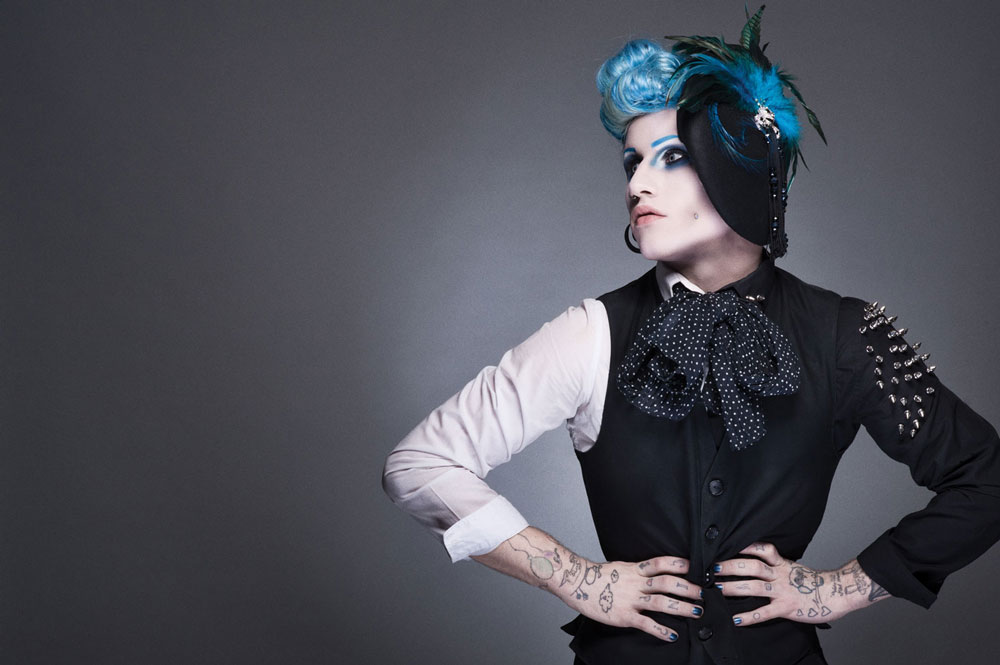
‘A constantly evolving cabaret chameleon, blurring the lines of decency within entertainment and continues to drive music and performance into strange new realms’ and ‘No stranger to the absurd, Joe Black creates a world where the shocking is the sublime and the ridiculous is the beautiful’, are just some of the numerous quotes we find when reading about Mr. Joe Black. An interview with the gin drinking cabaret darling, musical comedy misfit and acid tongued ringmaster.
How would you describe what you are doing?
Attempting to evoke the dark spirit of Weimar Berlin through the use of modern song and comedy nonsense.
Have you always been the creative creature that you are today?
I suppose so, yeah! I always loved acting and showing off. I meddled briefly in the world of filmmaking but decided my calling was performing rather than being behind the camera.
Would you like to tell me about your childhood?
My mother was a jackal and I was often followed around by a large black dog….that was the plot of The Omen, wasn’t it? Though I enjoyed drawing, painting, dressing up and playing games in my mind, I was always fascinated by villains. I wanted to be a super villain and take over the world.
What social reality lies beneath all that make-up?
I seem to have molded everything into one big messy ball. I perform and produce shows on a full time basis, so there isn’t really much of a gap between my reality and my art. I’ve let it envelop me and I don’t think I would ever change that. I love it.
Do you feel the urge to push boundaries?
All the time. I often have been told ‘no, you can’t do that. It’s taking things too far’, but I’ll try to push them as often as I can.
Does your look give you the chance to become who you want to be?
I think it aids it, definitely. Once the make-up and costume goes on, I feel like I’m ready to go on stage. It helps me to fully realize what I’m trying to achieve.
Do you aim for a gender- and sexless look?
Yes, completely. I want people to have to second-guess my gender. I don’t aim to look like a woman and I don’t aim to look like a man.
I want to look like a painting. Something from a twisted imagination!
On you’re website you talk about dark cabaret. Will you be able to do what you do for a long time?
I will continue to do it as long as I can. When the time comes where I can’t do it… I’ll probably still do it. Regardless!
Do you live in a fantasized parallel world?
Sometimes. I think it depends how many performances I have coming up. In times that are very busy, it is easy to become detached from reality and lose yourself. Sometimes I take my makeup off and I don’t recognize the person looking back at me.
When and why did you make the step from street performances to indoor shows?
Street performing can be cruel and unkind. I preferred the idea of a dedicated audience, rather than people who may not be interested or those who may feel aggressive against it. I think I did street performing for about a year and then fully took it inside. I haven’t done a street performance in a very long time.
Do you think legacy has become important for an artist? If so, what do you want to achieve?
A legacy is all the artists’ work. It is what they leave behind. I think it is incredibly important… it’s everything. What would be sadder than to do all that work, when nothing would be remembered? An artist’s legacy is their mark. It’s their tattoo on the world. I don’t think that should ever be forgotten. It should be appreciated for times and times to come.
Am I taking the whole thing too serious?
Not at all. Performing is a serious thing. Whether it’s a funny performance, a sad performance, a emotionally devastating performance or even just something really lighthearted. You leave a lasting impression on people. I think that is something to really be treasured.


De pagina die u zocht kon niet gevonden worden. Probeer uw zoekopdracht te verfijnen of gebruik de bovenstaande navigatie om deze post te vinden.

Text JF. Pierets Artwork Xiyadie
Paper-cuts originated in Eastern Han Dynasty China (AD 25-220) and are hung on windows or doors for good luck. But instead of the usual decorative flowers and birds, Xiyadie, whose pseudonym means ‘Siberian Butterfly’, portrays graphic and daring depictions of homosexual love — long considered taboo in China: “I was 17 in the 1980’s when I learned the folk art of paper-cutting from my mother. And I kept learning traditional Chinese folk art until I was 20.”
During that time he acquired the art craft of expressing happiness and blessings through traditional symbols, such as ‘Jixiangruyi ‘(to be lucky and achieve what you’ve hoped for), ‘Fuguipingan’ (wealthy and peaceful)’, ‘Wufuzhushou’ (Wishing you long live with five happiness), ‘Jiyumantang’ (may gold and jade fill your house), ‘Madaochenggong’ (wish you every success), etc.’
The traditional Chinese folk art of paper cutting is not usually used to depict sexually explicit homoerotic images, but Xiyadie found a means of self-expression for his sexuality in the 1400-year-old art form: “I have a pretty stubborn personality. I always tend to express beauty in the way I imagine it, the composition and content a piece should have. Which is the reason I used to be criticized quite a lot by my teachers when I was an apprentice. They say I’m ‘riding a donkey backwards’. But there were a few teachers who encouraged me, commenting that my work was something new, and that I endeavor to express scenes different from traditional ones.
In my opinion I have been improving as an artist. But in the meantime I do keep those traditional paper-cutting techniques that I feel is the essence of my art. I use the yin and yang spaces in a piece to add in symbols of flowers and birds, which bears traditional meanings of blessing. And of course these inspiration blooms from my life, imagination and hopes.”
The artist manages to cut out provocative scenes that make viewers take a second look just to make sure they’re seeing right. Gallery owner Joe Flazh – who brought Xiyadie’s work to art space Flazh!Alley in San Pedro, California – has been overwhelmed by positive reactions: “Xiyadie touched on emotions that are deeper than sexual orientation. Xiyadie addresses subjects that are relevant to the LGBT community, but also to any person, gay or heterosexual, male or female and parents.”
The artist himself feels wonderful about it: “American people see my work and understand my deepest intentions. The hugs and kisses from my audience makes me feel most welcomed. I love the bold, friendly way American folks express themselves. My paper-cutting has the same boldness in it.”
Like many gay Chinese men, Xiyadie is a married father living in Beijing with a son and a daughter. Both still have no clue as to their father’s true sexual orientation: “For people living in underdeveloped rural areas, it is hard to even imagine being gay. In bigger cities, capital of provinces or above, life could be easier. I personally feel Beijing to be the best place, where the gay community is strong and active. And the city being very tolerant towards our community is one of the reasons I love living here. The gay erotica that my work portrays still remains unacceptable for main stream media.
I hate that China is so dominanted by traditional doctrines, but on the other hand, this is the cultural earth and water that nourished my creativity. My work is changing constantly, and so is the state of life I try to pursue. Immigrating would be a wonderful option for me but I do what I can.”


De pagina die u zocht kon niet gevonden worden. Probeer uw zoekopdracht te verfijnen of gebruik de bovenstaande navigatie om deze post te vinden.
Text JF. Pierets Photos Michael James O’Brien
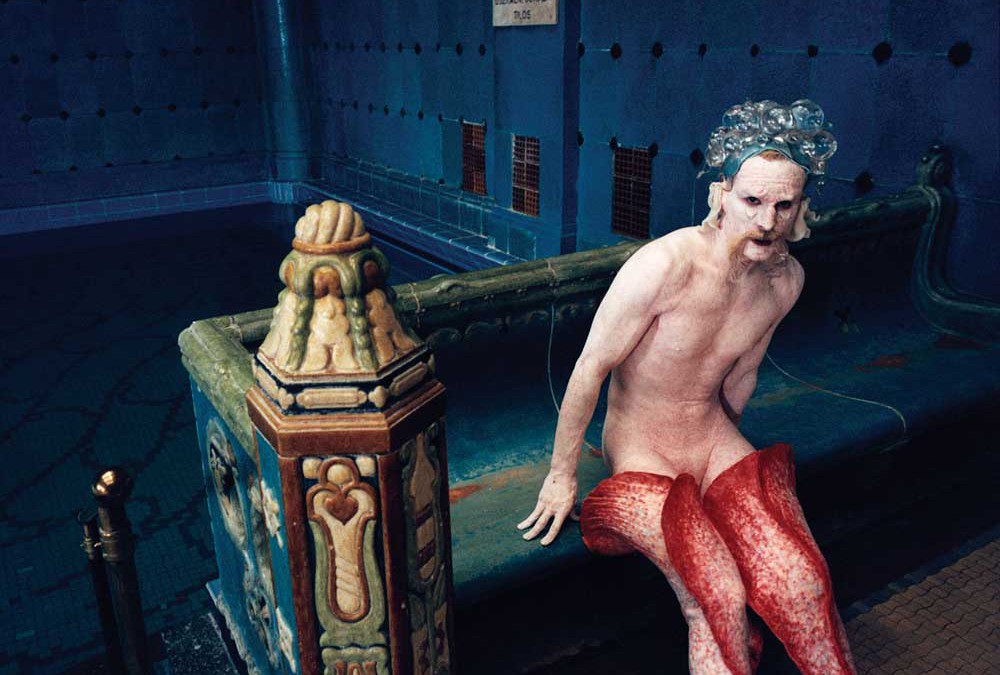
When talking to some friends in Antwerp, the name Michael James O’Brien was often mentioned. One couple bought a series of his pictures, another met him in a bar in Antwerp. When searching his name online, one can only produce a shriek of recognition. That picture of fetish legend/corsetiere Mr. Pearl! Dame Edna covered in pink feathers! Our über idol Matthew Barney! Iconic pictures that we’ve known for years turned out to be by the hand of an accomplished American photographer and poet who has exceeded in the field by being showcased in the greatest publications around such as Rolling Stone, L’Uomo Vogue, the New York Times, the Financial Times and many more. Michael James O’Brien. We managed to get his email address and were able to intercept him on his way to Istanbul.
When did you knew you wanted to be a photographer and why?
I was seduced by Walker Evans (and his groundbreaking work) when I took his graduate seminar at Yale in the early 70’s. I bought a Pentax 6×7 & changed my degree from literature to photography.
You come from Ohio and travel the world, yet you are often in Antwerp.
I taught in Ohio for 2 years only but was born in NYC & lived there after Yale until I moved with my partner to Paris in 2004. Now we move around constantly.
Among other things you owned a restaurant, your work has been commissioned by a long list of magazines and you are a published poet. Do you need to do all those things in order to feel fulfilled or are you easily bored?
I like to be busy and do big projects. Writing & photography & owning a bar are all inspiring & satisfying in different ways.
You photograph celebrities as well as dragqueens and performers. You like to be divers in your subjects?
I am attracted to a wide variety of subjects like most photographers. I don’t have one subject matter or a set style.
What’s your most treasured anecdote?
What comes immediately to mind is a walk with Ursula Andress through the Opera House in Budapest in 1996 preparing shots for Matthew Barney’s Cremaster5 when Ursula began to tell me about her “great loves”. You’ll have to imagine the rest…
You worked with Matthew Barney. How did that happen?
I worked with Matthew when he was a model while he was still in college in the late 80’s. When he began his art exhibitions in NY we often met in what were once called “underground” venues, like the fetish club Jackie 60 & Matthew asked me to collaborate on Drawing Restraint 7.
The people on your pictures often look fragile. Is that something you are looking for?
I am trying to give room & time when I do portraits for the subject to find their resting place. It becomes more difficult these days with instant photography to make the time.
When did you decide to make ‘Girlfriend: men, women and drag’?
I proposed the project to Random House in 1990 at the height of the Golden Age of NYC downtown nightlife which was often dominated by drag performers.
You seem intrigued by transformation. Why is that?
I am deeply interested in what is called the gender diaspora, in all it’s manifestations & I believe we all have the power to become what we want to be in spite of the “givens” of birth, race etc.
I read you have a fascination for freedom versus restriction. Is that a personal thing?
It’s equally personal, political & aesthetic but those are inseparable for me.
You do a lot on the subject of AIDS. Why?
I was in NYC when the epidemic hit like a tsunami. Loss was an essential part of our lives as in a war and the only response was awareness, involvement.
What’s next on your agenda?
Exhibitions in Istanbul in June & in October and preparation for shows in London & Liverpool, as well as commissioned work. And open a bar!
What’s the most important thing on your wishlist?
To work with less pressure; to re-edit my archive!


De pagina die u zocht kon niet gevonden worden. Probeer uw zoekopdracht te verfijnen of gebruik de bovenstaande navigatie om deze post te vinden.

Text JF. Pierets Artwork AMVK
Anne-Mie Van Kerckhoven is known for creating a diverse body of work in painting, sculpture and installation that has made her among the most important Belgian artists of her generation. She embraces a complex array of subjects, including alchemy, mythology, artificial intelligence and mystical scriptures from the past, working with the conviction that her work can someday answer the question if we, or if we don’t possess a soul. AMVK uses existing images in a disjunctive and semi-coherent way that only make full sense in the work’s final moment, when all the layers are combined together. Her career remains a subject of fascination and understandably so, because far from the mainstream circuit, she’s busy blazing her own conceptual trail. Her relationship with creativity is raw, almost primitive in its absence of compromise or concession. We meet Anne-Mie in her beautiful atelier in Antwerp, filled with books, work in progress and nude magazines. A conversation about reincarnation, porn and the urge to draw.
Your work contains contemporary issues regarding technology and sexuality while sourcing material from the past. Why this thirst for history?
Let’s start at the beginning. More than 10 years ago I’ve bought a book called ‘La science du bien et du mal’ by Victor Géhant that was written in 1848. In this book he’s searching for the connections between the fact that we are sleeping, the fact that we divide good and evil and the fact that we are convinced of having a soul. Afterwards it seemed that this book was based on the intellectual legacy of Marguerite Porete, a French mystic who died in 1310. We’re talking about the end of the ’90s so I had to search a long time before I could find ‘Le Miroir des Âmes Simples et Anéanties’ – ‘The mirror of the simple souls’. One of the last romans chevalier and one of the first mysterienspiele. The title of Porete’s book refers to the simple soul, which is united with God and has no will, other than God’s own, a spiritual dealing with the workings of Divine Love. She was burnt at the stake for heresy in Paris in 1310 after a lengthy trial, when refusing to remove her book from circulation or recant her views. It was only until 1965, when the original Old French version of ‘Le Miroir des âmes simples’ got published, that Porete’s status became one of the greatest of Medieval Mystics, as one of the most visionary exponents of the Love Mysticism of Beguine spirituality. When I read this book I felt like dropping down, I felt that I was her reincarnation.
How did this epiphany influence your work?
It was only when I finished my Headnurse project (96 women’s bodies combined with 96 terminologies taken from books on artificial intelligence. Ref.) I realized that this mystic, Marguerite Porete, had the same issues, the same pain as I have: the agony of a huge duality between my heart and my head. In 2005 I made a trialogue between Porete, Giordano Bruno, an astronomer, and Marcuse, who wrote ‘Eros et civilisation’, because those three people are also suffering from the same pain. I made drawings inspired by this trialogue and named it ‘I’ll Rob You’. I’ve been working on the subject ever since.
Are you heading towards a point where you can bring it all together?
Yes. It’s quite an ambitious project and sometimes my head can’t stop spinning but lately there are moments in which things start to fall into place.
You once stated that every piece of work you create is a survival mechanism.
Every period in my life is outlined by a series of entities that automatically evolve into a specific theme. By using these themes in my work, I’m able to control them, able to give them a logical position in my life. You can say I translate or canalize my inner process into an exterior three-dimensional structure.
When do you stop reading and start to work?
I do everything at the same time. I have concentration issues so most of the time it turns out that I’m drawing while reading, using the lyrics in my work. I make all different kinds of work at the same time. I need my drawings to place basic things such as anger, and grief.I can’t plant that in my bigger work.
You make all sorts of work. Paintings, sculptures, installations, you name it. You were never interested in sticking to one thing?
Some people used to complain about the fact that I make too much and all too different, but that’s who I am and what I am. Let’s say I have a wild creativity. From morning till night, it never stops. Picasso was also like this and I don’t hear anyone complain about him.
Does the slightly soft porn aspect of your work cause eyebrows to be raised?
You’re referring to the fact that my work is often called obscene. I have this big amount of nude magazines dating to the sexual revolution. In those magazines I find a lot of hidden filters to work with. Starting from those pictures I’m able to explain and deal with contemporary human or social issues. My choice of images is mostly based on false feelings of indignation. They haunt me with their nasty sort of beauty. It happens that they stick to me for 10 years or more before I’m able to really deal with them. In their innocence they touch something very deep and vital. For instance look at this scene (shows a 50’s black and white image of a woman playfully hanging on a rope in an artists’ studio. Ref.), why is she hanging there like this, what was that photographer thinking? To me the whole scene hides an essential urge from both sides of the lens, even with that retouched pubic hair. I find these women and the way they are depicted extremely beautiful too. The big challenge is to combine a tantalising image with peevishness and try to end up with something new that is meaningful and interesting.
Those 50’s images are quite harmless compared to contemporary porn. Are you even more annoyed when you look at this evolution?
I hardly buy those kinds of magazines because they are too simple-minded, too focused on one thing. But new kinds of sources do inspire me. For instance a year ago I found a magazine printed in 2000 with a lot of white and red rubber and women in funny scenes, with furry donkey ears. Very inspiring, I love it. I have also this thing with plastic, from when I was a kid. Lately I worked a lot with Sleek magazine with its homoerotic- and sado-masochistic images, flirting again with nazi-imagery, dark heavy leather, and bearded sexy men with an Arabic touch, in skirts. And again, quasi-silly. I find this all interesting and double because these magazines pretend merely to exist to sell clothes.
It sounds like you have the fierce need to push the limits of your inspiration?
Connecting sex and technology has always been my main activity as an artist . I am intrigued why naked women are portrayed, but on the other hand I’m also truly inspired by all things regarding the synthetic; thermodynamical laws and outer space issues. I had that since I was a child. I work with computers since 1977. I’m a pioneer when it comes to that. When I studied at the art academy we had a lot of contact with students who were both aspirant scientists as well as musicians. Performers. By that time I got very well acquainted with Luc Steels, who later started the laboratory of artificial intelligence (AI) at the VUB in Brussels, and it is thanks to him that I could start working with computers so early. I made my first movie on a very rigid piece of machinery that could only go black and white and was hugely pixelated.
What interested me from the start is that you can keep on working in different layers, which you can manipulate apart from each other, without focusing on a final result. And of course I loved drawing my naked women on these highly sophisticated machines. Something quite unusual to be done in the sterility of an AI-lab. The symbolic gesture of it was a statement and of big importance to me at the time.
What’s so interesting about artificial intelligence?
I always had this hunger for consuming science, as an outsider. I had a subscription on ‘The New Scientist’ as a student. In the beginning of the 80’s AI kept on searching for the essence of what defines human beings. Things like: what is intelligence, what is creativity, and how they related to each other. The books on knowledge representation reflected a modern kind of theology to me. AI used psychology and philosophy research and terminology, in order to develop new insights and to compact the abstract. At a certain moment the trail somewhat fell apart on the idea that language was the thing that made us more intelligent than other species. Later they decided that it is the complexity of human social structures that made us develop technologies as we do. As an artist I quickly knew I was more mesmerized by all things evolutionary, new ideas and new perceptions instead of art itself. Include my distrust towards the art world, because there were so few female examples, hardly any women to be found in art history books, and I soon felt much more liberated being creative in an atmosphere of science, logic and future.
How long did it take to find your path?
Not very long. As soon as I left the academy I started reading De Sade and Wittgenstein. This, combined with The New Scientist magazine, really influenced my choices.
Is there something you are looking for?
I’m not necessarily looking for something but I’m trying to make connections. I’m very conscious about all those different significance layers in reality and I like creating things that places everything back in perspective. That doesn’t exist in real life but it does in my work. Maybe it’s because I read a lot of fairy tales when I was young.
You talked earlier about the lack of women in the art world. Do you feel in place?
I consider myself a stand-alone. The past 10 years I thought a lot about it, but recently I decided to stop doing that. It starts to get too upsetting. The art world is mostly ruled by men. You have to have that certain mentality that when you find something that works, you stick to it. You are constantly supposed to stimulate the surroundings by shouting: look at me, look at my work, I’m the only thing that matters. You have to have an obese ego and I loathe it. I don’t know how this works with the younger generation of female artists. Maybe it has to do with the way I am brought up as a woman, that I keep other people as much in account as I do myself. For me the way I do it though is the only way I want it.
Do you find it important what people think about your work?
I’m very much interested in what people think about my work but I don’t take their judgments into account. When you work on something in your studio, you have a very intimate contact with your creation. You are in fact your work. From the moment you share it with another person you start looking through his or her eyes and your work has already changed by then. So it’s very important with whom I’m watching. After a while you let go, but in the beginning it’s essential.
And the final question; do you like living in Antwerp?
I do, I have a wonderful atelier here and Antwerp has a good vibe. I guess that’s why there are so many great artists living here. The only thing that bothers me is the lack of good spots to party, to dance. Since I’m also a DJ, maybe I’ll have to start one myself. Anyone interested?


De pagina die u zocht kon niet gevonden worden. Probeer uw zoekopdracht te verfijnen of gebruik de bovenstaande navigatie om deze post te vinden.
Text JF. Pierets Photos Charlotte Lybeer
From 2003 until 2008, Charlotte Lybeer photographed gated communities and actual “theme parks” in the US, South Africa, Europe, China and the Arab Emirates. ‘The success of these ‘enclaves’ proves that in a society without boundaries, we still desire controllability. It seems that happiness is only possible in an artificial reality where everything is under control of its makers. An architectural décor is being built; a scene in which the inhabitants step away from everyday reality.’
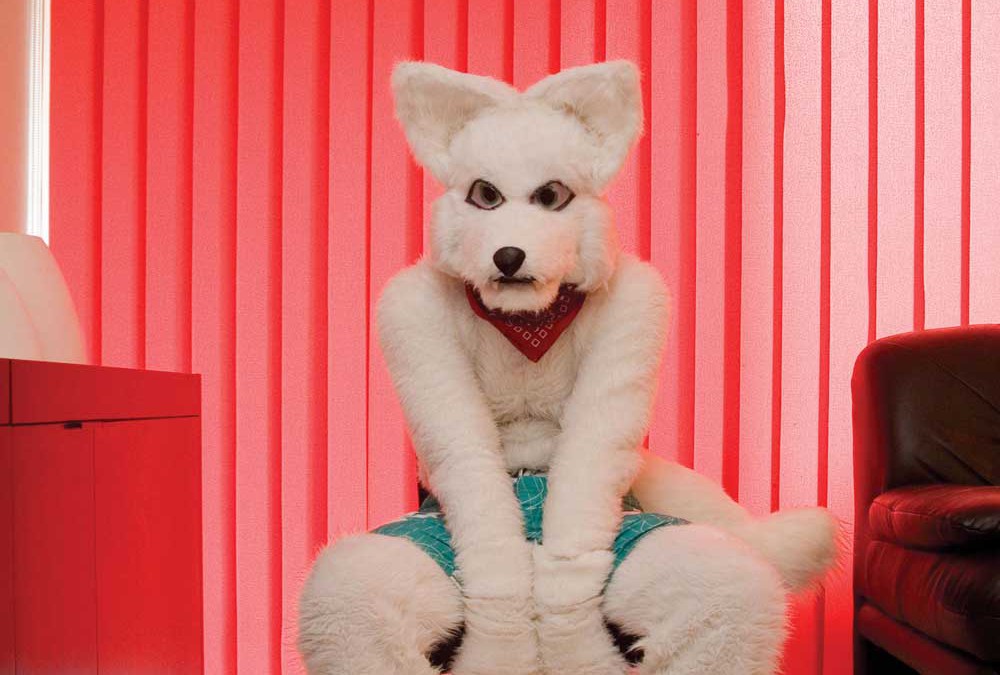
Charlotte Lybeer studied photography at the Academy of Fine Arts Ghent and the HISK in Antwerp. For the series ‘The furtastic adventures of the cabbit and the folf’ she submerged in the world of furries. ‘Each of my series is a logical continuation of the previous one. In this case it was a continuation of ‘Larp, taking a holiday from everydayness’ from 2009. A series of portraits from LARP (Life Action Role Playing) players.
Charlotte uses photography to research the capsular aspects of our society. In her projects Lybeer takes an aesthetic, as well as a social look at people who form groups and/or separate themselves from others. In this case; Furries. The furry fandom is a subculture interested in fictional anthropomorphic animal characters with human personalities and characteristics like intelligence, facial expressions, the ability to speak, to walk on two legs and wear clothes. During the 1980s, furry fans began to publish fanzines, developing a diverse social group that eventually began to schedule social gatherings. By 1987, there was sufficient interest to stage the first furry convention and throughout the next decade, the Internet became accessible to the general population.
To create ‘The furtastic adventures of the cabbit and the folf’, Charlotte had to infiltrate into its fandom. ‘I became a member of different forums and online communities related on the subject matter and went to conventions in England and Germany. They’re gathering yearly in large hotels which they rent for private use.’ For this series the individuals were taken out of their safe groups and placed into their personal and intimate habitats. The contrast between the costume, which the person uses to tell us something about his or hers virtual identity, and the homey interior is an approach rarely to be seen. The setting reveals the personal identity and daily reality of the player, yet he is still in character.
Gaining those people their trust is a tour de force since they are often described as freaks in mainstream media. ‘The hardest part of this project was gaining that trust. If it would have been easy, there would be much more series like this. The first step was to become a member of the group and talk openly and clear about my work and what I wanted to achieve. The second part was to prove that I was serious on the subject matter. That can be achieved by being humorous without being flippant. The hardest part was to get personal so they would trust me enough to let me into their houses.’
‘The furtastic adventures of the cabbit and the folf’ is part of Charlottes project to get her doctors degree. It’s called ‘Lifestyle Supermarket’. She’s photographing different fandoms that are related to virtual, three-dimensional worlds such as Second Life, in which players can create a second identity. ‘It’s a very intriguing given. People can transform themselves into a superhero, a monster or and animal with human characteristics such as furries. The unique feature of these fandoms is, that these trans human identities are nowadays also assumed outside the virtual world. For me, those are examples of how contemporary men tries to fit in the image imposed by mass media such as movies and games. All my projects are inspired by how people react in a world that is changing. Not only geographical, but also on an imaginary level.’


De pagina die u zocht kon niet gevonden worden. Probeer uw zoekopdracht te verfijnen of gebruik de bovenstaande navigatie om deze post te vinden.