Geen Resultaten Gevonden
De pagina die u zocht kon niet gevonden worden. Probeer uw zoekopdracht te verfijnen of gebruik de bovenstaande navigatie om deze post te vinden.


Text JF. Pierets
She’s the queen of alternative performance, won the Twisted Cabaret Crown World Burlesque Games in 2014 and is this edition’s cover model. But most important, sometimes you just meet one of those people who make you think YAY!
How does one become a performer?
When I was 20 I moved to Amsterdam and started my performance career. At a certain moment I’d done so many things, as a dancer and artist I had been on television for so many times that I wanted something different. I was working with Torture Garden and they asked me to come to London, because of all the work I would be able to do. So I went. I’m living here for 16 years already despite my intention to stay only for 2. Back then there used to be not as many performers as there are today. I’m talking about the year 2000 now. I guess we had about 10 or 15 really great performers. So I was always working, always abroad. Nowadays it looks as if there are way more people wanting to be an artist then 5 years ago. And as it usually goes, the party promoters rather fancy a lot of girls for less money than one or two very professional ones with a normal salary. But I’m not complaining. The year just started and I already have a good list of new assignments and bookings.
There’s a lot of burlesque these days, which is completely different than performance art.
There is a lot of burlesque and a lot is the same all over again. I guess it gets the audience and promoter confused and they don’t quite recognize the stylings anymore which goes from performance art to cabaret to burlesque. For me those are all different kinds of shows. I do wish that those younger performers would do a little research. Looking what other people do, or have done, and trying to be a bit more original. Really find your own stories and styling for you shows, it gives for a longer career.
Can you specify what it is that you do?
I call myself a ‘Jack of all trades’. I basically started out as a dancer in the beginning of the nineties, being a full time gogo dancer on Dutch television. When the rave scene commenced I danced at biggest house parties and finally ended up working in a fetish store called DeMask. 3 month later I found myself on a stage with my own show. A show performed in the fetish scene in which you can just ad that twitch of extra darkness to the act. Compared to a mainstream production, that is. In my first show someone laid dead on a bed, a second person would cut open the body and I would jump out as some kind of revenge spirit. For me it was a very important point in my career because I got to work with the artist called Crazy White Sean. We were both beginners when it came to performance art but we really felt each other when it came to designing new shows. 10 years later they called us ‘the most famous couple in the fetish scene’, he emerged into freak shows and I became The Vivid Angel. I’ve been performing at the largest festivals, in the biggest clubs. I worked with Alice Cooper, Dita Von Teese, Roger Taylor, you name it. I did and still do very exciting things.
Do tell!
I have a show called Art Noir where I’m creating a painting, live on stage, by using syringes and injecting coloring pigment through my skin. This particular show has been reviewed as ‘suffering for your art’ and you can take that quite literally. I’m going through a pain phase to manufacture that painting. Most of the time those kind of shows are my favorite ones because they are not about entertainment. I generate this surreal world where I try to bring the audience in an atmosphere that’s out of their comfort zone. But no worries. I also have an entertaining side to my personality and I also love doing shows where I can make people laugh, where all is beautiful.
That’s very bilateral.
That’s why I chose to use The Vivid Angel as my name. The vivid is my dark, weird, crazy side and the angel is the sweet, fun and sexy appearance. I always felt those two features both in my being, as in my performance career.
Both mainstream and non-mainstream?
There are not many non-mainstream performance artists. I have the feeling not many people dare to be confronting or extreme nowadays. I have this show about school bullying which you can, by all means, call autobiographical because those were terrible years. Doing that show really get’s to people. Some say after the show that they didn’t like it, while months later they confess that after doing some thinking, it really got to them. And I think that’s the difference between performance art and entertainment. What I do is not only beautiful and easy to digest. But I do hope the tendency will once again reach back to performance art because it’s an honest and very emotional art form. And if well represented, it’s one of the most beautiful things you can witness on a stage. I always find it very interesting to hear what people encounter after seeing my shows. I have my opinion about it and I’m always pretty sure the message is quite clear, yet that’s not always the case. When I was doing my Art Noir show it always astounded me what people made of it. One woman even told me it was about the circumcision of African women. And although I’m listening with amazement to these stories, they are ok. If she get’s that message and it get’s her to think about the phenomenon, that’s ok. As an artist you have to live with the fact that people project there own horrors, joys and everyday life issues to your work. That’s the beauty about being a performer, unconsciously you touch certain spots which you never would foresee. People don’t have to like you when you are on stage because it’s nice to encounter the challenge to get them excited and curious about the world and environment you are creating at that particular time. Whether it’s beautiful, ugly or scary. It keeps me humble and appreciative for every given moment that I can share my art, even after 20 years.
20 years is a long time. Are you still performing fulltime?
Not fulltime, no. Since long I’ve been writing a theatre play involving acting, video and word, which I love to exhibit in a small theatre or gallery. The piece itself is about the tide of life and the rolling about until that one moment where you just break through boundaries and limits. I’m also planning to write a book about my performances and myself. The crazy situations I’ve been in and the ludicrous moments I’ve encountered. But also hints and tips for people who have the ambition of being an artist. Next to that I’m working on a book about Crazy White Sean, whom I’ve been telling you about, and who sadly passed away recently.
Aren’t you going to miss the stage?
Well, I won’t quit entirely because like they say, ‘there’s no bigger addiction than a stage’. Over the 20 years on the podium I had busy and less busy times. And of course in those fewer active junctions you start longing to get back up there. I read a note the other day, stating that if an artist stops performing or painting, he or she commits emotional suicide. And that’s very true. The hunger to throw out your sentiment will always be there. Luckily I have more tools at my disposal than only being a stage performer. It’s time to project my energy into other creative outlets. Maybe I’ll take up painting again and combine it with performance, who knows. There are many ways to go and there’s no lack of activity or inspiration in all those future plans. It’s time to note down some document. Time to take some further steps. I still like working in clubs but I became more selective when it comes to locations and people I want to work with. People who know me and respect my work. But I came into a phase in which I don’t necessarily have to be everywhere. I think I became way too experienced to drop into yet another small club where nothing is arranged and not one thing you asked for is at hand. That said, the stage keeps on being the best spot to exorcist my demons.
Otherwise you might have been a serial killer.
O goodness, who knows? But having a creative outlet, which you don’t respond to, eats you alive in the long run. That’s true.
When I look at you I don’t see the average diva.
And glad not to be! I might be a Queen, but I not a diva. Every time I go on stage, it feels like the first moment all over again. And to be honest, I don’t want to get used to it. I have artist friends who are ‘just going through the moves’, I would hate that! It makes you very humble when you have to promote your own shows to the venues. The show is just part of the whole package. You have to do your own bookings, write your own invoices, make the deals, etc. And sometimes that’s a pity because it stops you from being entirely, exclusively creative. Which sharpens the pink edges that would normally smoothen the transaction between you and your audience. But.. if you have the opportunity to be a full time artist, it’s a beautiful choice to make.
Talking about choices, your performances have a lot to do with physical pain. Why does one do that?
When I first began I never thought I was about to start using needles and syringes. I was more the horror-effect and illusion kinda gal. It was always fake. But when I came to London and got to work with Miss Behave and Lucy Fire we designed a witch show. We all had our own ‘powers’. Lucy was good with fire, Amy swallowed swords and I was into blood effects. But then the others decided to begin the show with putting out a cigar on your tongue. And although I didn’t want to do it, I was kind of pushed into it. After a while I thought it might be great to actually master those skills and I started practicing. Slowly I started to intervene little things into my own shows and that’s when I got the question to perform a freak show. In 2005 there was this movement where people were really interested in seeing freak shows performed by woman, and there weren’t many performers fitting the bill, so there you go. I think once you’re able to cross the boundaries of pain, you’re capable of doing a lot of things. Needless to say the first time I stuck a needle in my arm was pretty weird. I’m not a masochist at all and the ‘pain versus pleasure’ concept is wasted on me. But I realized I could take it, and all of a sudden it was more of a ‘mind over matter’ thing. As soon as I realized that my mind is stronger than my body and that my mind has control over my body, I was able to take it to the next level. I like it when people can see that I’m actually in pain in order to create my art. That said, I must be honest and confess that I sometimes terribly injure myself during one of the shows.
What does such a thing to your body?
Well of course I have to be very careful with what I do. I never drink alcohol before a show because if you become less attentive or arrogant, you can really hurt yourself. But then again, some things are beyond your control. Fire for instance. You have quite little influence on fire, if you start to think about it. Fire does what it does and you have to learn to work around it. In my entire career I got terribly burned a couple of times. On my mouth, my arms, by just being that itch too quick or being a tad too negligent. Or people from the club that are leaving the airco on, well, you know what happens then. I also use a lot of piercings and staples on stage and like my boyfriend always says: ‘It doesn’t make her prettier’. Over the few years I gained so many scars that it’s quite a sight when I get a tan during summer. When people tell me they are interested in performing these kind of shows, I always ask them if they are ready to get marked. When you stick needles in your skin or you jump on broken glass, you always have to keep in mind that there will come a day when it goes wrong. Once I was unable to walk for 3 months because I cut my foot that deeply. Let’s say there’s a price to pay.
You must have developed a different view on external beauty.
A few years ago I involuntarily got into a fight. They knocked me down and I hit my head on the street, there was a big jaw in my face and my front teeth were in pieces. I had a lot of photo shoots for catalogues going on in that time. And I remember waking up, scared that all was finished and things could never be restored. But of course it does. And what I learned is that beauty doesn’t come in a framework. It’s what you carry in your soul. If you manage to be happy with whom you are, if you have self-esteem, than that’s your most attractive feature. My outer shell doesn’t really matter to me. Let’s say I grew out of it. I don’t look like the average woman yet I find myself in the possession of an interesting face. People love it or hate it and therefor beauty is not something that I dwell on. What I love to hear from people is that I have charisma when on stage. And that’s the main thing as a performer, isn’t it? Don’t get me wrong, I always want to look good and want to make a good impression, but I know I will never be your typical Burlesque beauty.
Are you happy?
I really am. I lost a lot of beautiful friends in the past two years, which made it a very emotional ride, and I experienced a pretty rough childhood. But I use that sentiment in my art. I try to develop all those bumpy roads and negativity into a story that I hope people can use for the good. But like I said, I made some changes recently and I would like to cut down to one show a week instead of three, and take more time to write my play and my book. Discovering new horizons and looking for people who want to join me in this new adventure.
Exciting times!
O yes! And I’m scared shitless! But if I have to choose one thing I really would like to accomplish, then it’s that theatre play. Last year I was able to work with the English National Opera House on Mozart’s Cosi Fan Tutte and that made me really proud. It was literally a dream come true to stand in the West End. Every time I went up those tube escalators I faced all these production posters of those big shows and I always thought ‘one day!’ I was so proud to work with such a solid firm and with all those award-winning professionals. And the Coliseum theatre is so beautiful that I started to cry when I first entered the stage. It is very different you know, performance art and theatre. And I hope I learned enough to make my own interpretation. It’s scary, but it’s something I really have to go for, how nerve wrecking it might be. So ’Put your head down and get to it girl!


De pagina die u zocht kon niet gevonden worden. Probeer uw zoekopdracht te verfijnen of gebruik de bovenstaande navigatie om deze post te vinden.
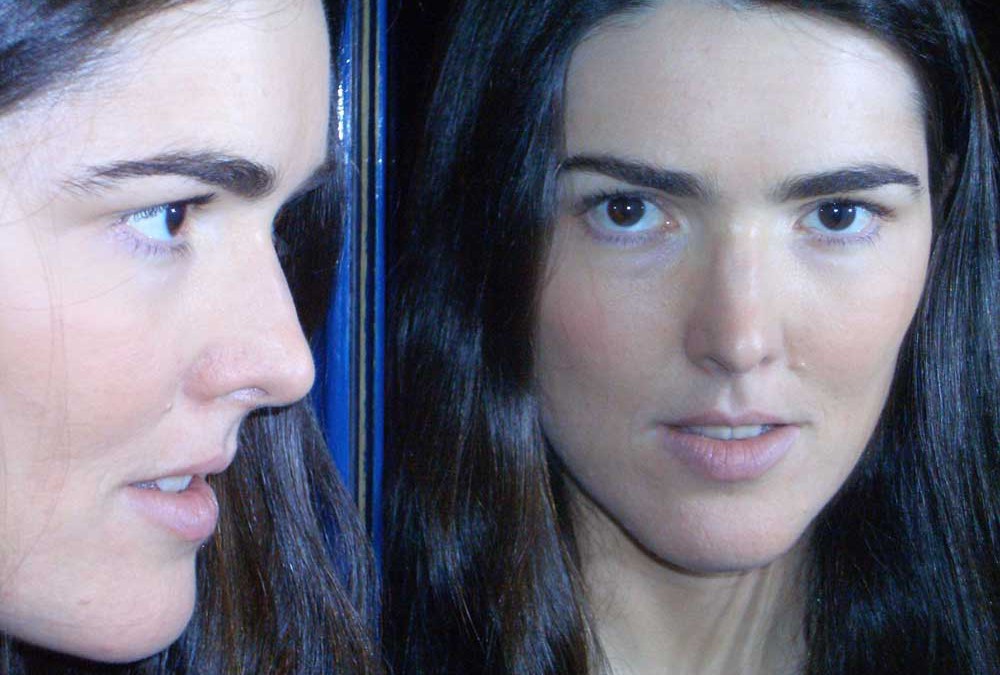
Text JF. Pierets
I was 20 when I read Nude Men and I instantly got hooked on the surreal imagination of this New York based writer. 21 years and 3 novels later there is The Unfortunate Importance of Beauty, and Filipacchi hasn’t lost an inch of her wit and dreamlike tale telling. On the contrary, her latest novel is a genuine work of originality and creativity. Needless to say I was thrilled to talk to her. A conversation about beauty, feminism and our shared fascination in the dictionary method.
Your readers are forced to be patient. It’s been 10 years between Love Creeps and your new book The Unfortunate Importance Of Beauty. Why did it take you so long?
It’s indeed a long time, but first of all, I take a long time with all my novels. Much longer than I would like to. Each time, I think it’s going to be faster next time, but then, well, it isn’t. Also, each novel is longer than the last. Not the finished product, but my first drafts, which this time around was almost twice as long as the final version. It’s like writing two novels. And the third thing is that I had some health problems I had to deal with. Life problems that got in the way.
The Unfortunate Importance Of Beauty wasn’t supposed to be a book about beauty?
I noticed a pattern in my life; things I wrote about, things that were completely invented, would sometimes come true. So I thought (but only half-seriously) that I’d better be careful and maybe only write about good things, in case they happen later. Turns out, I didn’t stick to that for long, luckily for the reader. In the beginning I thought it was going to be a book about a group of artistic friends. I intended to give each character a story of equal weight. But as I was creating my characters, there was one detail, one characteristic, I bestowed on my main character just for the fun of it: great beauty. I half-jokingly thought, “You never know, it might rub off on me a little.” Her great beauty was meant to be a small, unimportant detail, and I didn’t expect it to grow into one of the main themes of the novel. But it did. It wasn’t something I planned because in general I’m really not that interested in how people look.
“Maybe if I’m lucky it will rub off”. How important is beauty to you?
I meant that in a joking way because beauty is not that important to me. At all! And that’s one thing I find a little disturbing about some of the interviews and articles that have been published about me. Due to the fact that my novel is about beauty, that’s naturally the main thing I’m asked about in interviews. And when I read those interviews later, I feel that I come off as being really preoccupied by beauty, when the truth is actually the opposite. If you compare me to anyone you know, really anyone, you will notice that I seem to care less about how I look than almost anyone. I dress like a dork, I never shop for clothes, I wear sweatpants all the time and I haven’t worn make-up in two decades. But some of the readers of the media coverage have sent me e-mails saying things like, “You look fine! You’re quite pretty! So stop worrying about it, ok?!” It’s very nice of them, but I wish they realized that I probably give less thought to my appearance than they do to theirs.
Hearing you describe the way you look almost sounds like a statement.
It’s more laziness. I used to wear makeup in my 20’s and I couldn’t understand how a woman could not wear make-up because I thought women looked so much better with it. But then suddenly I had to start wearing glasses. And I thought; what’s the point? Glasses ruin the whole effect anyway. So at that point I stopped wearing makeup and that’s basically it. It wasn’t a statement. It was more like a giving up. And eventually my taste changed and I started thinking women looked better without makeup anyway. Despite not caring much about my own appearance, I am interested in the role beauty plays in our society and in human relationships—the unfortunate importance it has in those areas. But there are also plenty of other topics I’m interested in. In fact, there are topics in this book that I’m more interested in than the beauty aspect. For example the whole creativity topic. Trying to achieve excellence in your art, the feeling that you’re almost reaching something supernatural. I love that idea.
What do you do when you don’t write?
Usually I’m trying to get myself to write. I have trouble with discipline so I’m always trying to think of new ways to trick myself into doing more writing. But if you’re asking about other activities, then I must say that I love to ski, so usually in the winter we go skiing. I like to travel, I love interesting conversations with people. I take long walks every day while listening to audiobooks or just thinking about how to get myself to write more. Sometimes I do my daily walk with a friend and we catch up on each other’s lives. That’s about it.
You are using all different kinds of methods to get yourself to write. Do you start your imagination by putting limits on yourself?
I don’t know if it can be called a limit. It’s rather something that forces you to think in a different direction. When I wrote Love Creeps, I became really addicted to what I call “the dictionary method.” I was using it constantly. For every new twist in the story I got inspiration from random words in the dictionary. I actually became worried and was wondering if I was ever going to be able to write without using this dictionary method. So I decided not to allow myself to use it for my next novel. Just to see how it turned out. For The Unfortunate Importance Of Beauty, I didn’t use it once, and to my relief that was ok. I was less an addict than I thought I was. Even though I think my strong point as a writer is my imagination, I did notice that when I used the dictionary method, it seems to trigger new and sometimes even more unusual ideas. Even when I thought I had come up with every possible option for a certain scene, really gone over every possibility, still when I picked a word randomly out of the dictionary it generated new and interesting ideas I’m convinced I wouldn’t have thought of without that method.
You also had a method where you were only eating when writing?
Well, I used that method for only about a minute and then I gave it up, so it didn’t work out very well.
Does life influence your writing?
I think it does. When I wrote Love Creeps, I’d gone through some pretty bad relationships and hadn’t been very lucky in love, so I put all of that in the book. Not the specific experiences, because I almost never write anything autobiographical, but all my pessimism about love went into the book.
Why not write autobiographically? Is it too personal or are you afraid to jinx your life?
I think I don’t find it interesting enough. My recent New Yorker essay, ‘The Looks You’re Born With and the Looks You’re Given’, is the first really autobiographical thing I have ever written. I must say that I have discovered that it’s so much easier and faster to write nonfiction (or autobiographical fiction) because most of the material is already there and doesn’t need to be invented. But I think I will always prefer to make things up in my fiction because I enjoy inventing, creating something entirely new, from scratch, that did not already exist in some form in my life. I like startling myself by coming up with ideas I find original.
What’s your experience regarding being a woman in literature?
I don’t know if this is true, but I’ve heard it said by someone in the literary world that publishers are far less willing to publish long novels by women than long novels by men. Do you know the organization VIDA: Women in Literary Arts? Every year they count the numbers of men vs. women whose books were reviewed in various publications. The numbers are very depressing. Far more men get reviewed than women, and “the count” helps to bring attention to this unfairness which is based on sexism and subconscious gender-bias. It’s important that men and women get reviewed with equal frequency because when women don’t get reviewed as often or as prominently as men, it creates a whole chain reaction that results in far fewer women than men going down in history and being remembered for achievements that are actually of equal worth to men’s.
I recently read Siri Hustvedt’s novel, The Blazing World, in which she describes the Goldberg Study, which was a real study done in 1968: “Women students evaluated an identical essay more poorly when a female name was attached to it than when a male name was attached.” The same results were found when the study was repeated in 1983. When a female book reviewer compiles and publishes her list of her 10 favorite books of the year, and 9 out of 10 of the books on that list happen to be written by men, I hope she asks herself whether she might not be experiencing some degree of subconscious prejudice against female authors. (And this, of course, applies equally to male reviewers.)
We are all very sexist toward women, even those of us who think we’re not. We can’t help it, because we’ve been conditioned from our earliest days. I consider myself a feminist, and yet I see sexism in myself often. Sexism probably can’t ever be completely eradicated, due to biological factors such as differences in physical strength and temperament, but it can be lessened, starting, for example, with paying attention to what kinds of messages we send out in children’s books. Both men and women are prejudiced against women. And it’s essential that we fight it, not only in others but in ourselves.
So you’re a feminist?
Oh yes!
Have you ever done anything to help the feminist cause?
A little bit. Do you know about the Wikipedia thing I was involved in?
No, I guess I missed that.
In April 2013 I wrote an Op-Ed for The New York Times because I noticed that on Wikipedia, female novelists were being taken out of the category called ‘American Novelists’, and being put in a sub-category called ‘American Women Novelists’. So only the men were being left in the general category. I was really shocked, and felt this was a truly unacceptable situation that should not be tolerated for one second longer. So I decided to write about it even though I knew I’d be putting myself at risk. My Op-Ed, called ‘Wikipedia’s Sexism Toward Female Novelists’, caused a huge uproar. Wikipedia came under a lot of criticism, and not just from the U.S. media, but from media in other countries too. As a result, I experienced what is known as “revenge editing”: hostile Wikipedia editors pounced on the Wikipedia biography about me and started diminishing it and taking information out of it, until they were stopped by Wikipedia administrators. Thankfully, the page was not only restored but then also much improved by non-hostile Wikipedia editors. The most vicious of the attackers didn’t stop at ‘revenge editing’—he also spread horrific lies about me, until he was unmasked in the media and his lies were exposed. The whole experience was incredibly stressful and upsetting. That’s the kind of thing that can happen when you speak up against sexism.
This Wikipedia debacle drew more attention to the fact that female artists and writers have been neglected not only in the art and literary worlds, but also on Wikipedia. On average, the Wikipedia biographies of female artists and writers are less developed than those of their male counterparts, and also, a female artist or writer is less likely to have a Wikipedia biography than is a male artist/writer of equal accomplishment and notability. Several of the articles written about my Op-Ed stated that it increased awareness of the problem of sexism on Wikipedia. People started doing Edit-a-thons, which consist of a lot of women (and men who support them) getting together in various places, sitting with their laptops and editing Wikipedia together, improving the entries on women. One such edit-a-thon happened at The Museum of Modern Art recently. I stopped by to check it out and found it uplifting. Another little thing I do as a feminist is sometimes tweet about VIDA. I try to support and encourage them.
A lot of people are afraid of getting their careers damaged when they speak up.
Even though I believe that most female writers consider themselves feminists, they often feel they have to be careful about speaking up publicly because if they speak up too much, it can turn against them. And they are probably right, sadly. I know many successful female writers who are feminists and they privately rant and rave about the depressing VIDA numbers and other injustices such as the sexism on Wikipedia, and yet they don’t want to speak up or write about it publicly because they don’t want to be seen as complaining. They are afraid of the repercussions on their careers. I am not immune to those fears. I have spoken up a bit, now and then, but I too have my limits. I don’t say as much as I would like to, for fear of the repercussions. And I greatly admire female authors who do speak up more than I have, who do complain, because they are putting themselves and their careers at risk while helping all female authors.
Do you find it important what people think of you?
Yes, I care about what people think of me and of my work. I assume most writers do. I love it when people like my work, but then again, what writer doesn’t? I’m not one of those writers who can say they’ve always written, from their earliest days. I never had an urge to write stories until I was forced to do so at the age of 13. In school there was a class in which you had to write one short story every week. That’s when I discovered I had this talent, that I was better at this than at anything else I had done in my life—at least based on the reactions of teachers in school and of other adults who read my work. Their reactions gave me such a high, that’s when I decided to become a writer. Before that, starting at the age of eight, I loved reading novels and I greatly admired anyone who could write a whole novel because I thought that must be the most difficult thing in the world. I never thought I could, or would, do it myself, nor did I have any urge to even try. But nevertheless I was very imaginative. I made up a lot of stories for my brother. I just never wrote them down.
What’s your number one reason to write?
To be happy. Many things about it make me happy. When I come up with ideas I really like, I find that very exciting. And part of what makes it exciting is imagining how people will react to them, whether they will like them or not. I don’t write fiction only for myself. And if anyone claims that they are only writing for themselves, I suspect they are probably deluding themselves. So I’m writing to be happy. It gives me a sense of accomplishment and a sense of satisfaction, unmatched by anything else. And it makes me feel appreciated. I like the idea that people will enjoy my work and I always hope that I bring people pleasure.
The Unfortunate Importance Of Beauty is published by W. W. Norton & Company (February 16, 2015).


De pagina die u zocht kon niet gevonden worden. Probeer uw zoekopdracht te verfijnen of gebruik de bovenstaande navigatie om deze post te vinden.
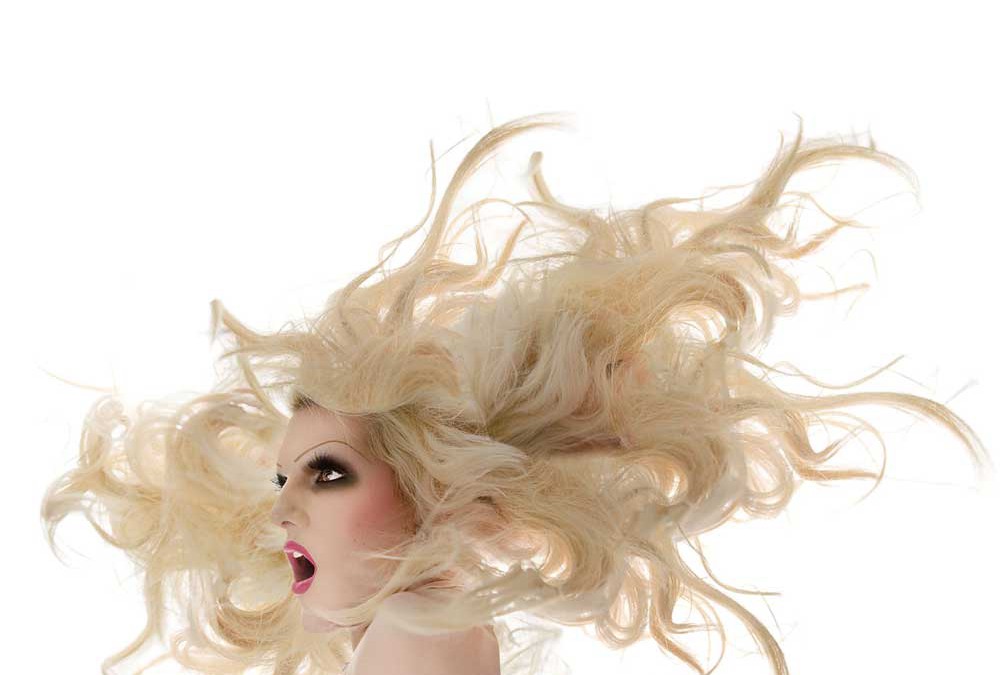
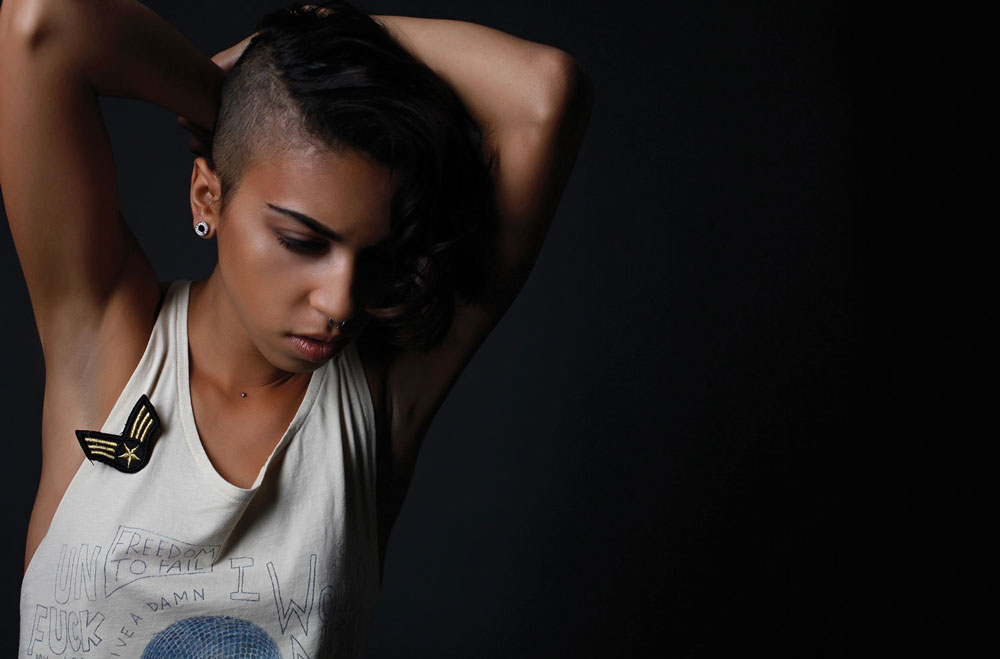
Text JF. Pierets Photos Beverli Alford
‘Well, these aren’t your typical flannel, mullet, boot wearing butches. This new art book pushes the Butch-definition beyond its seams. Packed with fashion forward pictures that are vivid, dramatic and provocative. These gender- bending bois will make your heart skip a beat. It is a feast for the eyes and the coffee table. You will fall in love and never again judge a butch by her cover.’ Kanithea Powell, Author.
Tell me about that gorgeous book of yours!
I wanted to do something that would get people talking about people like me. Sometimes I wear lipstick and make-up and I’m not as masculine as some women would like me to be. But I am who I am and I’m tired of people saying that I’m not butch enough, I’m not this or that enough. So I decided to create something that shows people that it’s ok to be exactly the way you are. Whatever that is. To get out of that box because I’m so tired of boxes.
You have a problem with the typical butch identity.
What’s typical? I wouldn’t say I have a problem with it. I would say that people love to put others in boxes. Whether it’s about the color of your skin or your sexual preferences. And if you don’t fit inside that little box, they get very uncomfortable and they don’t know what to do. This book forces you to remove the blinders and see how things have changed.
Isn’t the word ‘Butch’ also a box?
When you look at the book, it pushes what that definition means. This book is a popped collar, high fashion buffet of beautiful women who redefine the term. It gets you to rethink the word as a whole.
How did people react?
The reactions have been great. We are in over 16 countries right now. One person who bought the book actually slept with it for four days. It’s been very well received and we’ve been up for a few awards so that’s pretty awesome. People have embraced the work and I’m grateful for that.
And where did you find your models?
A lot of them I worked with in the past. I do a lot of filming for professional photographers and for fashion shows. I was at my friend’s apartment one saturday and we got on the phone and called the models we knew and got them down to DC to film. Let me tell you: it has been great! It’s good to know beautiful people.
You started Qwest Films? It’s television, movies, books,.. You don’t want to stick to one thing. I’m an artist and I don’t like being confined. Whatever I feel I want to create, I create. Whether it’s a show, a film, a book or a theatrical play. Whatever I feel inspired to do, I just do it. I created the company to be able to do all these sorts of things. It’s important to be open. When you think about a major player like a Sony or a Paramount, or what have you. They’re in every single bit of entertainment business. They’re in distribution, publishing, TV, they’re in everything. So… I like to think of myself as a big company.
And why do you want to do these things? Do you have a mission statement to change the world? Make things different?
I would like to show the world that we are more alike then we are different. We’re all the same. We’re all just humans being. Whether you are gay, straight, bi, whatever that is, we all love, we all hurt, we all get angry and feel pain. So, I want people to see our humanity versus just passing judgment.
How do you succeed in showing that without the ‘boxing’ that we talked about?
If you look at any of my films or the current work that I’m doing right now, it’s all about life experiences and how we handle/deal with them. Stripping away the stereotypes. Tearing down the walls of homophobia and all that crazy stuff that’s going on out there. I just want to do my part.
Do you have the feeling you can make some change?
Of course! I have a lot of straight people buying my books and films. That tells me that there is a desire to learn and understand who we are. And with those small moves we can open eyes and get people to become more accepting of people who are not like them.
Your new film is completely different? Tell me all about it.
It’s about a woman who sees too much, and has to play a deadly game of survival against a backdrop of greed and revenge. There is a beautiful lesbian couple in the film. I love it! Everybody in the film is acting out of desperation. It’s amazing to see how far a person will go and the things they will do when they’re desperate. Those moments speak to your character. It’s an item that’s quite right now in America. How they deal with immigrants and all that jazz. I thought it would be kind of interesting to shed a little light on it.
Is it also an experienced story?
I know quite a few people who deal with the topic and hearing their stories inspired me to write the screenplay. Hopefully we can pull off an authentic film that people can relate to.
You don’t stay into the LGBT interest field?
No, I do what inspires me, whatever that is. I’m eclectic and I enjoy being open to ideas. As long as it tells an authentic story I’m in!
What do you want to accomplish, as a person?
I would love to own a television network station where I can put out 24 hours of entertainment, and I can pick and choose what ever I like. I think that would be my ultimate goal. I’m working on a television show right now and hopefully that will give me another leg into that dream. Fingers crossed!


De pagina die u zocht kon niet gevonden worden. Probeer uw zoekopdracht te verfijnen of gebruik de bovenstaande navigatie om deze post te vinden.
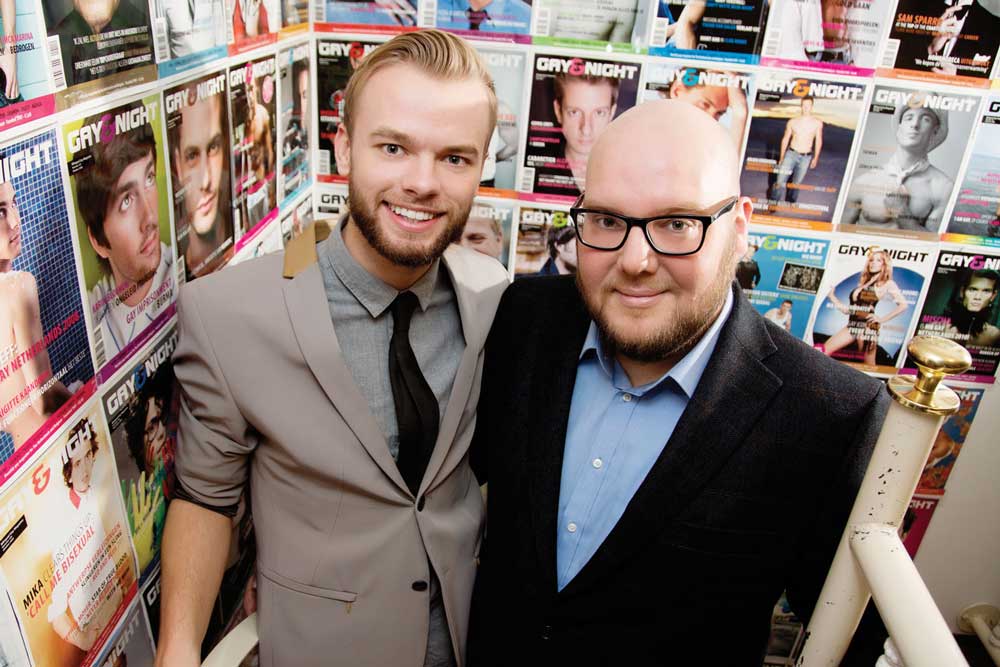
Text JF. Pierets Photos Johan van Walsem
Gay&Night Magazine started off in 1997 as a one-time special during Amsterdam Gay Pride. It soon however became so popular that it evolved into a monthly glossy. Distributed for free at almost all gay meeting spots in Belgium and the Netherlands, it serves as a light-hearted guide to the gay community. Editor-in-Chief Martijn Tulp and vice editor-in-chief Martijn Kamphorst took place on our Skype sofa and we promptly nominated them as funniest Dutchmen we know. Do we have to remind you that all good things come in twos?
You just celebrated your 200th issue. That’s quite an accomplishment nowadays.
MK Isn’t it?! Martijn [Tulp – ed.] joined the club when they where about to hit issue 100. My contribution came a bit later and asked for some shenanigans; when I applied for the position they told me they already had someone named Martijn and it would be too confusing to hire another one. The next day I wrote a letter signed Henk and got invited immediately.
MT Happy ever since.
What was it like, to start at issue 100?
MT It was a good thing because the magazine still had a lot of room for improvement. Still has, now I come to think about it, yet that’s called evolution. Needless to say we still have to keep our audience attentive and inspired. The magazine is a service to the gay community, so if we at some point start to notice that people are losing interest, we’ll have to close the shop. It’s great work but hard work, and still some people ask me what’s my job besides being involved in the magazine.
You feature articles from bisexuality and women with beards, to interviews with RuPaul’s drag queens and bears. Where do you keep your balance?
MK We try to maintain a balance by featuring topics that address a variety of readers. Having said that, it’s impossible to please everyone in one issue. Sometimes our focus will be on gender or bears, and in another issue you will find more content that’s interesting for lesbian readers or clubbers.
MT Not all issues are for everyone, but by offering a wide-ranging series of articles, we’re trying to make sure everyone feels tempted to pick it up at some point. We do focus on the entire LGBT scene, but most of our readers are gay males. Sometimes it’s quite hard to serve a shattered target group, but then again it teaches you how to make choices. An attitude that most of the time leads to quality.
Are we talking about an intuitive magazine?
MT For about 90%, yet we’re trying to cover all groups to the best of our abilities.
MK And that’s obviously not always in the same way. The great thing is that as a free magazine, we feel we have the opportunity to also cover niche subjects. Of course there will always be readers who aren’t happy with certain coverage, but then again, we luckily don’t rely on paying subscribers.
MT The magazine is distributed via the gay hotspots but is also available on mainstream locations, so we can afford to be a bit teasing, a bit more experimental towards a wider audience.
As a person, in what way are you both the ‘actual’ magazine?
MT Well, the fact that there isn’t much about sports and fitness probably says a great deal about the editors. On the other hand, however, there is plenty about music, which is my point of interest… and about food! I always want to publish something about how to bake a cake! You always color the things you write or feature and we do try to keep a certain amount of distance between our personal self and the magazine. That said, you can’t avoid being dragged into it with your own preferences, and many things we write about are things that catch our attention. I myself am single so I’m active on dating sites, especially on apps for bears. When I read about pandas, polar bears, etc., I was triggered to do some research on those different denominations within the gay scene, and it turned into an article.
MK I for example wrote a feature on how Asian boys are treated within the gay scene. I was out clubbing with a bunch of friends and overheard some rather hurtful remarks about those boys. That’s when the reporter in me awakens and starts asking questions. In the beginning it was merely out of personal interest, but after a while I realized that this topic might be more than suitable for an article in our magazine.
MT A quite hefty one if you ask me, on how Thai and Chinese boys are looking for each other’s company, because they can’t find any connection outside their circle.
MK And let me tell you, I didn’t have to beg for stories. A simple ‘how are you?’, and the words came running out.
Do you consider yourselves in an educational position?
MT We’re a magazine that’s not scared to face problems. So when we hear about a topic like those Thai kids, we feel obliged to write about it. To us, it’s important to keep on looking at the big picture to remain a very accessible magazine.
MK In a positive way!
MT Indeed, and that is something we actively work on. Even when a certain subject might be considered being too niche, there are still a large amount of people who would love the fact that you’re writing about that certain phenomenon, without considering it a sensational subject. We try to treat every topic as ‘mainstream’. Same with politics. We often write about changes in the LGBT legislation and focus on making the articles very accessible for those without any political background knowledge.
MK For us it’s very important to also cover the more or less ‘heavy’ subjects with a more social approach, for example by interviewing a couple of members from a movement. I think that’s our responsibility as a magazine, to feature the more committed content next to an article on, for example, gay tourism in Tel Aviv. By doing that, we aim for readers who normally won’t immerse into the subject matter. Not by simplifying, but by making it more accessible.
Can you give an example?
MT The first thing we did when the shit hit the fan in Russia, was not making a list of what politically went wrong over there, but we looked for someone who lived there. Someone who experienced the terror by seeing his friends bashed for no particular reason. We wanted to hear the voices on the street. Sometimes – and I’m talking about the Netherlands and Flanders – we are quite easy-going about coming out of the closet or having the same human rights.
MK By telling the story of an actual person, you make the subject matter more real and in your face. Because these are the sort of things that can also happen to you.
How important is it to keep on printing a magazine like Gay&Night?
MT I’d like to keep on printing as long as possible. The way people react to printed media has gone through a lot of changes. Even newspapers experience a difficult time, because you can read everything right away on the Internet. Nevertheless it’s still very enjoyable to sit on the couch with a printed version of whatever you want to read.
MK And besides the fact that you can hold it and it ‘smells good’, you don’t have to stick to a limit of 500 words in order to not lose one’s attention.
MT Our magazine can be found in bars, clubs, saunas, restaurants and lunchrooms, so that’s a very interesting place to gain visibility. If we, as publishers, keep on succeeding in making the magazine interesting for our audience, I think we will be able to keep on printing!
I hear a lot of evolution since issue 100.
MK When you see our series of covers, you’ll notice that we started getting more and more experimental. It starts with a parade of men…
MT Cute men, if I may add.
MK …and all of a sudden we have a picture of an older lesbian woman [he’s referring to Glee-actress Jane Lynch – ed.]. In 2013 we expanded with a Flemish edition, so now we have two covers to think about. Or better yet; to play with.
MT And don’t forget that not only the tone, but also the lay-out of the magazine changed. In May 2011 we started working with our new art-director Jeroen de Rooij – we couldn’t find a third ‘Martijn’ suitable for the position. One of the compliments we hear most often is that the magazine looks too good to be free. Needless to say that makes us very proud, but credit where credit is due; design-wise, all praise goes to Jeroen.
And yet the magazine is still for free.
MK Always has, always will be. Well, I definitely hope so.
MT We know a lot of people who carry our magazine in their hearts. We work very closely with our advertisers and also the festivals and events featured in Gay&Night. They help us keep it vivid and alive. Not only gay magazines, but a lot of magazines in general recently ceased their printed editions. We are one of the few gay magazines left in the Netherlands and we try to handle that position with care. It’s what’s gained us a lot of trust from our audience throughout the years.
MK This for example entails treating our interviewees with the utmost respect and always letting them check our version of their words before we go to press.
MT We also offer cheap subscriptions for people who don’t visit gay places that often.


De pagina die u zocht kon niet gevonden worden. Probeer uw zoekopdracht te verfijnen of gebruik de bovenstaande navigatie om deze post te vinden.