Geen Resultaten Gevonden
De pagina die u zocht kon niet gevonden worden. Probeer uw zoekopdracht te verfijnen of gebruik de bovenstaande navigatie om deze post te vinden.


Text JF. Pierets Artwork Xiyadie
Paper-cuts originated in Eastern Han Dynasty China (AD 25-220) and are hung on windows or doors for good luck. But instead of the usual decorative flowers and birds, Xiyadie, whose pseudonym means ‘Siberian Butterfly’, portrays graphic and daring depictions of homosexual love — long considered taboo in China: “I was 17 in the 1980’s when I learned the folk art of paper-cutting from my mother. And I kept learning traditional Chinese folk art until I was 20.”
During that time he acquired the art craft of expressing happiness and blessings through traditional symbols, such as ‘Jixiangruyi ‘(to be lucky and achieve what you’ve hoped for), ‘Fuguipingan’ (wealthy and peaceful)’, ‘Wufuzhushou’ (Wishing you long live with five happiness), ‘Jiyumantang’ (may gold and jade fill your house), ‘Madaochenggong’ (wish you every success), etc.’
The traditional Chinese folk art of paper cutting is not usually used to depict sexually explicit homoerotic images, but Xiyadie found a means of self-expression for his sexuality in the 1400-year-old art form: “I have a pretty stubborn personality. I always tend to express beauty in the way I imagine it, the composition and content a piece should have. Which is the reason I used to be criticized quite a lot by my teachers when I was an apprentice. They say I’m ‘riding a donkey backwards’. But there were a few teachers who encouraged me, commenting that my work was something new, and that I endeavor to express scenes different from traditional ones.
In my opinion I have been improving as an artist. But in the meantime I do keep those traditional paper-cutting techniques that I feel is the essence of my art. I use the yin and yang spaces in a piece to add in symbols of flowers and birds, which bears traditional meanings of blessing. And of course these inspiration blooms from my life, imagination and hopes.”
The artist manages to cut out provocative scenes that make viewers take a second look just to make sure they’re seeing right. Gallery owner Joe Flazh – who brought Xiyadie’s work to art space Flazh!Alley in San Pedro, California – has been overwhelmed by positive reactions: “Xiyadie touched on emotions that are deeper than sexual orientation. Xiyadie addresses subjects that are relevant to the LGBT community, but also to any person, gay or heterosexual, male or female and parents.”
The artist himself feels wonderful about it: “American people see my work and understand my deepest intentions. The hugs and kisses from my audience makes me feel most welcomed. I love the bold, friendly way American folks express themselves. My paper-cutting has the same boldness in it.”
Like many gay Chinese men, Xiyadie is a married father living in Beijing with a son and a daughter. Both still have no clue as to their father’s true sexual orientation: “For people living in underdeveloped rural areas, it is hard to even imagine being gay. In bigger cities, capital of provinces or above, life could be easier. I personally feel Beijing to be the best place, where the gay community is strong and active. And the city being very tolerant towards our community is one of the reasons I love living here. The gay erotica that my work portrays still remains unacceptable for main stream media.
I hate that China is so dominanted by traditional doctrines, but on the other hand, this is the cultural earth and water that nourished my creativity. My work is changing constantly, and so is the state of life I try to pursue. Immigrating would be a wonderful option for me but I do what I can.”


De pagina die u zocht kon niet gevonden worden. Probeer uw zoekopdracht te verfijnen of gebruik de bovenstaande navigatie om deze post te vinden.
Text JF. Pierets Photos Michael James O’Brien
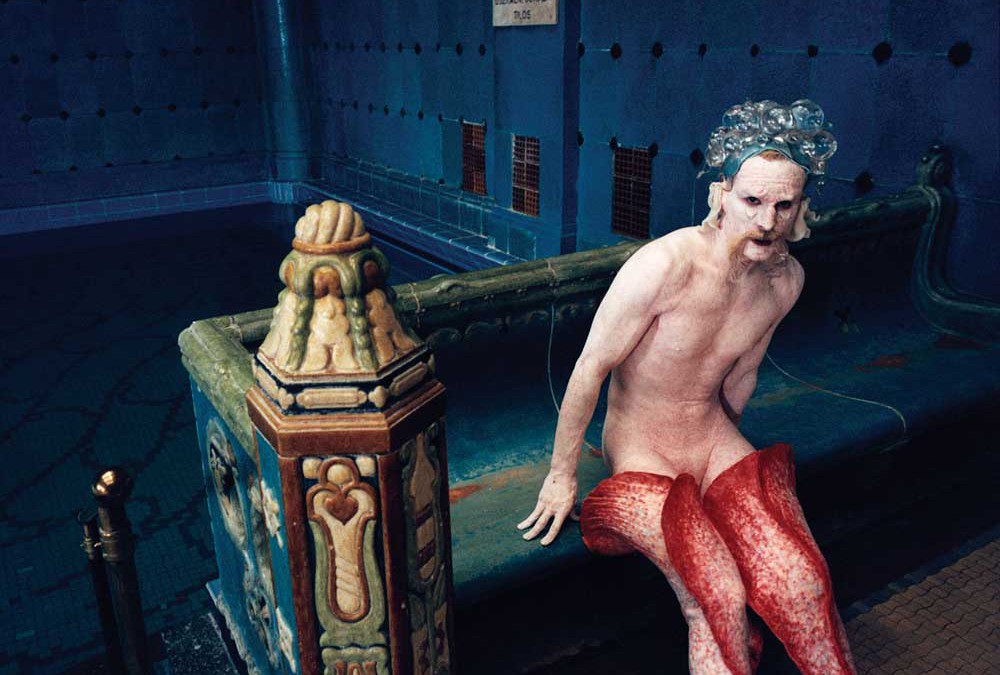
When talking to some friends in Antwerp, the name Michael James O’Brien was often mentioned. One couple bought a series of his pictures, another met him in a bar in Antwerp. When searching his name online, one can only produce a shriek of recognition. That picture of fetish legend/corsetiere Mr. Pearl! Dame Edna covered in pink feathers! Our über idol Matthew Barney! Iconic pictures that we’ve known for years turned out to be by the hand of an accomplished American photographer and poet who has exceeded in the field by being showcased in the greatest publications around such as Rolling Stone, L’Uomo Vogue, the New York Times, the Financial Times and many more. Michael James O’Brien. We managed to get his email address and were able to intercept him on his way to Istanbul.
When did you knew you wanted to be a photographer and why?
I was seduced by Walker Evans (and his groundbreaking work) when I took his graduate seminar at Yale in the early 70’s. I bought a Pentax 6×7 & changed my degree from literature to photography.
You come from Ohio and travel the world, yet you are often in Antwerp.
I taught in Ohio for 2 years only but was born in NYC & lived there after Yale until I moved with my partner to Paris in 2004. Now we move around constantly.
Among other things you owned a restaurant, your work has been commissioned by a long list of magazines and you are a published poet. Do you need to do all those things in order to feel fulfilled or are you easily bored?
I like to be busy and do big projects. Writing & photography & owning a bar are all inspiring & satisfying in different ways.
You photograph celebrities as well as dragqueens and performers. You like to be divers in your subjects?
I am attracted to a wide variety of subjects like most photographers. I don’t have one subject matter or a set style.
What’s your most treasured anecdote?
What comes immediately to mind is a walk with Ursula Andress through the Opera House in Budapest in 1996 preparing shots for Matthew Barney’s Cremaster5 when Ursula began to tell me about her “great loves”. You’ll have to imagine the rest…
You worked with Matthew Barney. How did that happen?
I worked with Matthew when he was a model while he was still in college in the late 80’s. When he began his art exhibitions in NY we often met in what were once called “underground” venues, like the fetish club Jackie 60 & Matthew asked me to collaborate on Drawing Restraint 7.
The people on your pictures often look fragile. Is that something you are looking for?
I am trying to give room & time when I do portraits for the subject to find their resting place. It becomes more difficult these days with instant photography to make the time.
When did you decide to make ‘Girlfriend: men, women and drag’?
I proposed the project to Random House in 1990 at the height of the Golden Age of NYC downtown nightlife which was often dominated by drag performers.
You seem intrigued by transformation. Why is that?
I am deeply interested in what is called the gender diaspora, in all it’s manifestations & I believe we all have the power to become what we want to be in spite of the “givens” of birth, race etc.
I read you have a fascination for freedom versus restriction. Is that a personal thing?
It’s equally personal, political & aesthetic but those are inseparable for me.
You do a lot on the subject of AIDS. Why?
I was in NYC when the epidemic hit like a tsunami. Loss was an essential part of our lives as in a war and the only response was awareness, involvement.
What’s next on your agenda?
Exhibitions in Istanbul in June & in October and preparation for shows in London & Liverpool, as well as commissioned work. And open a bar!
What’s the most important thing on your wishlist?
To work with less pressure; to re-edit my archive!


De pagina die u zocht kon niet gevonden worden. Probeer uw zoekopdracht te verfijnen of gebruik de bovenstaande navigatie om deze post te vinden.

Text JF. Pierets Artwork AMVK
Anne-Mie Van Kerckhoven is known for creating a diverse body of work in painting, sculpture and installation that has made her among the most important Belgian artists of her generation. She embraces a complex array of subjects, including alchemy, mythology, artificial intelligence and mystical scriptures from the past, working with the conviction that her work can someday answer the question if we, or if we don’t possess a soul. AMVK uses existing images in a disjunctive and semi-coherent way that only make full sense in the work’s final moment, when all the layers are combined together. Her career remains a subject of fascination and understandably so, because far from the mainstream circuit, she’s busy blazing her own conceptual trail. Her relationship with creativity is raw, almost primitive in its absence of compromise or concession. We meet Anne-Mie in her beautiful atelier in Antwerp, filled with books, work in progress and nude magazines. A conversation about reincarnation, porn and the urge to draw.
Your work contains contemporary issues regarding technology and sexuality while sourcing material from the past. Why this thirst for history?
Let’s start at the beginning. More than 10 years ago I’ve bought a book called ‘La science du bien et du mal’ by Victor Géhant that was written in 1848. In this book he’s searching for the connections between the fact that we are sleeping, the fact that we divide good and evil and the fact that we are convinced of having a soul. Afterwards it seemed that this book was based on the intellectual legacy of Marguerite Porete, a French mystic who died in 1310. We’re talking about the end of the ’90s so I had to search a long time before I could find ‘Le Miroir des Âmes Simples et Anéanties’ – ‘The mirror of the simple souls’. One of the last romans chevalier and one of the first mysterienspiele. The title of Porete’s book refers to the simple soul, which is united with God and has no will, other than God’s own, a spiritual dealing with the workings of Divine Love. She was burnt at the stake for heresy in Paris in 1310 after a lengthy trial, when refusing to remove her book from circulation or recant her views. It was only until 1965, when the original Old French version of ‘Le Miroir des âmes simples’ got published, that Porete’s status became one of the greatest of Medieval Mystics, as one of the most visionary exponents of the Love Mysticism of Beguine spirituality. When I read this book I felt like dropping down, I felt that I was her reincarnation.
How did this epiphany influence your work?
It was only when I finished my Headnurse project (96 women’s bodies combined with 96 terminologies taken from books on artificial intelligence. Ref.) I realized that this mystic, Marguerite Porete, had the same issues, the same pain as I have: the agony of a huge duality between my heart and my head. In 2005 I made a trialogue between Porete, Giordano Bruno, an astronomer, and Marcuse, who wrote ‘Eros et civilisation’, because those three people are also suffering from the same pain. I made drawings inspired by this trialogue and named it ‘I’ll Rob You’. I’ve been working on the subject ever since.
Are you heading towards a point where you can bring it all together?
Yes. It’s quite an ambitious project and sometimes my head can’t stop spinning but lately there are moments in which things start to fall into place.
You once stated that every piece of work you create is a survival mechanism.
Every period in my life is outlined by a series of entities that automatically evolve into a specific theme. By using these themes in my work, I’m able to control them, able to give them a logical position in my life. You can say I translate or canalize my inner process into an exterior three-dimensional structure.
When do you stop reading and start to work?
I do everything at the same time. I have concentration issues so most of the time it turns out that I’m drawing while reading, using the lyrics in my work. I make all different kinds of work at the same time. I need my drawings to place basic things such as anger, and grief.I can’t plant that in my bigger work.
You make all sorts of work. Paintings, sculptures, installations, you name it. You were never interested in sticking to one thing?
Some people used to complain about the fact that I make too much and all too different, but that’s who I am and what I am. Let’s say I have a wild creativity. From morning till night, it never stops. Picasso was also like this and I don’t hear anyone complain about him.
Does the slightly soft porn aspect of your work cause eyebrows to be raised?
You’re referring to the fact that my work is often called obscene. I have this big amount of nude magazines dating to the sexual revolution. In those magazines I find a lot of hidden filters to work with. Starting from those pictures I’m able to explain and deal with contemporary human or social issues. My choice of images is mostly based on false feelings of indignation. They haunt me with their nasty sort of beauty. It happens that they stick to me for 10 years or more before I’m able to really deal with them. In their innocence they touch something very deep and vital. For instance look at this scene (shows a 50’s black and white image of a woman playfully hanging on a rope in an artists’ studio. Ref.), why is she hanging there like this, what was that photographer thinking? To me the whole scene hides an essential urge from both sides of the lens, even with that retouched pubic hair. I find these women and the way they are depicted extremely beautiful too. The big challenge is to combine a tantalising image with peevishness and try to end up with something new that is meaningful and interesting.
Those 50’s images are quite harmless compared to contemporary porn. Are you even more annoyed when you look at this evolution?
I hardly buy those kinds of magazines because they are too simple-minded, too focused on one thing. But new kinds of sources do inspire me. For instance a year ago I found a magazine printed in 2000 with a lot of white and red rubber and women in funny scenes, with furry donkey ears. Very inspiring, I love it. I have also this thing with plastic, from when I was a kid. Lately I worked a lot with Sleek magazine with its homoerotic- and sado-masochistic images, flirting again with nazi-imagery, dark heavy leather, and bearded sexy men with an Arabic touch, in skirts. And again, quasi-silly. I find this all interesting and double because these magazines pretend merely to exist to sell clothes.
It sounds like you have the fierce need to push the limits of your inspiration?
Connecting sex and technology has always been my main activity as an artist . I am intrigued why naked women are portrayed, but on the other hand I’m also truly inspired by all things regarding the synthetic; thermodynamical laws and outer space issues. I had that since I was a child. I work with computers since 1977. I’m a pioneer when it comes to that. When I studied at the art academy we had a lot of contact with students who were both aspirant scientists as well as musicians. Performers. By that time I got very well acquainted with Luc Steels, who later started the laboratory of artificial intelligence (AI) at the VUB in Brussels, and it is thanks to him that I could start working with computers so early. I made my first movie on a very rigid piece of machinery that could only go black and white and was hugely pixelated.
What interested me from the start is that you can keep on working in different layers, which you can manipulate apart from each other, without focusing on a final result. And of course I loved drawing my naked women on these highly sophisticated machines. Something quite unusual to be done in the sterility of an AI-lab. The symbolic gesture of it was a statement and of big importance to me at the time.
What’s so interesting about artificial intelligence?
I always had this hunger for consuming science, as an outsider. I had a subscription on ‘The New Scientist’ as a student. In the beginning of the 80’s AI kept on searching for the essence of what defines human beings. Things like: what is intelligence, what is creativity, and how they related to each other. The books on knowledge representation reflected a modern kind of theology to me. AI used psychology and philosophy research and terminology, in order to develop new insights and to compact the abstract. At a certain moment the trail somewhat fell apart on the idea that language was the thing that made us more intelligent than other species. Later they decided that it is the complexity of human social structures that made us develop technologies as we do. As an artist I quickly knew I was more mesmerized by all things evolutionary, new ideas and new perceptions instead of art itself. Include my distrust towards the art world, because there were so few female examples, hardly any women to be found in art history books, and I soon felt much more liberated being creative in an atmosphere of science, logic and future.
How long did it take to find your path?
Not very long. As soon as I left the academy I started reading De Sade and Wittgenstein. This, combined with The New Scientist magazine, really influenced my choices.
Is there something you are looking for?
I’m not necessarily looking for something but I’m trying to make connections. I’m very conscious about all those different significance layers in reality and I like creating things that places everything back in perspective. That doesn’t exist in real life but it does in my work. Maybe it’s because I read a lot of fairy tales when I was young.
You talked earlier about the lack of women in the art world. Do you feel in place?
I consider myself a stand-alone. The past 10 years I thought a lot about it, but recently I decided to stop doing that. It starts to get too upsetting. The art world is mostly ruled by men. You have to have that certain mentality that when you find something that works, you stick to it. You are constantly supposed to stimulate the surroundings by shouting: look at me, look at my work, I’m the only thing that matters. You have to have an obese ego and I loathe it. I don’t know how this works with the younger generation of female artists. Maybe it has to do with the way I am brought up as a woman, that I keep other people as much in account as I do myself. For me the way I do it though is the only way I want it.
Do you find it important what people think about your work?
I’m very much interested in what people think about my work but I don’t take their judgments into account. When you work on something in your studio, you have a very intimate contact with your creation. You are in fact your work. From the moment you share it with another person you start looking through his or her eyes and your work has already changed by then. So it’s very important with whom I’m watching. After a while you let go, but in the beginning it’s essential.
And the final question; do you like living in Antwerp?
I do, I have a wonderful atelier here and Antwerp has a good vibe. I guess that’s why there are so many great artists living here. The only thing that bothers me is the lack of good spots to party, to dance. Since I’m also a DJ, maybe I’ll have to start one myself. Anyone interested?


De pagina die u zocht kon niet gevonden worden. Probeer uw zoekopdracht te verfijnen of gebruik de bovenstaande navigatie om deze post te vinden.
Text JF. Pierets Photos Charlotte Lybeer
From 2003 until 2008, Charlotte Lybeer photographed gated communities and actual “theme parks” in the US, South Africa, Europe, China and the Arab Emirates. ‘The success of these ‘enclaves’ proves that in a society without boundaries, we still desire controllability. It seems that happiness is only possible in an artificial reality where everything is under control of its makers. An architectural décor is being built; a scene in which the inhabitants step away from everyday reality.’
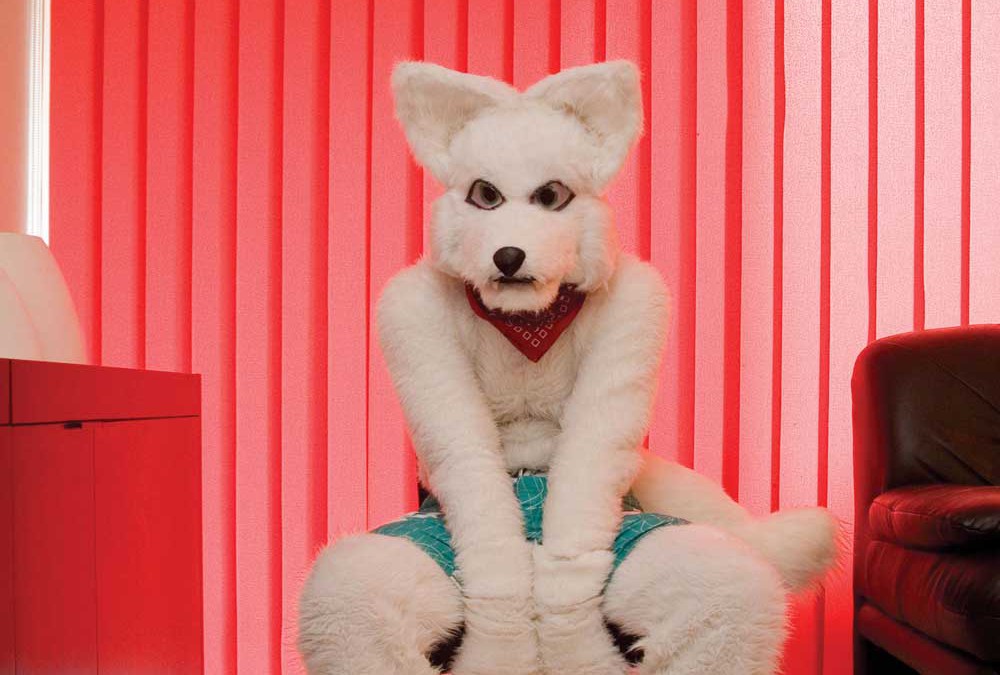
Charlotte Lybeer studied photography at the Academy of Fine Arts Ghent and the HISK in Antwerp. For the series ‘The furtastic adventures of the cabbit and the folf’ she submerged in the world of furries. ‘Each of my series is a logical continuation of the previous one. In this case it was a continuation of ‘Larp, taking a holiday from everydayness’ from 2009. A series of portraits from LARP (Life Action Role Playing) players.
Charlotte uses photography to research the capsular aspects of our society. In her projects Lybeer takes an aesthetic, as well as a social look at people who form groups and/or separate themselves from others. In this case; Furries. The furry fandom is a subculture interested in fictional anthropomorphic animal characters with human personalities and characteristics like intelligence, facial expressions, the ability to speak, to walk on two legs and wear clothes. During the 1980s, furry fans began to publish fanzines, developing a diverse social group that eventually began to schedule social gatherings. By 1987, there was sufficient interest to stage the first furry convention and throughout the next decade, the Internet became accessible to the general population.
To create ‘The furtastic adventures of the cabbit and the folf’, Charlotte had to infiltrate into its fandom. ‘I became a member of different forums and online communities related on the subject matter and went to conventions in England and Germany. They’re gathering yearly in large hotels which they rent for private use.’ For this series the individuals were taken out of their safe groups and placed into their personal and intimate habitats. The contrast between the costume, which the person uses to tell us something about his or hers virtual identity, and the homey interior is an approach rarely to be seen. The setting reveals the personal identity and daily reality of the player, yet he is still in character.
Gaining those people their trust is a tour de force since they are often described as freaks in mainstream media. ‘The hardest part of this project was gaining that trust. If it would have been easy, there would be much more series like this. The first step was to become a member of the group and talk openly and clear about my work and what I wanted to achieve. The second part was to prove that I was serious on the subject matter. That can be achieved by being humorous without being flippant. The hardest part was to get personal so they would trust me enough to let me into their houses.’
‘The furtastic adventures of the cabbit and the folf’ is part of Charlottes project to get her doctors degree. It’s called ‘Lifestyle Supermarket’. She’s photographing different fandoms that are related to virtual, three-dimensional worlds such as Second Life, in which players can create a second identity. ‘It’s a very intriguing given. People can transform themselves into a superhero, a monster or and animal with human characteristics such as furries. The unique feature of these fandoms is, that these trans human identities are nowadays also assumed outside the virtual world. For me, those are examples of how contemporary men tries to fit in the image imposed by mass media such as movies and games. All my projects are inspired by how people react in a world that is changing. Not only geographical, but also on an imaginary level.’


De pagina die u zocht kon niet gevonden worden. Probeer uw zoekopdracht te verfijnen of gebruik de bovenstaande navigatie om deze post te vinden.

Text JF. Pierets Artwork Paul Boudens
Originally, Paul Boudens wanted to become a fashion designer when he first set foot in Antwerp. Yet fate decided differently (he flunked his entrance exam) and nowadays he’s one of the most wanted graphic designers working together with the Antwerp Fashion Museum and icons like Walter Van Beirendonck and Haider Ackermann. We catch up with him just as he returns from the Otis College of Art and Design in LA.
I read you were in LA for a “provocative discussion about the creation, reinterpretation, and presentation of fashion”. Did you also have some fun?
Yes, we had a LOT of fun! Last year, Otis asked me to run some workshops with the students, but after sending some e-mails back and forth, I wondered if it wouldn’t be cool to take designer Walter Van Beirendonck, photographer Ronald Stoops and make-up artist Inge Grognard along with me. That way we had the four-leaf clover of Antwerp fashion: a fashion designer, a photographer, a make-up artist, and a graphic designer. Otis instantly loved the idea, and even involved the School of the Art Institute of Chicago (SAIC) so it turned out to be quite a tour.
Antwerp was put on the fashion map in 1988. How did that happen?
Well, if I remember correctly: six graduates of the Fashion Department of the Antwerp Royal Academy staged a group fashion show at London Fashion Week. The British press called them the “Antwerp Six” and turned Flemish fashion into a (inter)national phenomenon.
And fashion has become the fourth largest industry in Antwerp since then.
It’s amazing how much talent we have over here.
You work with Walter Van Beirendonck for over three decades now. Was it a well-considered decision?
Not at all. I rolled in by accident. He asked me to create prints for his T-shirts in 1989. I was in my third year of Graphic Design and Illustration. We’ve been working together ever since. His work explores challenging social issues and ignores conventional trends. It’s great working with this kind of explosive energy.
And quickly your fluorescent colors and exciting invitations attracted the attention of other designers. Isn’t it difficult to work for and with so many different creative people?
In the beginning we had a blast kicking all things sacred and bourgeois. Something that came both out of rebellion as out of inability, I must say: the folly of youth! Or the ignorance and arrogance, of course. (laughs) As time goes by you develop a kind of empathic skill and I discovered that I’m good in translating what a designer wants or likes to see, without losing my own persona.
Nevertheless you describe your work as ‘classic with a schizophrenic twist’.
You have to: that’s how you become when working with so many different people. (laughs)
The punk twist has become partly one of your signatures and your work communicates a strong vision. Is it possible to hold onto your outspoken style in an industry saturated by hype?
I never was a punk, you know. But, most designers create an aesthetic through a certain photographic vocabulary that is already very strong. There’s no reason for me to re-invent that. The image has to stay close to what they are standing for. But they trust me enough to play around with their ‘vocabulary’.
Don’t you ever feel frustrated not having more to do with the principle image?
No. I love working in the shadow of a fashion designer, helping to expand their vision. Once in a while, I venture out into the limelight, but it quickly bores me. I’m perfectly happy where I am and with what I do.
In the meantime, you can add Dries Van Noten, Olivier Theyskens, Comme des Garçons, Yohji Yamamoto, Wim Neels, Jurgi Persoons, A.F. Vandevorst, Haider Ackermann, The Antwerp Fashion Academy, Het Zuidelijk Toneel and MoMu, the Fashion Museum of the Province of Antwerp, and many others to your palmarès. What are the things you are most proud of?
I consider every thing I design as a sort of ‘baby’, you know. But, two things are very dear to me. First, there’s my monograph Paul Boudens Works Volume I, which was published in 2003, and second there’s my solo exhibition at The Wapping Project in London in 2010 called ‘Trust Me (I Know What I’m Doing)’. How’s that for an ego boost! (laughs)
In 2001, you were responsible for the art direction of ‘Fashion 2001 Landed’, the ambitious fashion city project in Antwerp with Walter Van Beirendonck and Gerdi Esch. Didn’t you become art director and graphic designer of A Magazine during this project?
You are totally right, my dear. (laughs) We wanted A Magazine to be a fashion magazine that explores the universe of a chosen fashion designer in each issue. We invited a guest curator – an international fashion designer, group or house – to develop innovative, personalized content to express their aesthetic and cultural values. Each issue celebrated the designer’s ethos: their friends, their passion, their stories, emotions, fascinations, spontaneity and authenticity. Back then, we made issues with, among others, Bernhard Willhelm, Hussein Chalayan and Olivier Theyskens, and more recently Maison Martin Margiela, Yohji Yamamoto, Haider Ackermann and Riccardo Tisci from Givenchy. The magazine was always a wonderful race against time. I got the material a little ahead of time, so I could do some preliminary lay-outs for when the designer came to Antwerp, we could work like crazy to do the whole magazine in three or four days. Sadly, I had to say goodbye to the magazine: let’s cite musical differences. (laughs)
Does fashion still make you happy?
You know, fashion itself doesn’t interest me. (laughs) But it’s a fun sector to work in. However, society has changed tremendously in the last ten years and fashion became a really serious business. Everything has to be profitable so things are less intuitive, spontaneous and dangerous. Nevertheless, that’s the way it is and I like the fast pace of fashion. I can’t remember what a holiday feels like because I’m always at work and the fashion show invitations are always lurking around the corner.
Next to fashion show invitations you’re also designing books, catalogs, posters. You obviously love your work.
I just love to create stuff. Maybe it’s because I’m easily bored. I always say: ‘the nicest job is always the next one’.
Do you have other ambitions?
Not really, like I said before: I am where I should be, doing what I should do. I once said that finding the right typeface is like falling in love — I guess that illustrates how I feel about my work.
Were you the class swat or the rebel?
As a teenager I was a total wuss: if I would meet myself now I would kick myself and shout ‘MAN UP!’. However, studying graphic design, I had a lot of fun. Mind you, I flunked my entrance exam to the Antwerp Fashion Academy in the mid-80’s and on a comfortable budget from my parents; I tried some other things like Press and Communication and Translation. Nevertheless, the moment I really had to make an effort and discovered Graphic Design, I knew where my heart was and it went rather smoothly.
You started off in the ‘80’s so I guess the tools to work with were quite different from now?
I started off making cassette covers and cards for friends with Mecanorma letters in a time when colour photocopies were still a novelty. Yes, I’m a dinosaur now. (laughs) I guess you can say the possibilities were different, yet not per definition worse; on the contrary: there was a lot more freedom!
Your work shows taped edges and paint splatters on wallpaper or cotton amongst other materials. The result is both rough and sharp, somewhat twisted and leaving a strange impression. Is that where your handywork comes in?
You know, I started analog then went digital — there was no other choice. But I like that combination: design or art is simply not done just on a computer. When you work with tape, paper and scissors, your mind works differently than when behind a screen. Anyway, I always want to give my work a human touch.
What’s your main philosophy when it comes to your work?
I don’t like designs with a shelf life of one day only. How ironic this might seem while working mainly in fashion, I want my work to be timeless, which is actually impossible. However, my work ages quite well, I think — there’s some good genes in it. (laughs)
And does it always work?
Not always, of course. Most of the time the right image pops up in my head and I try to recreate that. If nothing appears, I’m in trouble, but it happens rarely… (laughs) If it takes a little longer, there’s always my gut feeling, which makes me avoid hypes and go for the long run.
Tell me your future dream.
Yuk, what a difficult question! Let’s say ‘publishing the second volume of my monograph’, maybe? It’s Bald Ambition I guess: look at my head! (laughs)


De pagina die u zocht kon niet gevonden worden. Probeer uw zoekopdracht te verfijnen of gebruik de bovenstaande navigatie om deze post te vinden.