Geen Resultaten Gevonden
De pagina die u zocht kon niet gevonden worden. Probeer uw zoekopdracht te verfijnen of gebruik de bovenstaande navigatie om deze post te vinden.

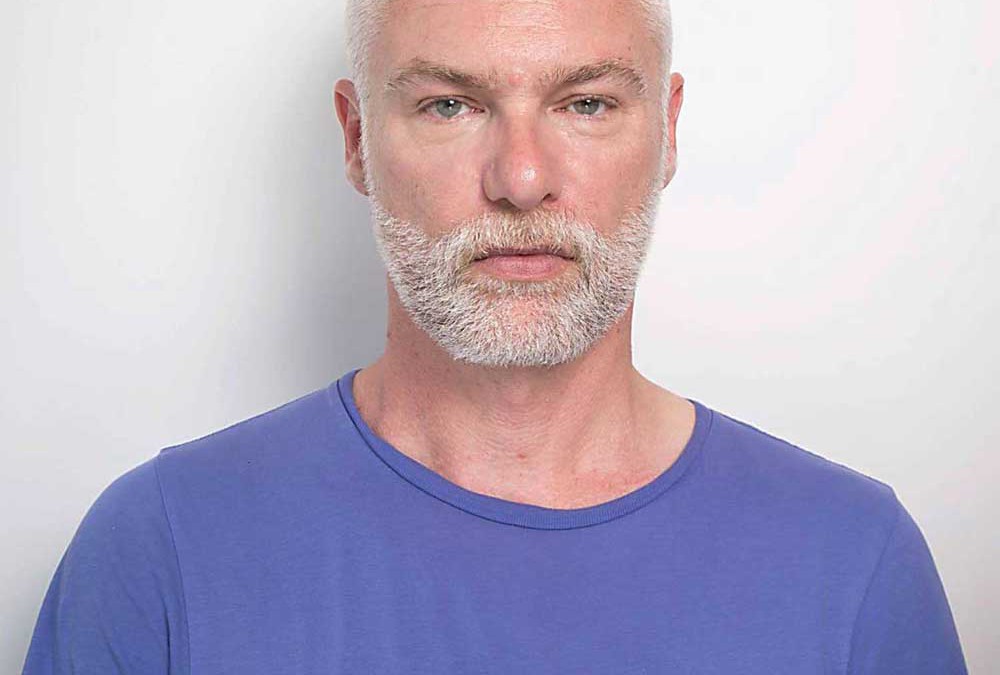
Text JF. Pierets Photo Christa Holka
When 64-year-old Grace Wellbeck thinks she sees the ghost of her first husband, she fears for her sanity and worries that she’s having another breakdown. Long-buried memories come back thick and fast: from the fairground thrills of 1950s Blackpool to the dark reality of a violent marriage. But the ghost turns out to be very real: a charismatic young man named Luke. And as Grace gets to know him, she is jolted into an emotional awakening that brings her to a momentous decision. We’ve talked to Jonathan Kemp, about his latest novel, Ghosting.
The subject matter of Ghosting is completely different from London Triptych, 26 and The Penetrated Male. What happened?
I suppose I got bored with writing about cock (laughs). I think I said everything that I had to say about gay male sexuality in the first three books. Having said that, my forthcoming book, Homotopia?, a nonfiction book, is about homosexuality. It’s basically my Masters thesis, written in 1997, before any of those other three books. But all this considered, I believe as a writer you get seduced by a story or a character, and the origin of Ghosting is rooted in a journey that my mother made in 1967 when I was 8 weeks old. My father was in the Royal Air Force and got stationed in Malaysia. He went ahead because she was pregnant with me and she stayed behind to give birth in Manchester. After that we flew out there. Obviously I don’t remember a thing about it, but in my head it became this magical, mythical journey of a working class young woman who’s never been outside of the UK, traveling with three small children from one world to another. My original conception was to use the journey as a central metaphor, the notion of a journey. But then the character of Grace came to me and things developed from there.
So it’s not a novel about your mother?
Not in any sense. There are massive differences in terms of Grace’s personality and the things that occur to her; my father didn’t beat my mother nor did he die. I’m not interested in writing an autobiography; I’m interested in expressing different strategies, events, and the truth of an emotion. But again, a lot of writing in general comes from asking yourself the question, “What if?” What if she’s relieved to find her husband dead upon arriving in Malaysia? He was a vile alcoholic and she didn’t want to go back to him anyway. What if she loses her daughter from whom she felt very estranged? I wanted to explore the concept of grief, but I also wanted to challenge some maternal issues in a We need to talk about Kevin, kind of way: in that, you might not necessarily like your child.
Why write about grief?
In many ways both London Triptych and 26 explore sexual grief, but it’s not really noticed upon. Grief is something that I’m fascinated by. It comes in many forms and I think, like most emotional realities, it’s experienced in radically different ways. Sometimes grief is considered inappropriate, as if it has a certain expiration date after which you have to get on with it. The whole capitalist, utilitarian mindset generally dictates that; they give you a month to grief and then you have to get back to work, be productive. It was that lack of compassion that I wanted to explore, to put Grace in a situation where her second husband didn’t allow her to grief.
You’re also intrigued by mental illnesses, can you elaborate?
Mental illness is related to grief in a way that it’s also an inappropriate emotion. What I wanted to do with Ghosting was explore the whole women-madness thing. It has been, and probably still is, a way of controlling female behavior. Asylums are places of containment for people, and quite often women, who are not acting appropriately. I have spent the last 20 years reading texts, novels, and poetry that center on the issue of female madness so I wanted to weave the subject into the book.
Do you think this book will attract a different audience than for example London Triptych?
I didn’t aim for any audience with any book really, other than attracting people who might be interested in the subject matter, the stories. I’m very pleased that London Triptych had a wider appeal; my mother and a lot of her friends really loved it and when I won the Authors’ Club Best First Novel Award, there were much older women congratulating me because they really wanted that book to win, “Because it’s filthy.” Ghosting had some great reviews and maybe that’s because of the way in which it’s so different from my previous work. It didn’t had the impact that London Triptych had, but that probably had to do with its slightly sensational subject matter and the explicit sex scenes. London Triptych is massively important to me because it shone a light on something that was marginalized: the history of male prostitution. It became a kind of stock novel for queer culture and queer history in London, which is great. It’s wonderful when a novel can have such an impact and is not just a flash in the pan. Ghosting is a much quieter book, yet it seems to have appealed to new readers. I’m grateful that they enjoy what I’m doing but I never really think about a specific audience and I certainly didn’t think it wasn’t for my ‘LGBT audience’. Primarily I will always write about LGBT lives, because that’s the life I live, and the world I inhabit, and as a writer you do draw of your own experiences. The way in which sexuality is dealt with, both historically and currently, in society has always been of interest to me so I will continually explore these issues in some shape or form.
Next to being a writer you also teach creative writing and comparative literature at Birbeck College, University of London. Do you like it? I do. I love the contact with my students and the whole experience of being in a classroom. The difficult part however is the marking, because you have to sit in judgment about the work of people you really like and in creative writing there is, obviously, a huge subjective element to it. Luckily there are criteria that you have to work with and even if you don’t like what you’re reading, you try to see the merits of it. I never imagined myself as a teacher though. I was always so desperately shy about talking in front of a group of people but I found that I really liked it. I was relieved to be good at something that actually made some money (laughs).
I once read an interview with Paul Auster in which he stated that he could tell when a writer had followed a creative writing course. Do you agree?
The whole industry of creative writing has been going on much longer in America than in the UK, but I’d agree with Auster on that one. Luckily you still get enough books that are maverick, written by somebody who has not allowed it to characterize their writing.
You think there’s an actual formula for a bestseller?
I do believe there is a formula, yes. I’m teaching a course at the moment about genres and analyzing the narrative structures of them. I think a formula is actually something that provides a pleasure to readers who would be disappointed otherwise. In a thriller, for example, you expect a certain unease; there’s a body and you have to solve the crime. You cannot, not solve the crime. You find a good metaphor for a reader/writer relationship-gone-wrong in Misery by Stephen King where the reader cripples the author when he does something she doesn’t like. Arthur Conan Doyle got bored with Holmes and killed him off in order to be able to write something else, but his readers became furious and demanded he bring Holmes did; so he did. He almost had no choice. The other things he wrote and published didn’t sell in the same amount so he was kind of coerced into resurrecting his most famous character. As a writer you obviously have some rules of commitment.
Do you have to write? Is it an urge?
I’ve been writing all my life and my first novel only got published when I was in my early 40’s, so I always had that compulsion to write. I have always had the compulsion to read too, and for me the two go hand in hand. I don’t feel driven in as much as expressing something that ‘has to come out’. I’m driven to explore things that I’m thinking about, or images and characters that appear and who need to be observed.
How do you write?
I’m not sitting down and tapping away my random thoughts; it’s usually a story that I want to tell, need to tell. I don’t know where the ideas come from; they just pop into my head. I work really slowly and I like to rework a text quite a lot. Ghosting got re-edited, re-drafted, probably over 20 times. The first draft I wrote was in the first person, in Grace’s voice, or an attempt at Grace’s voice, but it didn’t work. While I was figuring out why it wasn’t working, I came up with the idea of changing the point of view. I tried it out on the first couple of chapters and immediately the prose came alive. It wasn’t simply a case of replacing ‘I’ with ‘her’ or ‘she’, but something entirely different had to happen with each sentence once the point of view was shifted.
You’re quite an activist on the internet, is writing also an attempt to change the world?
I wouldn’t call that activism. That’s a big claim for any writer to take. Books don’t really change the world but they can change people and people can change the world. When my PhD, The Penetrated Male, came out, I talked about it at an event in a room filled with people from different sexualities and different genders. They were all talking about something because I’ve written a book about it. It was amazing because how often do you really have a serious, large scale conversation about men being penetrated?


De pagina die u zocht kon niet gevonden worden. Probeer uw zoekopdracht te verfijnen of gebruik de bovenstaande navigatie om deze post te vinden.
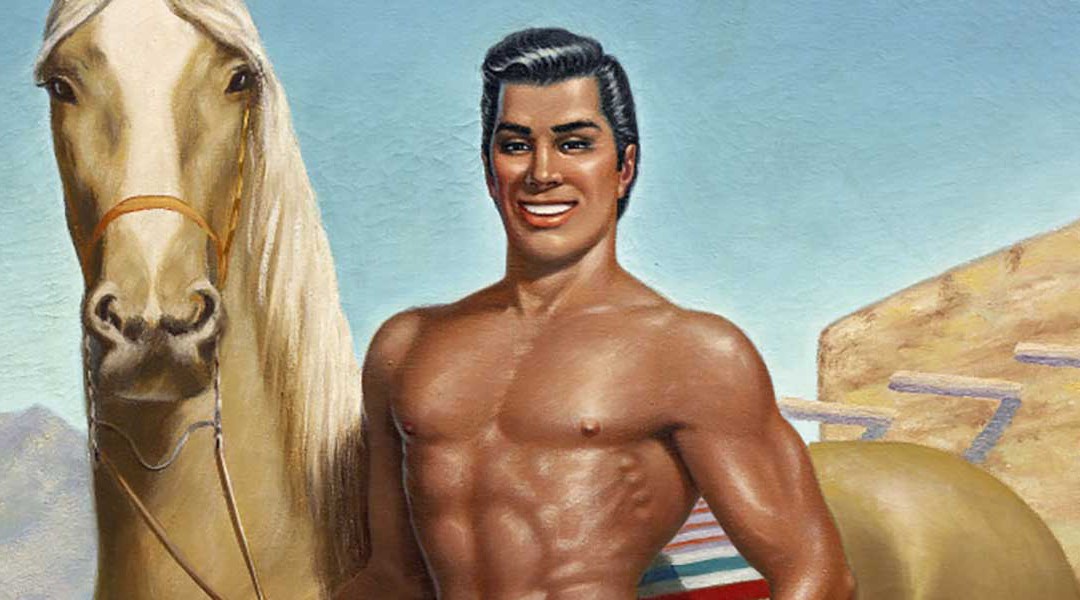
Text JF. Pierets Photos Courtesy of TASCHEN
George Quaintance was an artist ahead of his time, a man who forged several successful careers, yet never enjoyed mainstream fame. Had he been born a few decades later, we might know him today as a multi-tasking celebrity stylist, as a coach on Dancing with the Stars, or perhaps as the fine artist he aspired to be. But Quaintance, who died in 1957, lived and worked during an era when homosexuality was repressed, when his joyful paintings and physique photos could not depict a penis.
In an era before Stonewall, the sexual revolution, gay rights and the AIDS crisis, Quaintance and his high-camp erotic art existed in a demi-monde of borderline legality. The Master Painter of the Male Physique, was out in an age when out was not only risky, but largely illegal. Raised on a farm in rural Virginia, Quaintance traveled a fascinating path of reinvention: at various points in his life he was a Vaudeville dancer, the favored portraitist of Washington’s smart set, and a celebrity hair designer—though he never actually touched hair. In 1982, The Voice stated, “Quaintance was gifted with so much drive and artistic talent that he had the ability to transcend the puritanical restrictions of the times and leave us something of his daring imagination in his paintings”.
Seventy years since the creation of his first physique painting of a masculine fantasy world, populated by Greek gods, Latin lovers, lusty cowboys and chiseled ranch hands, the work retains its seductive allure. As the preeminent male physique artist of the 1940s and early 1950s, his work for photographer and gay publishing pioneer Bob Mizer’s Physique Pictorial, Demi-Gods and Body Beautiful, inspired a generation of artists like Tom of Finland, Harry Bush, Etienne, and other, lesser stars in their constellation. His highly prized oil paintings—numbering just 55—rarely come to auction; instead they are traded privately among an avid and secretive group of fans—until the TASCHEN gallery in LA showed a tribute.
TASCHEN’s book Quaintance, traces his remarkable life story and reintroduces his colorful, kitschy and culturally resonant paintings. Work that made George Quaintance the most popular and successful physique artist of his time, and one of its most intriguing figures.


De pagina die u zocht kon niet gevonden worden. Probeer uw zoekopdracht te verfijnen of gebruik de bovenstaande navigatie om deze post te vinden.

Text JF. Pierets Photos Charmain Carrol
Chubby Vogue Divas is an ongoing photography project by artist and activist Charmain Carrol. Her being an activist started in the 90s when black lesbians went through a phase where their parents were not accepting their children’s sexual orientation. At that time her daughter Lynne was 2 years old yet Charmain decided to take in about 11 lesbians and 2 gays because they had no place to live. From that point on she became an active member of the LGBT movement, attended and sat in many discussions on the well being of black lesbians in the townships of Cape Town.
As a member of the Global Girl Media South Africa – an organization that trains young girls from disadvantaged backgrounds in telling their own stories through media by offering them assistance in research, film and photography.
As well as giving them the opportunity to do their own sound and lighting and edit their own stories – Charmain uses her art and photography to make a point. She’s an activist when it comes to women and specifically the image they present in the media.
Growing up with different women like her grandmother, mother, aunts and her step mothers sisters, she noticed that they all had their own idea of what beauty was and she herself never seemed to fit in any of the boxes. What she saw in magazines and on television was totally different then her reality.
While researching and reading about black women in history like Saartjie “Sarah” Baartman – the most famous of at least two Khoikhoi women who were exhibited as human zoo attractions in 19th-century Europe – and Mkabayi Kajama’s step sister in particular, Charmain build a platform for big, strong woman and added the word Vogue to the title since full figured women still seemed to be unfashionable.
Both pictures and the models stories are to be found on the Chubby Vogue Divas blogspot, since most of the models have been bullied or teased at some point in their lives and now speak up about how they made it beyond the bullying. Models with different backgrounds and upbringing but with similar stories to tell, and all part of this inspiring project with a positive impact on a large range of women.
www.charmaincarol.wordpress.com


De pagina die u zocht kon niet gevonden worden. Probeer uw zoekopdracht te verfijnen of gebruik de bovenstaande navigatie om deze post te vinden.
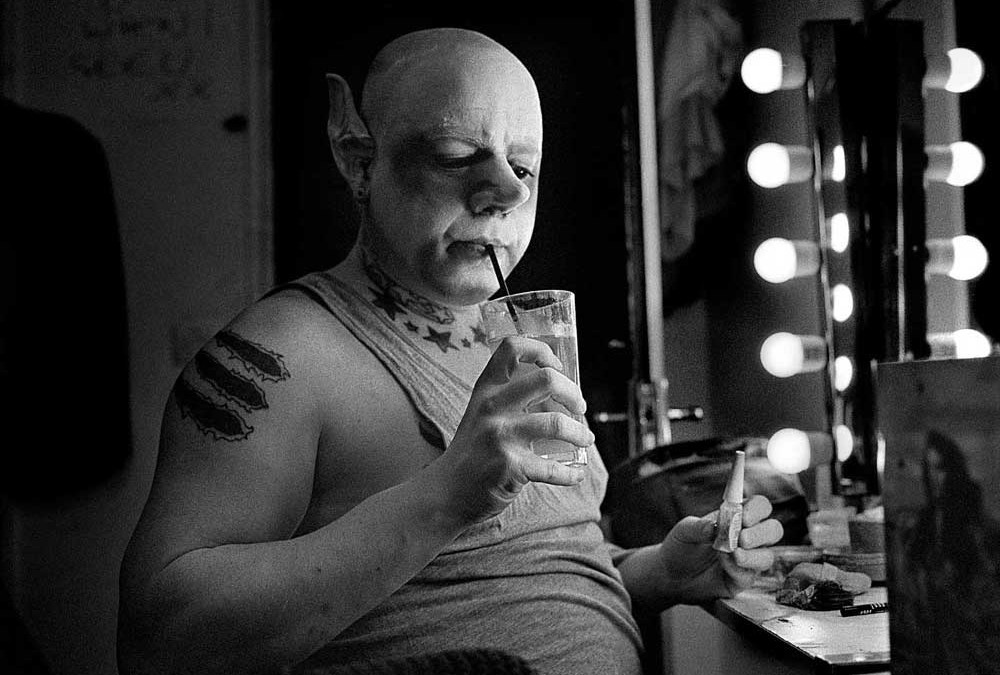
Text JF. Pierets Photos Magnus Arrevad
Danish-born Arrevad spent five years documenting the international, subterranean world of male performers, burlesque, go-go dancers, cabaret singers and porn stars. The journey would take him to New York, Berlin, Paris, London, Copenhagen as well as County Sligo in Ireland and a trailer park in Tacoma. His journey resulted in an exhibition and a book called Boy Story.
Arrevad explains: “The series features performers from eighteen countries, living all around the world, in the places you’d probably least expect, but with a sense of community and mutual respect unlike anything I’ve ever known before. I had no intrinsic link to this world when I embarked on the project. It all started quite by accident, in a basement in Copenhagen, on the night of a Gay Pride parade, which I was photographing in a completely different context”.
Boy Story was shot on black and white film. “I’m a traditionalist, in the sense that I believe in the quality and beauty of film. The prints are handmade on the very best quality fiber paper. Digital just doesn’t look as good”. Arrevad decided against photographing his subjects’ performances, choosing instead to focus on the performers off-stage, often in their most vulnerable moments, trying out a new act, applying make-up or getting into costume. “I was fascinated by the processes and preparations through which the performers visibly liberated themselves from the roles they observed through the daylight hours. They had invented a world in their own image, with their own gods and their own ceremonies. It wasn’t just about sexuality, though of course this was a large part. It was about being. The application of make-up each night was one in which a mask was taken off, not put on. I wanted to document this process of liberation”.
Once the masks were off, the stage awaited, “The performances are debauched, magical and often hilarious, but underpinning it all is grave sense of purpose; to bring the dream of oneself into being. A million times I’ve heard people saying, just be yourself. To which the only sensible answer is, which one? We act different selves to our parents, our friends, our lovers and to ourselves. The self we act to ourselves is the most interesting, because in most cases, the sense we have is that we’re too scared to express it, to explore it in public. Figuring out oneself is a process. What the subjects of Boy Story have allowed me to do is to watch them constructing their inner selves”.
The images of these often very private moments, push the viewer into the position of voyeur, a role in which Arrevad himself felt perfectly comfortable with, even to the point of transition, inserting himself into some of the images. “The only two modes of documentation possible are voyeurism and participation. Either one’s peeking in, or one’s trooping in like a marauding elephant and becoming an unseen part of the subject. This idea of neutral, objective documentation is nonsense. Even the unseen eye has a gaze, has a charge”. None of the images were staged. “It was all spontaneous. There are a couple of images in which the performers are playing up because they could see a camera in the room. But I certainly never choreographed any of it”.
While the world of male performers is now a global community, it does nevertheless have roots in a specific time and place. Berlin during the Weimar years, its hedonistic nightlife and its vibrant arts scene, looms large for many of the performers, as it does for the photographer himself. “I saw Ernst Ludwig Kirchner’s ‘Berlin Night Scenes’ series at MOMA in New York before I took any of the pictures for Boy Story. I’m not sure that I realized it at the time, but it opened my eyes to a world I had a previously seen little glimpses of, both in terms of art and life, and to the extent to which, properly performed, both become the same thing. In short, the series seduced me, and probably set in motion a lot of what followed. I loved the sense of the performance of life being even more dramatic than that which took place on stage. Weimar is my time. I felt the same with Otto Dix’s portraits, particularly his portrait of Anita Berber, which created an imaginary world for me that I wanted more than anything to be a part of. I loved the painting, and read upon the woman behind it, which made it, and its world, the most erotic and exciting place. And so I moved to Berlin to establish what legacy of Weimar remained. It surpassed, but was completely different from my dreams – more real, somehow, less glamorous, dirtier, but lit with magic, communicating through gestures over cigarettes with piano men and drag queens, lacking a mutual language. Boy Story followed the same trajectory into heaven”.
The exhibition is curated by Michael Diemar and is presented in association with Bloomsbury-Estates, Bloomsbury Cultural Renaissance and Red Room Industries.The book ‘Boy Story’ is published by Red Room Books ISBN 978-1-943278-43-5.


De pagina die u zocht kon niet gevonden worden. Probeer uw zoekopdracht te verfijnen of gebruik de bovenstaande navigatie om deze post te vinden.

Text JF. Pierets Photo Courtesy of Rea Theodore
Superheroes
I am, I am, I am superman
And I know what’s happening.
I am, I am, I am superman
And I can do anything.
— R.E.M., Superman
The boy glows as if he has swallowed a jar of lightning bugs or a fistful of sparklers.
At first, I think it’s the light bouncing off the stainless steel counters of the ice cream parlor.
Upon closer inspection, I see it’s him.
He looks to be about 8 or 9, stocky like a short stack of 2×2 Lego bricks, with freshly scrubbed pink cheeks and white-blonde hair.
The word “ethereal” gets stuck in my head, and I can almost feel it melt on my tongue slow and sweet like strands of strawberry cotton candy.
The boy is with an old woman, who I assume is his grandmother. There appears to be an invisible string linking them together that rests slack at most times but tightens when she asks him what flavor of ice cream he wants or taps him on the shoulder when it’s time to go.
After I purchase a half gallon of cherry vanilla, I follow them out of the store and wait as they make their way through the front doors.
She looks over her shoulder and sees she’s holding me up.
“Sorry,” she says.
“Not a problem,” I say.
“I didn’t see him,” she says to the boy.
“Her,” he corrects.
He’s like a mini superhero with the ability to see things as they are.
“Oh, whatever,” she says. She doesn’t give me a second glance.
Whatever, I repeat in my head.
Whatever.
Whatever.
Whatever.
Out in the parking lot, her gray hair sparkles in the sunlight like slivers of tinsel.
I think she’s a superhero, too.
Extract from Leaving Normal: Adventures in Gender by Rae Theodore.
Leaving Normal: Adventures in Gender is creative nonfiction that takes an unflinching but humorous look at living as a butch woman in a pink/blue, boy-girl, M/F world. A perfect read for anyone who has ever felt different, especially those who have found themselves living in the gender margins without a rule book.
This is your first book. Why did you start writing?
I’m the caretaker at home and I had to do something for myself. Something that had nothing to do with my wife, my three teenage kids and the cats. So I started to write stories, just one at the time but before I knew it turned into a book. I found out I like telling stories about my childhood.
It’s all autobiographical?
At first I labeled it creative non-fiction, but they are true stories with some artistic liberties taken here and there. For some reason I’m drawn to memoir. It resonates with me. It’s almost like a puzzle and I think of it as a little time capsule or a little time machine. You try to put yourself back there whether it was a year ago or twenty years ago and remember what it was like and what you felt, what you saw. That appeals to me very much, trying to recreate those moments.
It’s a very personal genre.
It is. And lot of these things I never told anyone about because I found them very shameful or painful. Having an opportunity to write them down and having people read them and validate the experiences really helped me. Even if people may not have gone through the same type of thing, everybody has felt different at times or felt shame. In the book I learned to accept myself. This is whom I am and I’m not going to change.
The book has been out for a month now. How are the reviews?
So far the reviews have been very good. There are not a lot of books out there about butch women. You don’t see them in mainstream literature, you don’t even see them in the LGBT literature that much. I heard from readers who have gone through similar things. They say it’s very powerful and affirming to see themselves in the book. For example; just going to the bathroom can be a challenge for butch women.
Is it a book for gay people?
Not necessarily. Even if you are not gay you can read this book and probably feel similar feelings. Everybody dealt with confusion at one point in their lives. People often see more similarities than differences and that can be something that unites.
What’s the main message you like to get out there?
The story references to superheroes in some small way, so I like that message of being your own superhero. Live your life however you see fit and whatever your definition of normal is. For me that’s the big message. Be yourself. And I found that most people don’t care. They don’t care if you are gay or butch or whatever. As long as you treat people with respect and kindness. I live in a very small and conservative town and people are very welcoming. I’m aware that other people can have different experiences but just be who you are and people will accept you for that.
Did it change you personally, writing this book?
Writing the book has given me a little more confidence but you have to keep in mind that I’m in my late ‘40’s so a lot of the things in the book happened 30-some years ago. I’ve gone through a lot of growth since then and I don’t care so much what people think. When you’re in your 20’s your whole world is about whether people like you or not but a good thing about getting older is that you care less about that.
So no insecurities anymore?
I still have them, to a degree. For me, getting dressed up is wearing a pair of men’s trousers, a button down shirt and a bow- or a necktie. Sometimes and in some situations I still can’t help but wonder if that’s ok. I’m a woman who wears men’s clothing and once in a while I still have to remind myself that it’s ok.
What’s next?
I look at this book as a stepping-stone to the next one. I have some sequel chapters that I’ve written out and are floating in my head somewhere but I’m going to do some public speaking as well. I’m going into the local highschool to talk to the gay-straight alliance there and I also got the opportunity to go into a local company and do a presentation for their gay and lesbian organization. I never did anything like that but I’m trying to keep myself open to all the possibilities and opportunities. Find out what resonates with me. Maybe I’m good at it and I will be able to spread my message a little further, who knows.
You’re speaking at a high school. Do you think it’s important to talk to kids?
Definitely. We didn’t have that kind of exposure when I was a teenager. I grew up in a town where people weren’t Out. I didn’t know any gay people, I didn’t have family members who were gay and there weren’t gays and lesbians on television. My life may have turned out differently if I had been around gay people. If the possibility existed. So it might be a powerful thing to go and speak at schools and meet young people.
What would you say to a 16 year old butch girl who reads this article?
I would say be true to yourself. Don’t change for somebody else and keep the swagger! That’s the best part of being butch. The swagger.
www.middleagebutch.wordpress.com
www.weaselpress.com
www.amazon.com/leavingnormal
De pagina die u zocht kon niet gevonden worden. Probeer uw zoekopdracht te verfijnen of gebruik de bovenstaande navigatie om deze post te vinden.